A good topic, left untouched for the most part by Tolkien.
We can however, when we dig deeper into some Tolkien lines and appendices get a bit of a clearer picture.
What is known about Dwarven beliefs of death and the afterlife:
1) Join Mahal in the Halls of Mandos
The Dwarves believe that Mahal will gather their spirits, if it is not to be reborn, to the Halls of Mandos with the other Children of Ilúvatar. It was to the Halls of Mandos that the spirits of Elves and Men were gathered to await their different fates, and so Mandos was given its common name of the Halls of Waiting. No dwarf knows the fate which awaits them there.
2) Spirits are reborn
The dwarrows believe that the spirits of the Seven Fathers of the Dwarves–the seven Dwarves that were originally created (not including their spouses)–are at times ‘reborn.’
Mahal gave us dwarves also this privilege that distinguished them from Elves and Men: that the spirit of each of the Fathers (such as Durin) should, at the end of the long span of life allotted to Dwarves, fall asleep, but then lie in a tomb of his own body, at rest, and there its weariness and any hurts that had befallen it should be amended. Then after long years he should arise and take up his kingship again. (Tolkien, The Peoples of Middle-earth 383)
Meaning that dwarves cannot be burned* (cremated) after death and should always be buried… as their spirit sleeps in their own body.
*Note however, that Tolkien says, that after the battle of Azanulbizar that there were far too many dwarves fallen for them to be buried in the usual fashion. So “they stripped all their dead, so that Orcs should not come and win there a store of weapons and mail.”, then “they built many pyres and burned all the bodies of their kin.” Tolkien adds, as a footnote “Such dealings with their dead seemed grievous to the Dwarves …. But those who fell in Azanulbizar were honoured in memory, and to this day a Dwarf will say proudly of one of his sires ‘He was a burned dwarf’, and that is enough’
Note though that this dwarrow resurection is a rare exception, only seen with few dwarrows, most notably those of Durin’s line. Little else, or perhaps even nothing, is said of what happens to other Dwarves at death (if indeed Tolkien himself even knew), so apart from the above one can conclude nothing for certain on the matter.
3) Their inner name is not written on their tomb.
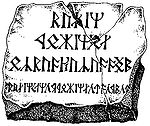
Dwarrow title or rank (uzbad) and outer name (Balin) is written on their tombs, not even their inner name.
4) Tearing of the Beard.
As a sign of grief dwarves tear there beards. An example of this can be found when Nar brought back the tale of Thrór to Thrain: “… and when he had wept and torn his beard he fell silent”. (This again clearly shows the link between the dwarves and the jews – as it is a judaic custom to tear clothes to express the mourner’s grief.)
What is likely to be true, logical or assumed about dwarven death rituals and beliefs
1) Their weapons or greatest treasures are buried with them
If we look at the burial of Thorin Oakenshield, both the Arkenstone and Orcrist were placed on his chest when he was buried deep under the Lonely Mountain. We cannot be sure this is the case for all dwarrows, but it seems very logical as dwarrows are so over protective of their treasures, that they would take them into their graves.
2) Inner name is revealed at their funeral.
The name they hide all their life, given to them by their father or mother, is likely reveaveled at their funeral, though only when the gathering is only made up of dwarves. – As non-dwarves should not hear the inner name of a dwarf.
Beliefs and Customs related to death and burial
Dwarves do not consider death to be a tragedy, even when it occurs early in life (before a dwarf turns 240) or through unfortunate circumstances. This is mainly due to the firm believe dwarves have in an afterlife where they will be at the side of their creator Mahal.
Mourning
Mourning practices of dwarves are extensive, but they are not an expression of fear or distaste for death. Dwarrow practices relating to death and mourning have two purposes: to show respect for the dead and to comfort the living dwarves, who will miss the deceased.
Care for the Dead
After a dwarf dies, the eyes are closed, the body is laid on the floor and covered.
Respect for the dead body is a matter of paramount importance. For example, those in the presence of the dead may not eat, drink or smoke. To do so would be considered mocking the dead dwarf, because he/she can no longer do these things.
Most dwarrow kinships have one or more “amradshomak” (Guard of the Dead), a dwarf that not only guards the dead dwarrow till his/her funeral but cares for the dead. Dwarrows that are amradshomak are volunteers. Their work is considered extremely meritorious, because they are performing a service for someone who can never repay them.
As the dwarrows believe their body is a vessel for their spirit it must not be harmed in any way. Hence cremations are not done and autopsies in general are discouraged as desecration of the body. Meaning that the body of the dwarf is not embalmed, and no organs or fluids may be removed.
In preparation for the burial, the body is thoroughly cleaned. The dead dwarf is then clothes in his/her finest robes, as a token of their riches. It is not unheard of, and even seen as a gesture of kindness, for a dwarf lord to donate gold for the burial of a poor dwarf, so fine robes can be bought to bury the dwarrow in. It is generally done though when the dwarf had no other family or lived in poverty, as otherwise the donation would be considered an insult to the mourning family. Once the deceased is clothed in fine attire, jewels and/or weapons can be placed on the chest of the dead by the amradshomak. The amradshomak then continues his/her guard and care for the body till the burial.
Coffins are not required to bury a dwarf, but if they are used, they must have a hole drilled in them, close to the head, so the spirit can escape and join Mahal when he calls. For this reason dwarven tombs also have a small hole in them.
The body is never displayed at funerals; exposing a dwarven body is considered disrespectful, because it allows not only friends, but also enemies to view the dead, mocking their helpless state.
Mourning Practices
Dwarrow mourning practices can be broken into several periods of decreasing intensity. These mourning periods allow the full expression of grief, while discouraging excesses of grief and allowing the mourner to gradually return to a normal life.
When a close relative (parent, sibling, spouse or child) first hears of the death of a relative, the mourner is expected to ask Mahal to let his/her spirit sleep until he/she is buried – when Mahal can call upon his/her spirit.
From the time of death to the burial, the mourner’s sole responsibility preparing for the burial. During this time, the mourners are exempt from all orders that take time away from the preparation of the burial, because the preparations take first priority. This period usually lasts a day or two; dwarrow believes require prompt burial – in case Mahal would call for them and their body is not yet buried.
During this period – called “atkât” (“silence”), the family should be left alone and allowed the full expression of grief. Condolence calls or visits should not be made during this time.
After the burial, a close relative, near neighbor or friend prepares the first meal for the mourners. This meal traditionally consists of eggs (a symbol of life) and bread. The meal is for the family only, not for visitors. After this time, condolence calls are permitted.
The next period of mourning is known as hadud (seven, because it lasts seven days). Hadud is observed by parents, children, spouses and siblings of the deceased. Hadud begins on the day of burial and continues until the morning of the seventh day after burial. During hadud mourners are expected to stay within their halls and honor the deceased and not do anything for comfort or pleasure.
If a festival occurs during the mourning period, the mourning is terminated, but if the burial occurs during a festival, the mourning is delayed until after the festival.
The next and final period of mourning is known as trem (thirty, because it lasts until the 30th day after burial). During that period, the mourners are allowed to leave their halls but do not attend parties or celebrations, nor listen to music.
Tombstones / Tombes
A buried dwarrow must have a tombstone or placed within a tomb, so that the deceased will not be forgotten and the grave will not be desecrated. It is customary to keep the tombstone/tomb veiled, or to delay in putting it up, until the end of the last mourning period. The idea underlying this custom is that the dead will not be forgotten when he/she is being mourned every day. There is generally a formal unveiling ceremony when the tombstone is revealed.
It is preferred that dwarrow tombstones or tombes are placed beneath the mountain in the halls, not on flat land. As it is believed to allow the spirit to reach Mahal easier through the mountain.
Dwarrow Mourning Prayer
During the different mourning periods, adrûthigulûb (Words of Mourning – a dwarrow mourning prayer) is recited again and again by the mourners, at least once each day.
Adrûthigulûb:
Bless those who mourn, creator, shield them from the pain with your hammer and guide them to a new day.
Umhûdizu tadaizd ku’ adrûthîzd, Mahal , murukhîzd udu charach bakhuzizu ra udnîn izd ana ghiluz nur.
Death in Battle
It is considered an honor to die in battle amongst dwarves. Only in this case is it allowed that the body is buried with other dwarves and a common tombstone be placed. The reason behind this is that time should not be wasted as the spirits await Mahal. Once buried the mourning rituals preceed as normal.
EDIT NOTES: – Tearing of the Beard added – Used all I could find on dwarven death, burial (such as death and burial of Thorin Oakenshield, tomb of Balin, Gimli’s words at the tomb, etc..) and colored it in with Jewish traditions (due to Tolkien stating the Jewish influence on his dwarven characters).