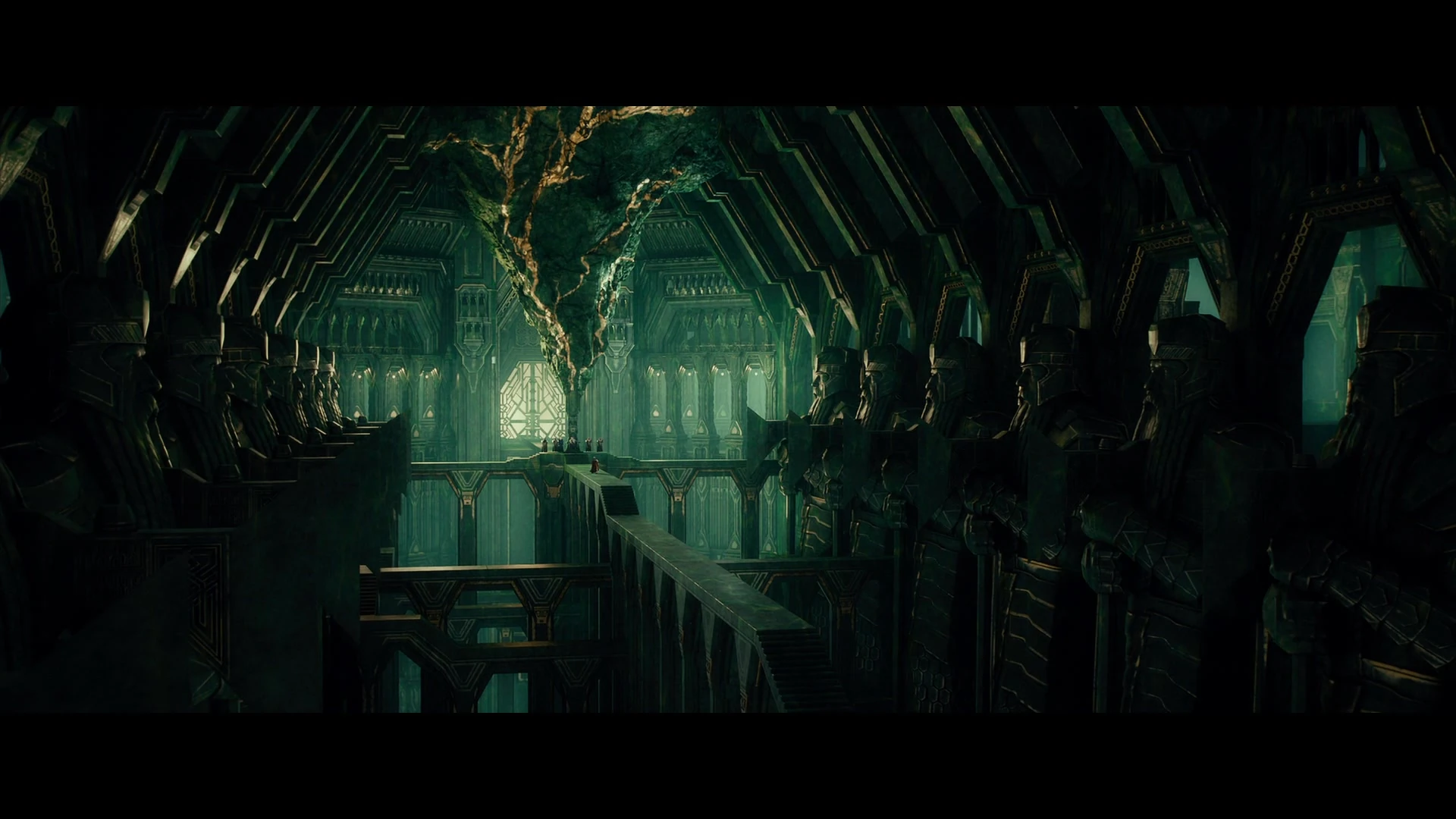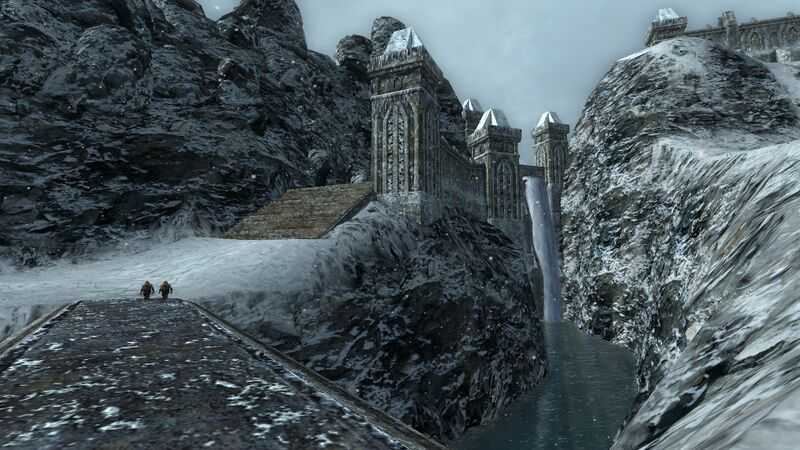
“A dragon is no idle fancy.” (J.R.R. Tolkien, “Beowulf: The Monsters and the Critics,” 1936)
1. Before the Dragon Had Wings
Ask ten people to describe a dragon and most will probably reach for much the same image: four legs, leathery wings, a long tail, claws, scales and a gullet full of fire. It feels like the obvious shape for a dragon to take, but it is not.
The familiar Western dragon is only one particular branch of a much older and considerably stranger family of ideas. Earlier traditions give us enormous serpents, creatures of river and sea, guardians of sacred places, embodiments of primordial chaos, monsters wrapped around trees or treasures, and beings associated not with destruction at all but with rain, fertility or legitimate rule.
Even the word dragon points backwards toward the serpent. English dragon descends, through Old French and Latin, from Greek drakōn (δράκων), a word used for a dragon or great serpent. Its probable relationship to the Greek verb derkesthai, “to see clearly,” has encouraged an old association between the dragon and the watchful, deadly gaze. Tolkien’s Glaurung provides a remarkable later echo of that idea: his gaze is itself a weapon, capable of overpowering and dominating those who meet it.
So where did dragons come from? There is no single answer. Dragon-like creatures occur across a remarkable range of cultures, but that does not mean every dragon tradition descends from one forgotten prehistoric original. Stories travel, images are borrowed, and religions absorb the monsters of neighbouring peoples. Similar creatures can also emerge independently, since snakes, crocodiles, large predators, storms, rivers and the terrifying unknown are hardly unique experiences.
What we call a “dragon” is therefore less a single mythological species than a collection of creatures that later translators and storytellers have gathered beneath one convenient name, and they can be very different creatures indeed.
2. Dragons Across the Ancient World
The aim here is not to trace every serpent-monster ever imagined; that would take a book, not an article. A handful of traditions are enough to show how broad the idea really is.
Mesopotamia
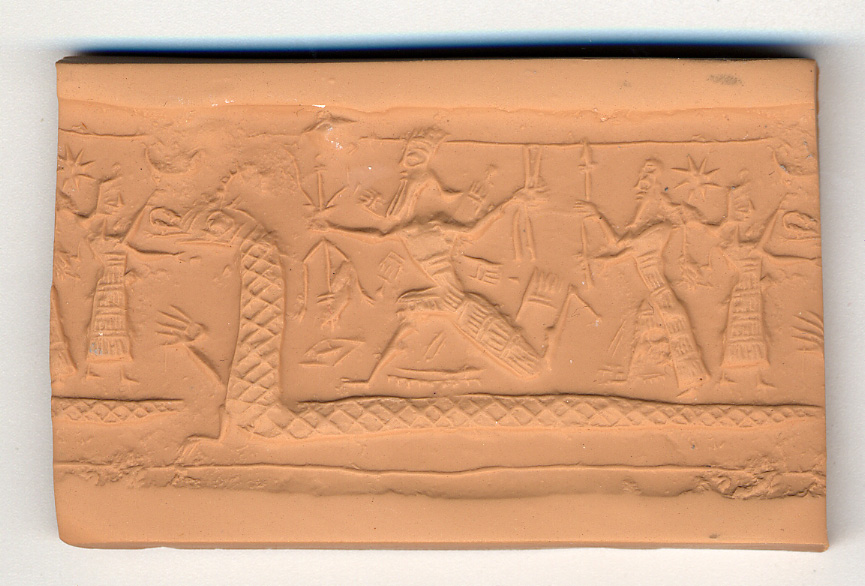
Ancient Mesopotamia gives us several creatures modern writers comfortably call dragons. The mušḭuššu, familiar from Babylonian imagery, is a fantastic composite beast (serpentine, scaled, and equipped with the limbs of other animals) particularly associated with the god Marduk, for whom it functioned as much as a protective symbol as a monster.
Then there is Tiamat. In the Babylonian Enūma Eliš, Tiamat belongs to the primordial waters and becomes the great power defeated by Marduk as the younger gods establish a new cosmic order. Calling her simply “a dragon” risks flattening a more complicated figure, but the pattern she embodies, a divine champion confronting a monstrous power tied to the primal sea and chaos, would prove immensely influential.
Greece
Greek drakontes are often much closer to serpents than to the dragon of modern fantasy. Python guards Delphi until Apollo kills it; Ladon coils around the tree bearing the golden apples of the Hesperides. Elsewhere, great serpents protect sacred places, treasures or sources of power.
Here we meet something particularly important for the later European dragon: the dragon as guardian. It need not own what it guards, and it need not have made or earned it. It is simply there, so that the hero cannot reach the precious thing without first confronting the creature wrapped around it: an association between serpent, treasure and heroic confrontation that will prove remarkably durable.
The Hebrew tradition
The Hebrew Bible contains the tannîn, a term capable of referring to a serpent or a great sea-monster, as well as Leviathan, the enormous twisting creature of the deep. In passages such as Isaiah 27, Leviathan becomes the fleeing, twisting serpent ultimately defeated by divine power; other biblical passages preserve older imagery of God overcoming the forces of the sea.
Later Jewish and Christian interpretation increasingly drew such monsters into a moral framework in which serpent, dragon and Satan could converge, an identification Revelation makes explicit in its “great dragon” and ancient serpent. From there, the dragon entered medieval European tradition increasingly as an embodiment of evil, something to be confronted and overcome.
India
Indian tradition contains yet another family of great serpentine beings, the nāgas. They are not simply monsters: depending on story and tradition they may be divine, semi-divine, dangerous, wise, protective or associated with water and fertility. Vṛtra offers a closer parallel to the western monster-battle: in the Rigveda, Indra kills the serpent-like power holding back the waters, a pattern of divine champion versus serpentine chaos that recurs across several ancient cultures.
China
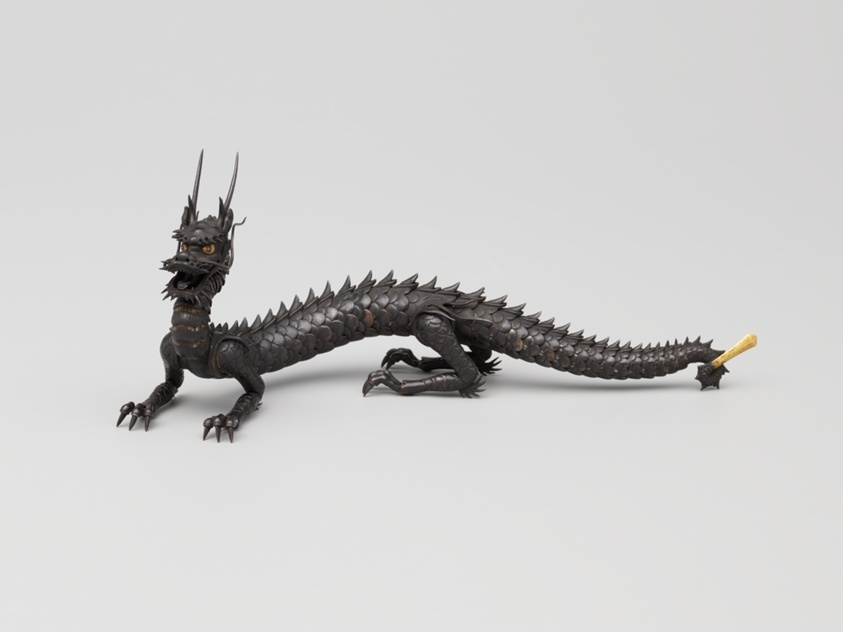
The Chinese lóng shows why translating all of these beings simply as “dragons” can mislead. Chinese dragons became strongly associated with water, clouds, rain, good fortune and political authority. Rather than an evil monster awaiting a hero with a sword, the dragon could be a beneficial and majestic power: an emperor might wish to be associated with one, while a medieval European tale was far more likely to send someone out to kill it. Rather different relationships.
Japan and East Asia
Dragon traditions moved extensively between China, Korea, Japan and neighbouring cultures, with local religions and folklore reshaping what was borrowed. Japanese dragon traditions, for instance, preserve strong associations with water while incorporating local serpent stories and indigenous deities: the result being neither simply “the Chinese dragon in Japan” nor anything resembling the medieval European fire-drake.
The Americas and the Pacific
Dragon-like beings appear far beyond Eurasia. Among the Cherokee, the Uktena is an immense horned serpent associated with deep waters and mountain passes, bearing a powerful crystal in its forehead and possessing a deadly gaze and breath. The combination of great serpent, dangerous gaze and precious object makes the resemblance to some Old World dragon traditions particularly striking.
Further south, Mesoamerican traditions offer the Feathered Serpent, most famously Quetzalcoatl. Here the comparison becomes more difficult: Quetzalcoatl is a sacred and creative figure rather than a monster to be slain. Calling him a dragon risks flattening a much richer religious tradition, but he demonstrates how differently cultures could imagine the great serpent.
Across the Pacific, Māori traditions preserve the taniwha, supernatural beings associated with rivers, lakes, caves and the sea. Their forms and roles vary considerably: some are dangerous, while others are kaitiaki, guardians of particular peoples and places. Some traditions describe them in reptilian or serpent-like terms, providing another example of the great serpent or reptile as something that could inspire both fear and reverence.
The Problem with “Dragon”
None of these traditions need have contributed directly to Tolkien’s dragons. Their value here is comparative: immense serpentine beings appear in cultures separated by enormous distances, sometimes as monsters, sometimes as guardians, and sometimes as sacred powers.
That does not make them members of one universal family of “dragons”. Similarities can arise through cultural contact, independent development and, importantly, the categories imposed by later translators. A mušḫuššu, a Greek drakōn, a Chinese lóng, an Uktena and a taniwha were never members of some universally recognised species.
Tolkien’s dragons, however, belong to a much narrower branch of this enormous family tree. To trace their clearest ancestry, we first need to return to Europe.
3. The European Dragon Takes Shape
As we have already seen, several of the strands that would shape the European dragon were already in place: the serpent-monsters of the classical world, the increasingly sinister dragon of biblical tradition, and Revelation’s explicit identification of the great dragon with the ancient serpent and Satan. In medieval Europe, those strands began to come together. The dragon therefore became an ideal opponent for saints and angels: Michael tramples or pierces it, St George confronts one, and medieval churches, manuscripts and sculpture filled with monsters beneath the feet of holy figures. The dragon could represent evil defeated, chaos mastered, and the pagan or demonic brought beneath Christian authority.
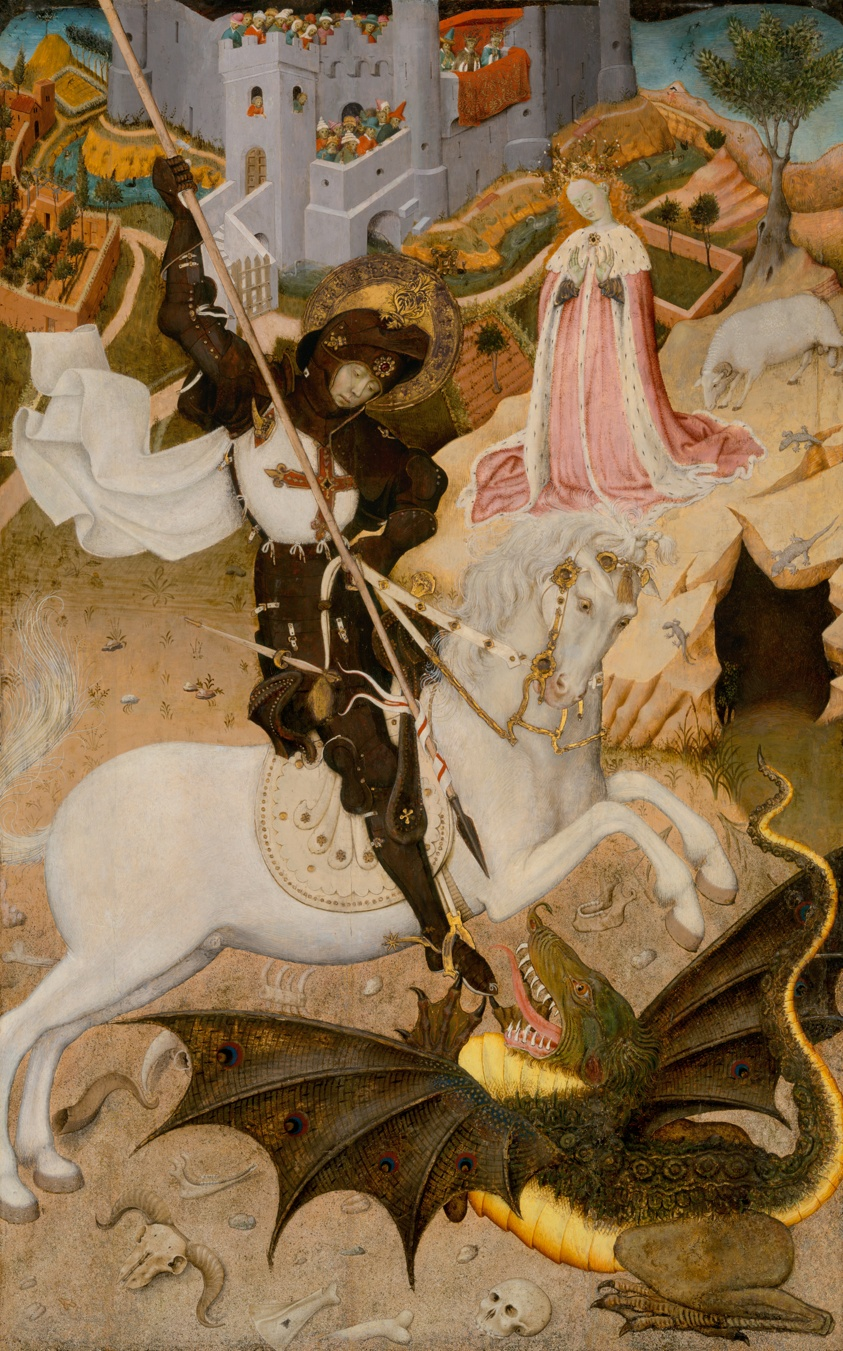
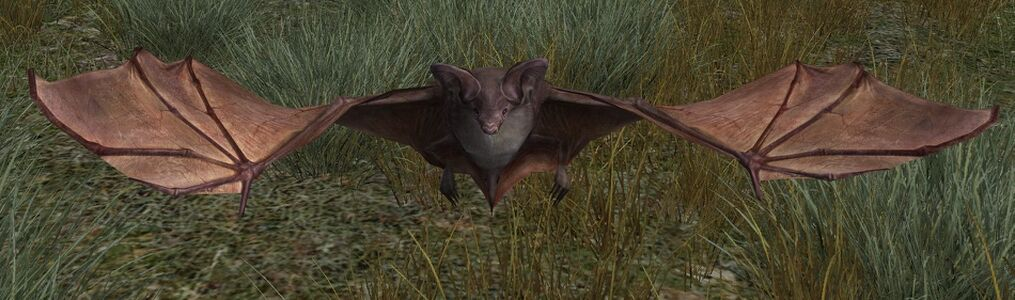
At the same time, its very ferocity made it useful as a symbol of power. Dragons entered banners, heraldry and royal imagery: something sufficiently terrible to be your enemy was also sufficiently terrible to advertise as your ally. Over the medieval centuries the dragon’s physical appearance also became increasingly familiar to modern eyes. Serpentine bodies acquired legs, claws and, eventually, the great bat-like wings now difficult to separate from the word itself.
But appearance is only part of the dragon Tolkien inherited. For some of its most recognisable behaviour, we need to look more closely at the dragons of the Germanic North. They do something particularly characteristic. They lie on gold.
4. The Northern Dragon: Treasure, Greed and Doom
This is where Smaug begins to become recognisable centuries before Tolkien wrote The Hobbit. Two dragons matter enormously: Fáfnir and the dragon of Beowulf.
Fáfnir
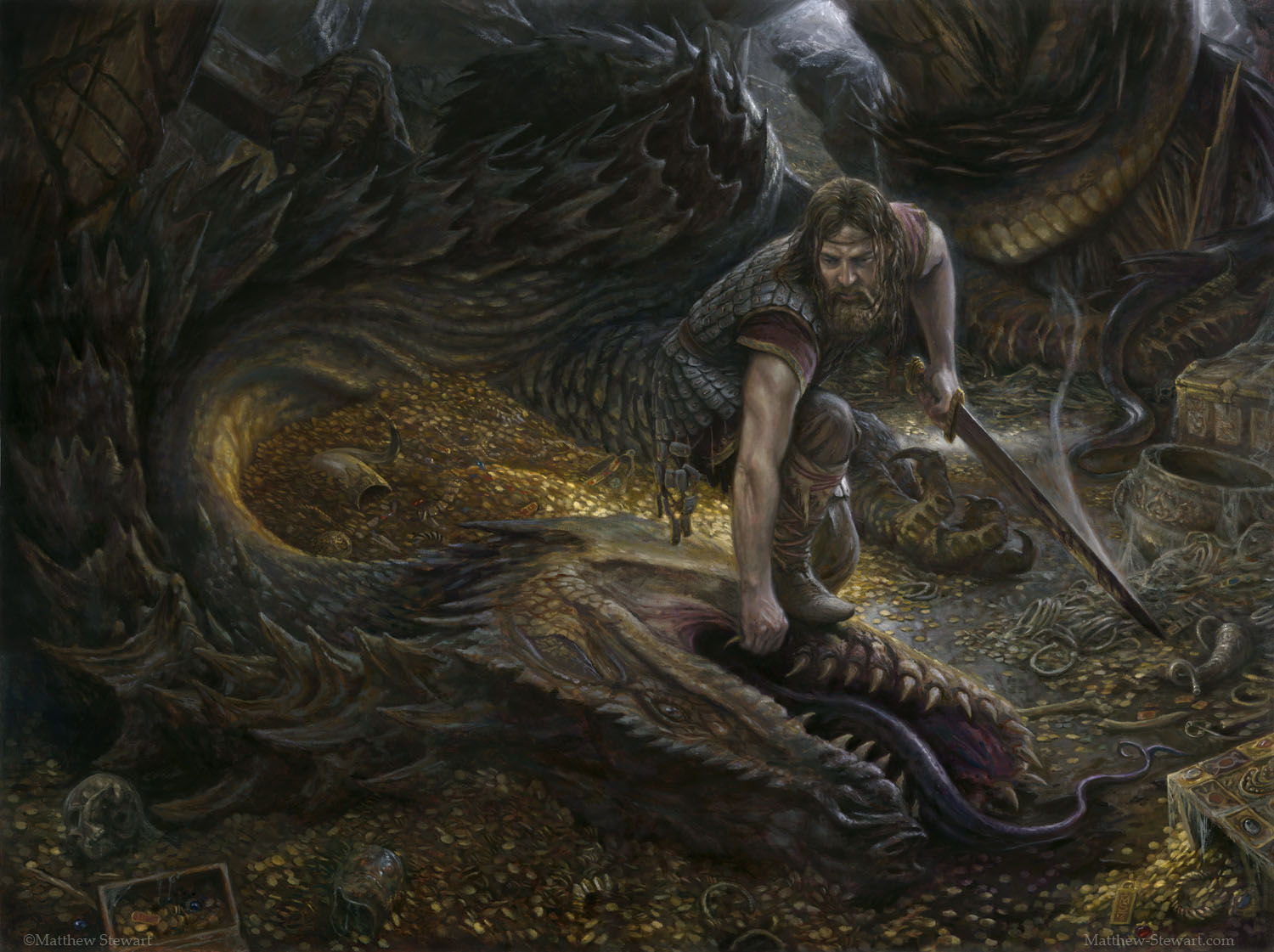
In the Norse Völsung tradition, Fáfnir is bound to a treasure already poisoned by murder and greed. He kills for the hoard, possesses it, and eventually exists as a dragon or great serpent guarding it. Sigurd kills him by digging a pit in the dragon’s path and striking upward at his vulnerable underside.
The similarities with later dragon stories are obvious, but the truly important element is not the method of killing: it is the treasure itself. Possession of the hoard brings no happiness; killing the dragon does not cleanse the treasure. The gold continues to carry violence, suspicion, betrayal and death into the lives of those who inherit it. The dragon guards corrupted wealth, but the corruption does not necessarily end with the dragon.
The dragon of Beowulf
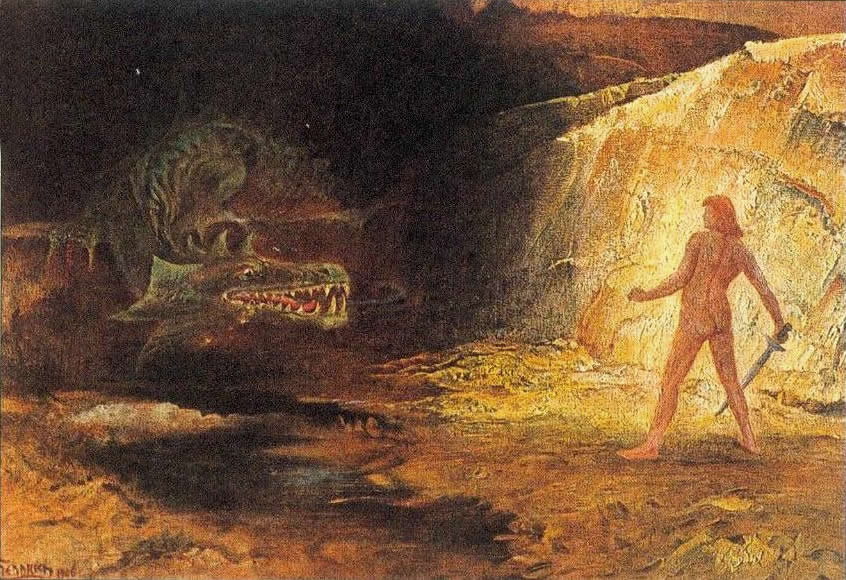
The final monster of Beowulf gives us another form of the northern treasure-dragon. An ancient hoard has lain underground for generations; a dragon discovers it and makes the barrow its home. Then someone steals a single cup, and that theft alone provokes the dragon into burning the surrounding land. Houses and halls are destroyed, and at last the aged Beowulf goes to confront it. He kills the dragon, but the dragon kills him in turn, so that victory and the hero’s death become inseparable.
Tolkien knew exactly how important this dragon was. In his famous 1936 lecture, “Beowulf: The Monsters and the Critics”, he wrote:
“A dragon is no idle fancy. Whatever may be his origins, in fact or invention, the dragon in legend is a potent creation of men’s imagination, richer in significance than his barrow is in gold.”
That sentence could almost serve as a motto for Tolkien’s own dragons.
The parallels with The Hobbit are impossible to miss: the underground treasure, the sleeping dragon, the stolen cup, the furious search for the thief, the destruction visited on the surrounding settlement. But Smaug is not simply Beowulf‘s dragon translated into Middle-earth. Tolkien borrowed a situation, then gave the dragon a personality.
A Nose for Thieves
One detail carries over from the Beowulf-dragon to Smaug so precisely that it is worth pausing on: both hunt by scent.
When the Beowulf-dragon wakes to find its cup missing, the poem does not simply have it notice the theft: it has the creature track the intruder. The Old English describes the dragon finding the thief’s footprint and picking up his scent along the ground before it ever takes to the air in its rage. Philologists have debated the precise sense of the verb involved (some read it as “moved rapidly,” others as “sniffed” or “caught the scent”), but the surrounding lines are unambiguous about the dragon hunting the ground for the intruder’s track before resorting to fire, in a manner readers have long compared to a hound casting for a scent.
Smaug does the same thing, more explicitly and to greater dramatic effect. Bilbo’s whole plan depends on the invisibility of the One Ring, and it fails immediately: not because Smaug can see him, but because Smaug can smell him. “Well, thief! I smell you and I feel your air. I hear your breath,” Smaug says, before Bilbo has said a word. Tolkien even builds the detail into the wider plot: Gandalf’s reasoning for recruiting a hobbit burglar in the first place partly rests on the hope that Smaug, who knows the scent of Dwarves intimately after devouring so many of Thrór’s people, will not recognise the unfamiliar smell of a Hobbit.
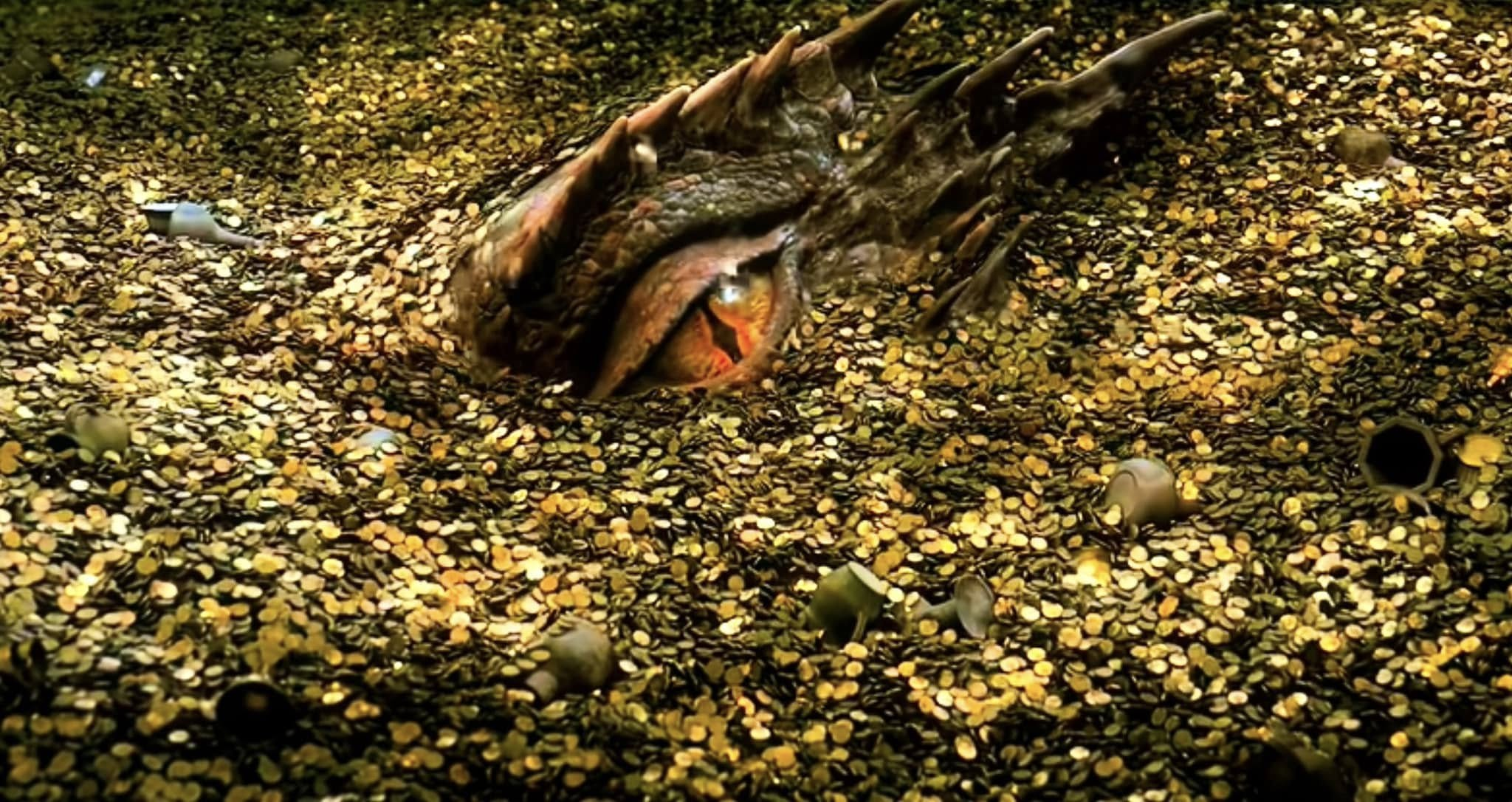
This is a fairly narrow piece of evidence: it is well attested specifically in the northern, hoard-guarding lineage that runs from the Beowulf-poet’s dragon through to Smaug, rather than a trait clearly established across every tradition surveyed earlier in this article. But it is a nice reminder of where dragons come from in another sense: real snakes and monitor lizards navigate largely by scent, flicking a forked tongue to sample the air and read it through the Jacobson’s organ in the roof of the mouth, seeing the world chemically as much as visually. A dragon that finds its enemies by smell before it ever sees them is, in that one respect, behaving exactly like the ordinary reptile its mythical ancestors were once merely a much larger version of.
5. Tolkien and Dragons
Tolkien’s dragons become more interesting once we remember that their author was also a medievalist who spent much of his professional life studying the literature some of them descended from.
In Tolkien’s previously mentioned 1936 British Academy lecture, “Beowulf: The Monsters and the Critics”, he challenged what had become a common approach to the poem in contemporary scholarship. Much criticism treated its monsters as an embarrassing distraction from the useful historical material surrounding them: critics wondered why a poet capable of preserving glimpses of ancient kings, peoples and feuds had wasted so much of his poem on Grendel and a dragon.
Tolkien turned that complaint on its head. The monsters were not an unfortunate addition to Beowulf; they were, in his words, “essential, fundamentally allied to the underlying ideas” of the poem, not decoration surrounding the real subject, but the poem’s structural and thematic centre. Beowulf is ultimately a man confronting enemies no human victory can permanently overcome. He can defeat Grendel, defeat Grendel’s mother and even defeat the dragon, but he cannot defeat death. The dragon therefore works precisely because it is more than a large dangerous animal; it brings something mythic into the hero’s final confrontation.
Tolkien’s own dragons work much the same way. Glaurung is not merely a weapon Morgoth points at an army, and Smaug is not merely a large obstacle between Thorin and a pile of money. Dragons carry something with them: terror, possession, corruption, destruction and fate. They make the story around them larger.
6. Where Middle-earth’s Dragons Come From
Middle-earth does not give us a natural history of dragons. There is no account of harmless prehistoric proto-dragons slowly becoming larger, cleverer and more flammable. Instead, dragons appear through Morgoth. The first known dragon is Glaurung, who emerges from Angband during the long Siege of Angband. He is not yet mature. The Silmarillion, in the chapter “Of the Return of the Noldor,” describes him:
“He was yet young and scarce half-grown, for long and slow is the life of the dragons.”
Fingon and mounted archers surround him, and Glaurung retreats because his armour is not yet strong enough to withstand their arrows. He disappears back into Angband, and when he eventually returns, Middle-earth encounters something very different. But saying Morgoth “created” dragons immediately produces a problem. Within Tolkien’s mythology, Creation in the fullest sense belongs to Eru; Tolkien was careful to distinguish genuine creation from the ability of the Valar (or of Morgoth) to shape, make, breed, imitate and corrupt things that already exist.
This becomes especially important in his discussions of Orcs. In a 1954 draft letter to Peter Hastings, Tolkien distinguished sharply between “creation” and “making,” explaining that Morgoth could remodel and corrupt existing beings but could not simply originate independent rational life the way Eru does. The principle is expressed even more memorably by Frodo, describing the Orcs to Sam on the stairs of Cirith Ungol:
“The Shadow that bred them can only mock, it cannot make: not real new things of its own.”
That line concerns Orcs, not dragons, but the same metaphysical problem applies here. Glaurung clearly possesses far more than animal instinct: he speaks, reasons, lies, and understands shame, family, loyalty and guilt well enough to use all of them as weapons. Smaug does the same centuries later.
What, then, did Morgoth actually do? Did he corrupt and breed some existing creature, embody spirits in monstrous forms, or employ some combination of breeding, corruption and his own dispersed power? Tolkien never tells us. What we do know is that dragons emerged through Morgoth’s work, that Glaurung was the first to appear, and that dragons later reproduced or at least multiplied: the texts speak of Glaurung’s “brood” and eventually of whole populations of dragons. Beyond that, we simply do not possess a dragon Genesis. We could invent one, of course, but then we would be explaining our dragons rather than Tolkien’s.
7. The Dragon-kinds of Middle-earth
This is where modern fandom can impose rather more order on Tolkien’s dragons than the texts themselves provide. Tolkien certainly distinguishes between different kinds of dragon, but he never arranges them into a consistent system of classification. Before attempting any classification of our own, then, let us look at what Tolkien actually gives us.
Dragons, Worms and Great Worms
Dragon and worm are broad terms. Calling a dragon a worm does not mean it is shaped like an earthworm, nor does “long-worm” necessarily establish a formal biological category. The word descends from the old Germanic use of worm/wyrm for serpents and dragons, exactly the sort of archaic vocabulary Tolkien delighted in recovering. Glaurung is called the Great Worm, Scatha is a long-worm, and Smaug can likewise be spoken of as a worm.
Nor does worm automatically mean dragon in Tolkien. Sometimes it is entirely ordinary: in The Two Towers, the distant Morgul-road is likened to a “glow-worm thread” in the darkness. More intriguingly, Bilbo boasts in The Hobbit that he would walk from the West of the Moon to the “East of East” and fight the wild Were-worms in the Last Desert. Tolkien never tells us what these Were-worms actually are, and nothing in the text identifies them as dragons. Since he certainly does use worm for dragons elsewhere, the possibility cannot be ruled out, but neither can the name alone establish it. A dragon may be called a worm, but something called a worm is not necessarily a dragon.
Fire-drakes: the Urulóki
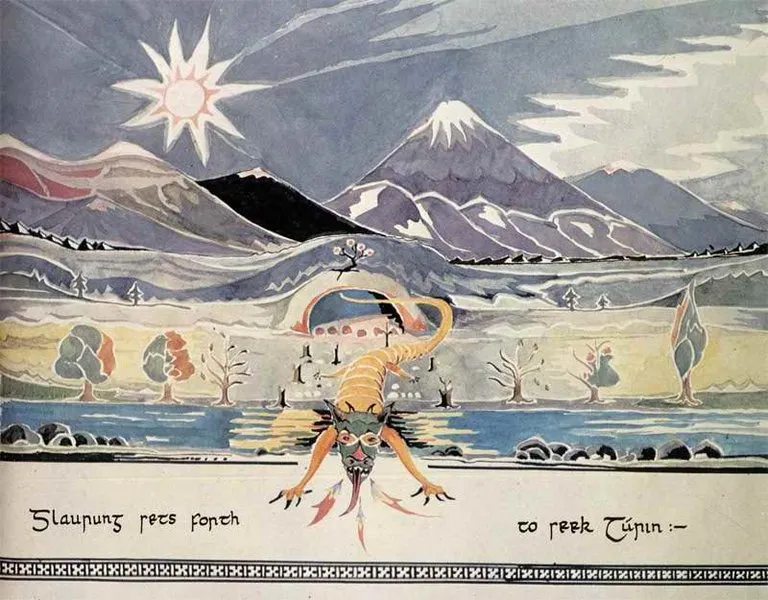
The clearest functional category is the fire-drake. The Quenya term Urulóki is applied to the fire-breathing dragons of the North. Glaurung represents the earliest attested form of the Urulóki. Glaurung does not fly, a fact worth stressing, since modern illustration makes it easy to forget that Tolkien’s first great dragon has no wings. He crawls, and when Túrin attacks him at Cabed-en-Aras, he does so from beneath, an image far closer to the ancient serpent-dragon than to the now-standard flying fantasy dragon.
Winged dragons
Wings come later. At the very end of the First Age, as Morgoth is being overwhelmed in the War of Wrath, he releases a weapon his enemies have never encountered:
“Out of the pits of Angband there issued the winged dragons, that had not before been seen.”
Whatever experimentation, breeding or transformation produced them, winged dragons represent a genuinely new development within Morgoth’s dragon-host. Their appearance temporarily reverses the battle, and at their head is Ancalagon the Black.
Winged dragon should not, however, be mistaken for a category that Tolkien sets in opposition to fire-drake. The terms describe different characteristics: one tells us that a dragon has wings, the other that it breathes fire. Smaug is both, while the first winged dragons appear amid the fire and destruction of the War of Wrath. Tolkien’s linguistic papers even preserve the Qenya rámalóke, literally “winged dragon”, confirming that the distinction was meaningful enough to name. For the cautious taxonomy that follows later, we therefore separate winged and wingless forms, but this is a classification we are imposing on Tolkien’s evidence rather than one he explicitly provides.
Cold-drakes and a necessary correction
Then we come to what is likely one of the most overdeveloped terms in Tolkien fandom: cold-drake. The word’s only substantial occurrence in the published Lord of the Rings comes in Appendix A, in the account of Durin’s Folk, where a great cold-drake kills King Dáin I and his son Frór outside the doors of his hall in the Grey Mountains. Beyond identifying that this was somehow distinct from the fire-drakes (most plausibly because it lacked dragon-fire), Appendix A tells us nothing about what a cold-drake actually did.
For decades, that near-silence left the popular idea of freezing or icy breath as pure fan and game invention, with no support in anything Tolkien had published. Here, however, we may have to give fandom rather more credit: it appears they were remarkably close to the mark. The Collected Poems of J.R.R. Tolkien (2024), edited by Christina Scull and Wayne G. Hammond, prints for the first time a short draft poem, “Scatha the Worm,” which Tolkien sketched around 1954–1955 while correcting the galley proofs of The Return of the King. In it, Tolkien does describe an icy breath:
“He crawled like a slow creeping death, too horrible to flee from, froze Men with fear and his icy breath, and then crushed them, ground them, under his long white belly.”
This is genuine Tolkien material, and it does describe a dragon freezing its victims. Two cautions are still worth holding onto, though. First, this passage was never published in Tolkien’s lifetime; it surfaced only with the 2024 edition, and Tolkien evidently abandoned the poem rather than developing or publishing it. Second, the poem is specifically about Scatha (whom Appendix A itself calls a “long-worm,” not a “cold-drake”), so even this new evidence does not, strictly, tell us that cold-drakes in general breathed cold. Some recent fan commentary has begun folding Scatha into the cold-drake category on the strength of this poem, but that identification is an inference layered onto Tolkien’s draft, not a label Tolkien himself applied to Scatha.
The honest position, then, sits between the old view and the popular taxonomy: Tolkien did, in private draft material, imagine a dragon with a freezing breath capable of killing through fear and cold alike, but he never published it, and he never explicitly tied that power to the term “cold-drake.” The fire-drake/cold-drake opposition beloved of tabletop games is therefore closer to Tolkien than earlier readers of the published corpus could have known. Tolkien never formally defined the cold-drake by its freezing breath, but neither did he leave us a formal taxonomy for his other dragon-kinds. Given that he explicitly used cold-drake as a category and, elsewhere, imagined a dragon with icy breath, fandom has a reasonable case for putting the two together.
Long-worms
Scatha is himself associated with the “long-worms” of the Grey Mountains, and in his case the name appears to describe something quite literal. In the recently published poem Scatha the Worm, which we discussed earlier, Tolkien describes his body as long and serpentine, giving us considerably more reason to treat long-worm as a description of physical form rather than merely a traditional name. Whether every creature called a long-worm shared Scatha’s precise appearance remains uncertain, but the evidence for a genuinely elongated, worm-like dragon-kind is stronger than the older published texts alone suggested.
Sea-serpents and fish-dragons
Tolkien’s linguistic writings preserve still more dragon terminology, although no examples of these creatures ever enter the recorded history of Arda. In The Etymologies, under the root LOK-, Tolkien gives the Qenya lingwilóke and its Noldorin cognate lhimlug, both glossed “fish-dragon, sea-serpent”. The terminology therefore shows that Tolkien had at least conceived of an aquatic kind of dragon or great serpent. Beyond the names, however, almost nothing can safely be said. No individual fish-dragon is identified in the Middle-earth narratives, and Tolkien gives us no description from which to determine whether such creatures had limbs or wings, breathed fire, spoke, hoarded treasure, or belonged to the same stock as the dragons bred by Morgoth. It is therefore a genuine part of Tolkien’s dragon vocabulary, but only the outline of a category rather than a developed species. Still, it is rather fun to imagine a fish-dragon brooding over the sunken treasure of some long-lost Númenórean ship.
Spark-dragons
The same linguistic source preserves another category that never reaches a surviving narrative. Under LOK-, Tolkien gives the Qenya fealóke, “spark-dragon”. The first element is associated elsewhere with the root PHAY-, “radiate, send out rays of light”. That makes some connection with light possible, but it does not tell us what the creature actually did. Nothing establishes lightning, electricity, glowing scales or any other specific ability. Like the fish-dragon, the spark-dragon is therefore evidence for a dragon-concept Tolkien named, not for a creature whose anatomy or behaviour we can reconstruct.
A dragon vocabulary still in motion
Another useful warning against making the system too tidy is Foalóke. In Tolkien’s earliest Qenya material the name was associated with a serpent guarding treasure and was applied to the dragon who developed into Glaurung. Decades later, a related form föalócë appears in linguistic notes with föa “breath”, giving something like “breath-dragon”. Rather than supplying another secure species, the changing word shows Tolkien repeatedly revisiting the language of dragons across his life.
Names without stories: Gostir and Lhamthanc
The linguistic papers also preserve at least one dragon-name without a dragon-story. Gostir is explicitly glossed “dread-glance” and identified as a dragon-name in The Etymologies. Nothing survives to tell us what kind of dragon Gostir was, where it lived or what it did. Lhamthanc, “forked tongue”, appears as a serpent-name. Since Tolkien frequently uses serpent and worm language for dragons, and the name occurs in the same broad linguistic material, it is tempting to include it among them, but the surviving gloss does not actually prove that Lhamthanc was a dragon. Gostir can therefore be counted as a named dragon; Lhamthanc should remain a possibility rather than a certainty.
And then there are the Were-worms
Bilbo’s boast in The Hobbit about going to the “East of East” to fight the wild Were-worms in the Last Desert gives us one more tantalising name, but no usable taxonomy. Tolkien never explains what Were-worms are, or even confirms that they exist outside Hobbit folklore. The earliest drafts make the trail stranger rather than clearer: Bilbo originally offered to fight the “Wild Wire worms of the Chinese” in the Great Desert of Gobi before Tolkien gradually transformed the line into the wholly secondary-world form we now know. Since “worm” can mean dragon in Tolkien, a connection is possible, but Were-worms cannot responsibly be added to the dragon family on that basis alone.
What his terminology gives us, across all these categories, is not a scientific taxonomy but a collection of overlapping descriptions. One term may tell us whether a dragon breathes fire, another whether it has wings, another something about its shape, and another simply what the people threatened by it happen to call it. That untidiness is probably closer to how real pre-modern peoples would classify monsters anyway. If a dragon is eating your livestock, burning your hall or sleeping on your grandfather’s gold, Linnaean classification is unlikely to be your immediate concern.
Interlude: A Cautious Taxonomy of Dragons
A note on what follows: The Latin binomials are my own invention, used in the spirit of a naturalist’s field guide. The diagnoses are based on what Tolkien’s texts actually attest for each kind, while the Dwarvish names are Neo-Khuzdul reconstructions rather than names supplied by Tolkien.
Wingless fire-drake: Draco ignivomus
Dwarvish name: ’ursuslukh (“fire-dragon”)
Type specimen: Glaurung
Diagnosis: Quadrupedal, wingless, fire-breathing; heavily armoured, slow to mature; capable of speech, deception and domination of the will. The Urulóki in their original, archetypal form. No other individual wingless fire-drake is named in the texts, though Glaurung’s “brood” implies others existed.
Winged fire-drake: Draco volans
Dwarvish name: gaihûslukh (“wing-dragon”)
Type specimens: Smaug; Ancalagon the Black
Diagnosis: Winged and fire-breathing. Not attested before the end of the First Age, when the winged dragons of the War of Wrath, Ancalagon foremost among them, first appear amid fire and thunder. Smaug demonstrates that later members could possess the intelligence, speech, acquisitiveness and vanity characteristic of Tolkien’s great dragons.
Cold-drake: Draco algidus
Dwarvish name: iklaluslukh (“cold-dragon”)
Type specimen: The unnamed drake that killed Dáin I and Frór, T.A. 2589
Diagnosis: Named once, in Appendix A, with no description of its abilities beyond the killing itself. Presumed to lack dragon-fire. A related but separately-attested trait, breath that freezes with cold and fear, appears in Tolkien’s unpublished draft poem on Scatha (2024), though Scatha is elsewhere called a long-worm, not a cold-drake, so the two categories may or may not be the same animal.
Long-worm: Draco elongatus
Dwarvish name: siginuslukh (“long-dragon”)
Type specimen: Scatha
Diagnosis: Great, long-bodied, serpentine dragon of the Grey Mountains; wingless; fire-breathing status unconfirmed by the primary texts. Scatha is explicitly described with an elongated, worm-like body. May overlap with the cold-drake category above, but the surviving evidence does not establish their relationship.
Sea-serpent / fish-dragon: Draco marinus
Dwarvish name: ‘âzahuslukh (“sea-dragon”)
Type specimen: None attested in the narratives of Arda
Diagnosis: Aquatic dragon or great serpent, attested only by the linguistic forms Qenya lingwilóke and Noldorin lhimlug, both glossed “fish-dragon, sea-serpent” in The Etymologies. No narrative specimen is known, and no further anatomy, abilities or behaviour can be established.
Spark-dragon: Draco scintillans
Dwarvish name: ‘arisuslukh (“spark-dragon”)
Type specimen: None attested in the narratives of Arda
Diagnosis: Attested only by the linguistic form Qenya fealóke, “spark-dragon”, in The Etymologies. The first element is associated with radiating or sending out rays of light, but no narrative specimen, anatomy, breath weapon or other ability is described. Any more specific reconstruction would be speculative.
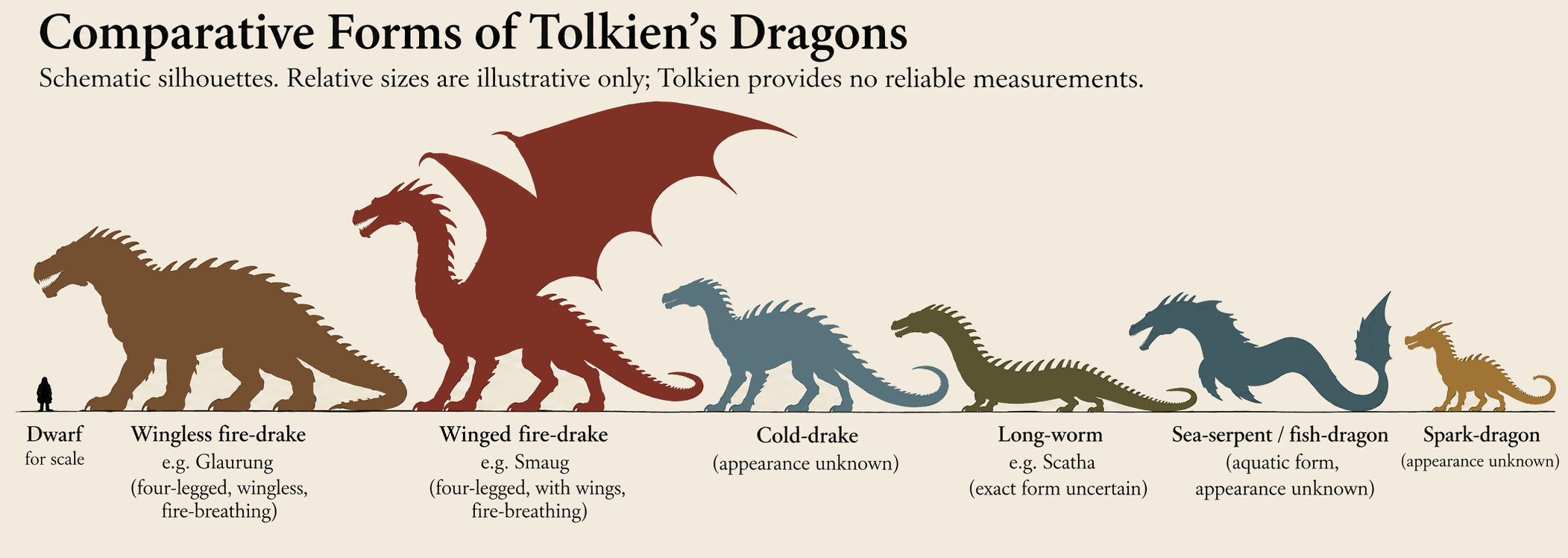
A few notes on the scheme. All six kinds are placed in a single invented genus, Draco, since Tolkien himself never distinguishes his dragons at that level, while “dragon”, “worm” and “wyrm” are overlapping rather than consistently taxonomic terms in his writings. Glaurung is treated here as the type specimen for the wingless fire-drake: he is, after all, both the Father of Dragons and the earliest named fire-drake in the history of Middle-earth.
The sea-serpent and spark-dragon are necessarily the most tentative entries. Neither has a type specimen because Tolkien left us only the linguistic categories, not identified creatures from the history of Arda. Their inclusion therefore records kinds Tolkien actually named without pretending that he developed either one into a fully described animal.
The relationship between the cold-drake and the long-worm is left deliberately unresolved in the table, for the reason given in Section 7: it is entirely possible Tolkien was imagining one animal under two different names, applied at different points in his life and in different registers: the formal chronicle-name in Appendix A, and the older, more folkloric “long-worm” used of Scatha specifically.
8. The Great Dragons
The four dragons below are the named individuals for whom Tolkien left enough narrative material to say something substantial. Gostir, noted above, is also explicitly preserved as a dragon-name, but no story or description survives from which to build a comparable portrait.
Glaurung: Father of Dragons
Glaurung is the first great dragon of Middle-earth and, in some respects, one of its most sinister. He is wingless, breathes fire, and is protected by armour that makes him extraordinarily difficult to wound, but his physical strength is only part of what makes him dangerous. Glaurung is intelligent, he speaks, and, perhaps more importantly, he understands people remarkably well.
When Túrin confronts him at Nargothrond, Glaurung does not simply overpower him physically. He fixes Túrin with his gaze and attacks precisely where Túrin is most vulnerable (his pride, his guilt, his sense of responsibility for the family he abandoned), mixing truth and falsehood so skilfully that Túrin cannot separate one from the other. That is what makes Glaurung particularly dangerous: a sword may defend against claws and teeth, but it is far less useful against an enemy capable of persuading you to ruin yourself.
Glaurung later places Nienor under an enchantment so profound that she loses knowledge even of her own identity, with consequences that ultimately destroy both her and Túrin. The “Father of Dragons” establishes, from the very beginning, something fundamental about Tolkien’s great dragons: they can be far more than enormous beasts, possessing intelligence, speech and, in Glaurung’s case, a terrifying capacity for psychological domination.
Ancalagon the Black
At the War of Wrath, Morgoth finally releases the winged dragons, and their arrival is sufficient to drive back the otherwise victorious Host of the Valar. The “mightiest of the dragon-host” is Ancalagon the Black. Eärendil, aided by Thorondor and the great birds of heaven, battles the dragons “all the day and through a dark night of doubt”, before Ancalagon is finally slain. Eärendil casts him from the sky; Ancalagon falls upon Thangorodrim, and its towers are “broken in his ruin”.
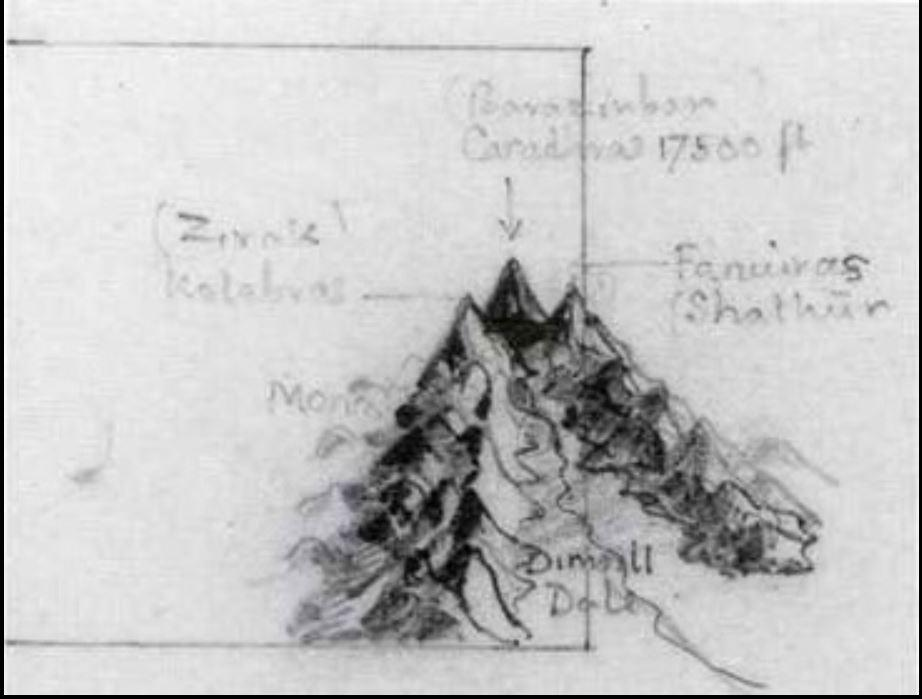
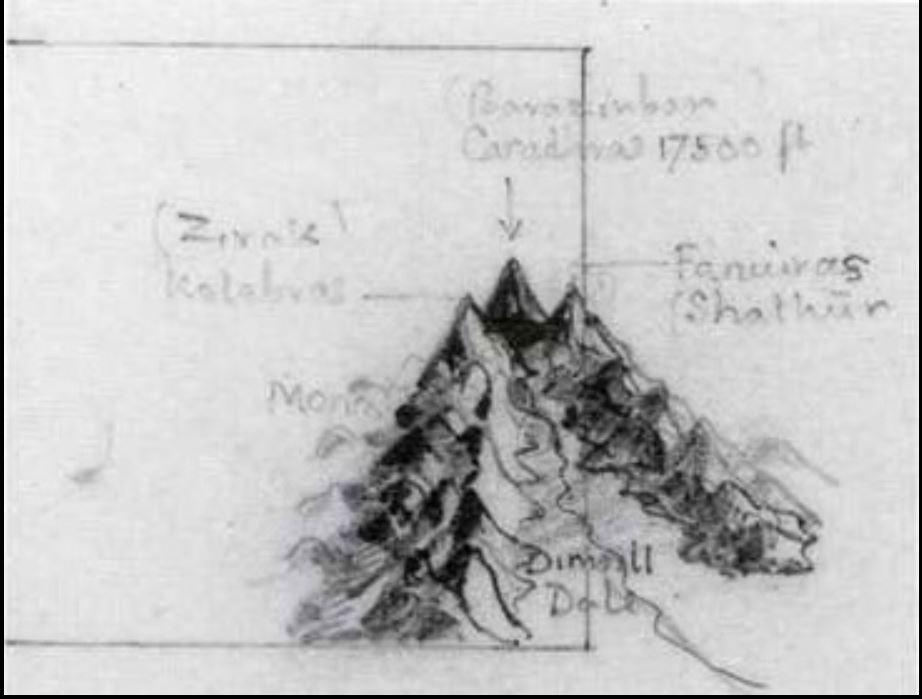
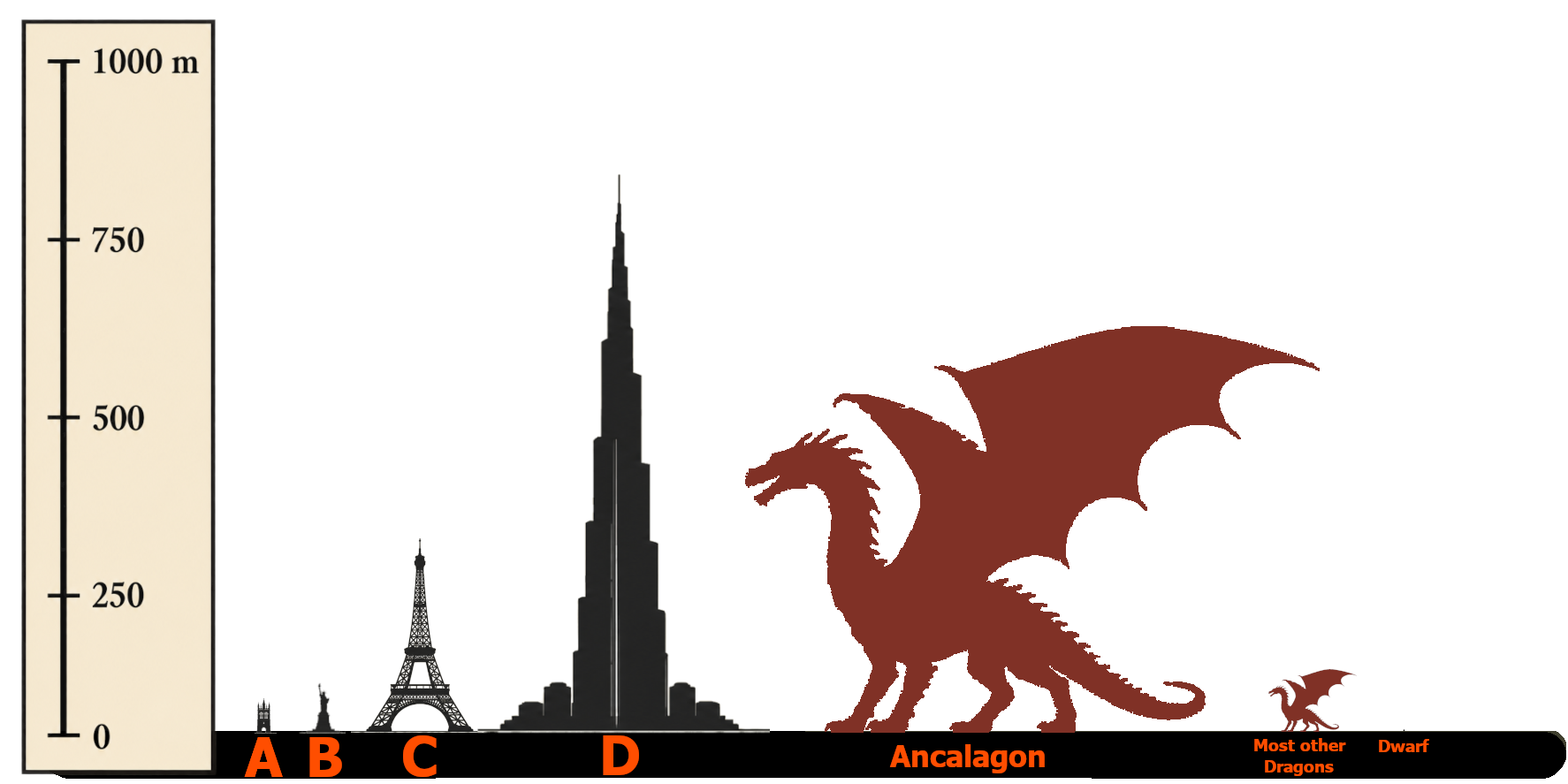
That is almost everything Tolkien tells us, and it leaves one particularly tempting question unanswered: just how large was Ancalagon? Tolkien gives us no measurements, but the manner of his death makes it difficult to imagine him as merely another large dragon. Elsewhere Tolkien calls the peaks of Thangorodrim the “mightiest of the towers of Middle-earth”. Karen Wynn Fonstad, attempting to reconcile Tolkien’s own drawing of Thangorodrim with his geographical distances, estimated its central peak at roughly 35,000 feet high and five miles across at the base. Her figures cannot be treated as canonical measurements, since Tolkien’s geography of the region changed and contains unresolved inconsistencies, but they illustrate the extraordinary scale that Tolkien’s picture suggests.
We can even take the thought experiment a little further. Rather than beginning with one of the gigantic Ancalagons familiar from modern artwork, we can ask the question the other way around: how large would Ancalagon actually have needed to be for his fall to break the three peaks of Thangorodrim? If we conservatively halve Fonstad’s dimensions, we are still left with peaks more than five kilometres high. Yet Ancalagon would not necessarily need to be anything like that long himself. Suppose, purely for illustration, that he measured around 500 metres from nose to tail. Size alone does not tell us his mass: as a flying creature he might have been comparatively lightly built, with hollow bones or some other weight-saving anatomy, while a more massively constructed dragon of the same length could weigh enormously more. If we nevertheless give our hypothetical Ancalagon a mass of around a billion kilograms, and suppose he was flying at around 300 metres per second when Eärendil brought him down before falling another two kilometres, his existing motion and the acceleration of the fall would together produce an impact energy on the order of 15 kilotons of TNT, roughly comparable to the Hiroshima atomic bomb. Double his length to one kilometre and, if we simply scale the same creature upwards, his mass and impact energy increase roughly eightfold, taking us into the region of several Hiroshima bombs. None of these figures tells us how large or fast Ancalagon really was. They merely demonstrate that a dragon does not need to be five kilometres long before the energies involved become extraordinary. Such an animal is, of course, biologically preposterous. But we’re testing Tolkien’s mythic event, not designing a viable zoo enclosure for Ancalagon.
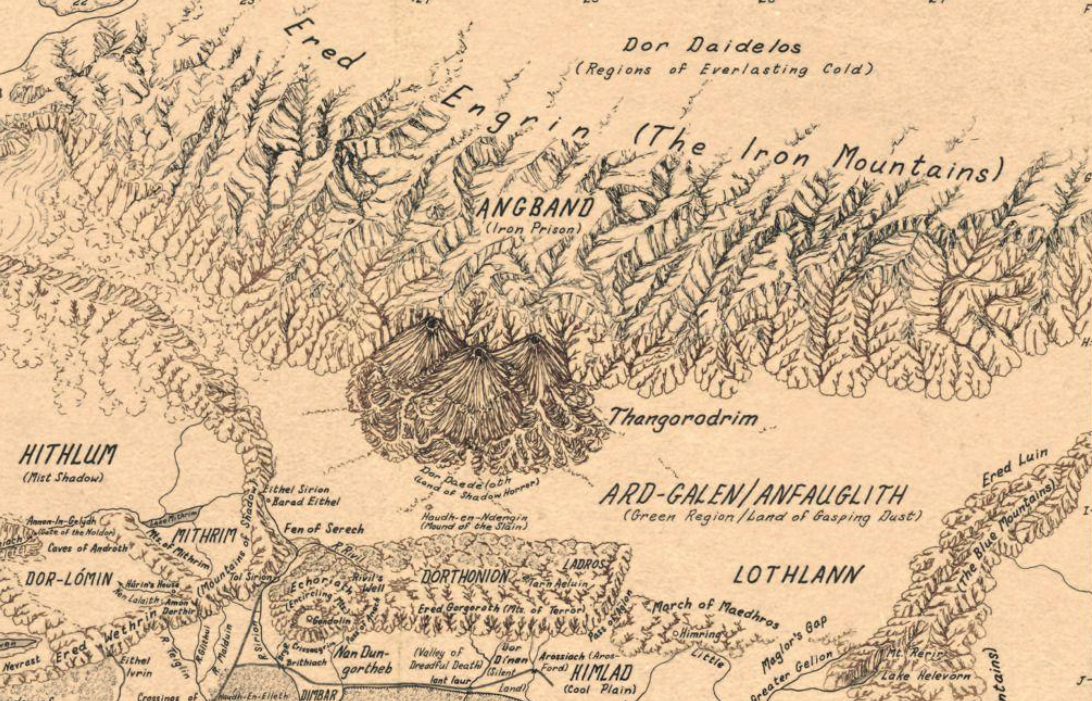
Unfortunately, this also means that we cannot calculate Ancalagon’s size backwards from the destruction of Thangorodrim. We do not know his mass, his proportions or anatomy, how far he fell, how fast he was travelling, or precisely what Tolkien imagined the three peaks to be made of. Thangorodrim had been raised above Angband from the vast slag and refuse of Morgoth’s excavations, so “they were broken in his ruin” need not mean that Ancalagon’s body pulverised three solid mountains of rock. His impact might instead have shattered and destabilised the peaks, sending enormous masses of material collapsing with him. A dragon hundreds of metres long could therefore conceivably have caused such a catastrophe under the right assumptions; one approaching a kilometre makes it considerably easier to imagine. There must nevertheless be some lower limit. A dragon only fifty metres long, for example, would simply not possess enough mass to account plausibly for the ruin of three mountains of this scale, however dramatic its fall. At the other extreme, nothing in Tolkien’s description requires Ancalagon to have been several kilometres long. Somewhere between those extremes lies a range in which the event becomes physically conceivable, but the surviving text gives us nowhere near enough information to narrow it further. The gigantic Ancalagons of modern artwork can therefore fit the scale of destruction Tolkien describes, provided we first suspend the laws that would have prevented them from getting into the air at all. Exactly how colossal Ancalagon was, Tolkien leaves us to imagine, but “big” would certainly seem to be something of an understatement.
Smaug the Golden
Smaug is probably Tolkien’s most complete dragon as a character. Where Glaurung is terrifying, Smaug is entertainingly terrifying: vain, suspicious, intelligent, cruel and extraordinarily perceptive.
Bilbo enters the Mountain believing invisibility gives him a tremendous advantage. Smaug rapidly demonstrates the limits of that assumption: he cannot initially see Bilbo, but he can smell him, hear him and, most dangerously, talk to him. Bilbo does something remarkably sensible and refuses to give his name, answering instead in riddles while Smaug tries to work out who sent him, where he came from, what he wants and how much trust exists between Bilbo and the Dwarves. Their conversation becomes a duel.
Smaug is also enormously proud. Bilbo discovers the missing scale on the dragon’s underside not through force but through flattery, persuading Smaug to display his magnificent armour, and that tiny flaw eventually kills him. Smaug is powerful enough to destroy Erebor and Dale, yet vain enough to demonstrate the only place he can be killed. His weakness, in other words, is not a lack of strength but an excess of pride.
Scatha the Worm
Scatha receives far less narrative space than Smaug or Glaurung, but for the history of the Dwarves he matters a great deal. He was a great dragon of the Grey Mountains and possessed a substantial hoard, much of it taken from the Dwarves. Fram, son of Frumgar and an ancestor of the Rohirrim, killed him, and then came the difficult question of who owned the treasure.
The Dwarves claimed it; Fram refused to surrender it. According to Appendix A, he sent them instead a necklace made from Scatha’s teeth, with the words: “Jewels such as these you will not match in your treasuries, for they are hard to come by.” Some say the Dwarves killed Fram for the insult. Rightly so. How dare he insult the Dwarves and claim their partially stolen treasure for his own, the horse-flea-infested little(*)… cough… Anyhow.
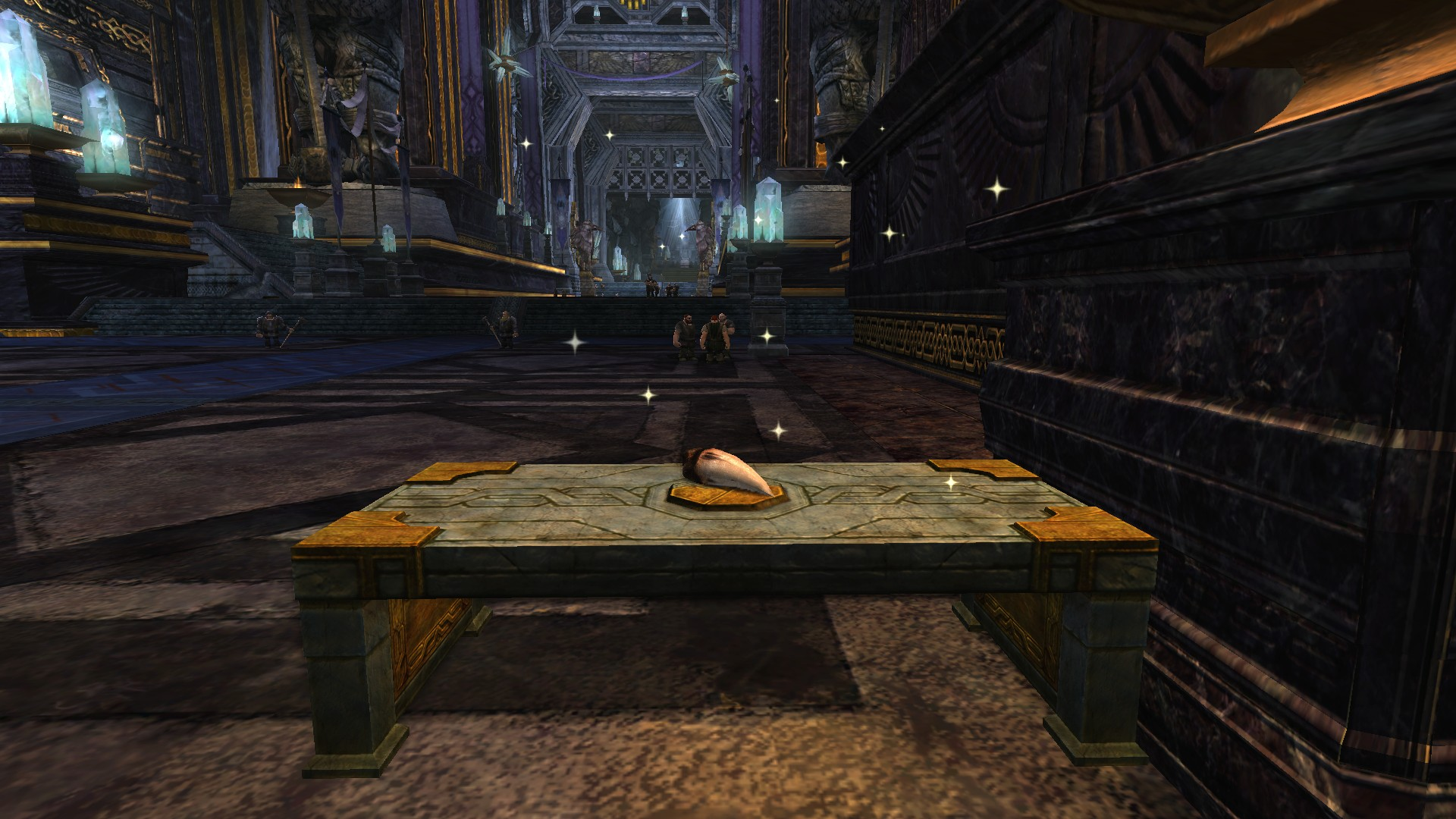
Centuries later, at least part of Scatha’s treasure was still remembered among the Rohirrim: the horn Éowyn gave to Merry was said to have come from that hoard. Scatha has also become slightly more vivid since the 2024 publication of The Collected Poems of J.R.R. Tolkien, whose previously unpublished draft “Scatha the Worm” distinguishes him from more magnificent dragons: dragons whose hides are like armour, whose tails are like steel, dragons golden, green or glowing red. “Not so was Scatha,” Tolkien writes, before describing the blind, pale worm and his icy breath. Tolkien never developed the poem into a finished narrative, but it is a fascinating glimpse of a dragon he plainly thought about well beyond the few lines that made it into The Lord of the Rings.
9. Dragons and Dwarves
For the Dwarves, dragons are not merely legendary monsters. They are a recurring historical disaster, and the relationship begins much earlier than Erebor.
During the Nirnaeth Arnoediad, when Glaurung and his brood help break the armies opposing Morgoth, the Dwarves of Belegost do something extraordinary: they stand. Their armour and fearsome war-masks let them endure dragon-fire better than Elves or Men, and they surround Glaurung with their axes. In his rage, Glaurung strikes down their lord Azaghâl and crawls over him, but with his last stroke Azaghâl drives a knife into the dragon’s belly, wounding him badly enough that Glaurung and his brood flee the field.
For all the disasters dragons later inflict on the Dwarves, one of Middle-earth’s earliest direct confrontations between Dwarf and dragon therefore ends with the dragon being driven off. That encounter belongs to the First Age. More than three thousand years later, the descendants of Durin would face dragons not on a single battlefield, but in a conflict lasting nearly twenty years.
10. The War of the Dwarves and Dragons
If Smaug’s assault on Erebor is the single most famous dragon-attack in Dwarven history, it was not the first, and Erebor itself was in some ways a refuge from an earlier catastrophe. That earlier catastrophe was the long conflict between Durin’s Folk and the dragons of the Grey Mountains. Tolkien tells us explicitly that the dragons “made war on the Dwarves,” and the conflict is now generally known to readers as the War of the Dwarves and Dragons, a conventional later name for the events, rather than a title Tolkien himself gives them.
Background: a kingdom in the Ered Mithrin
Centuries before that war began, Durin’s Folk had already lost one great home. In T.A. 1981, Dwarves delving too deep and too greedily in Khazad-dûm woke Durin’s Bane, and Moria was abandoned. Some of the homeless Longbeards eventually settled at Erebor; others, under Thorin I, chose instead to join kin already established in the Grey Mountains, moving there in T.A. 2210.
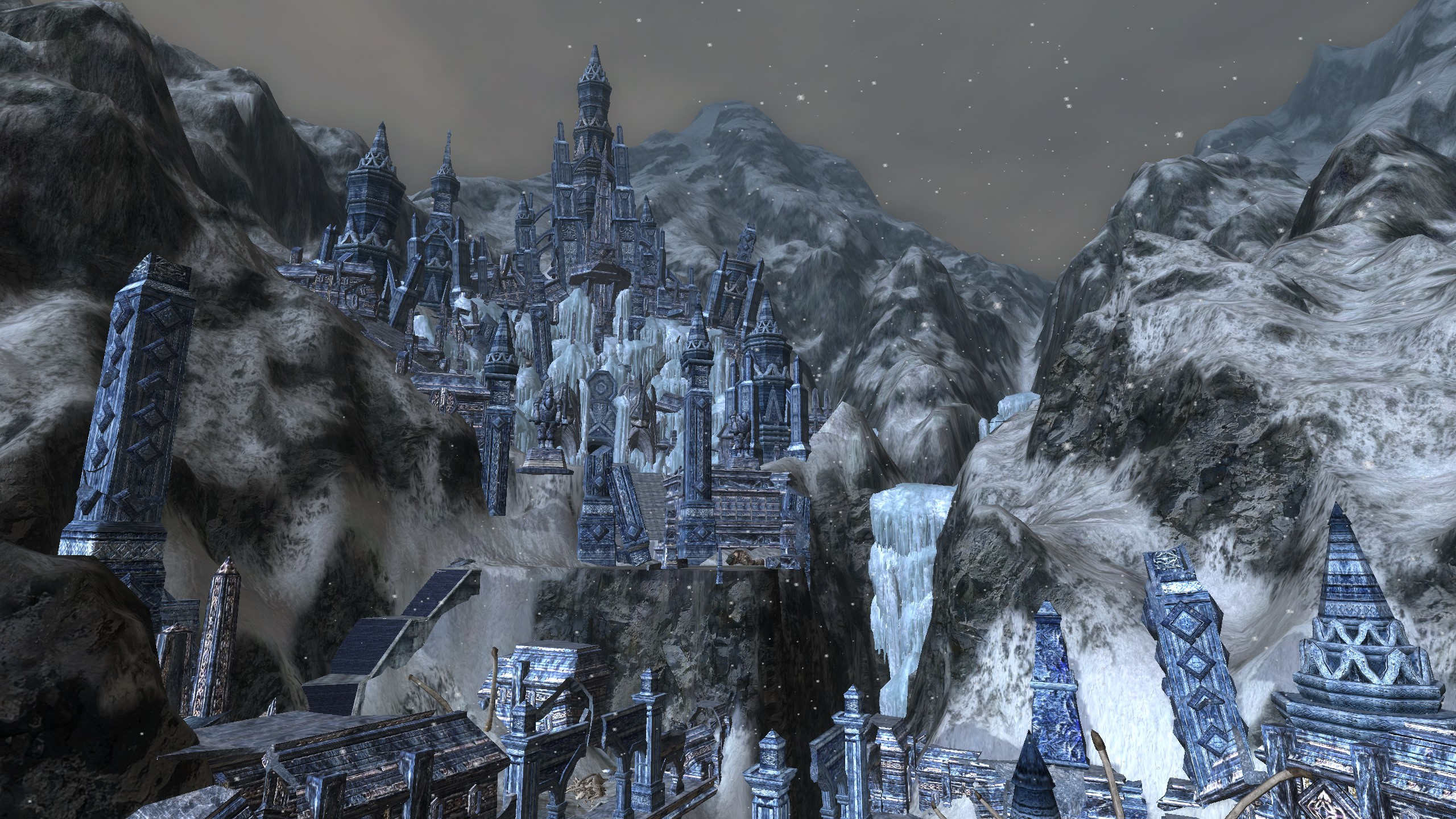
The Grey Mountains (the Ered Mithrin) were rich in mineral wealth, and after Thorin I joined the Longbeards already established there in T.A. 2210, the northern realm prospered for another three and a half centuries. It was not an empty range. At its eastern end the mountains split into two parallel spurs enclosing the valley of the Withered Heath, a breeding-ground for dragons since ancient days, and long before Durin’s Folk settled there in strength, the long-worm Scatha had already plundered the Dwarves and added their treasure to his hoard. Fram, cursed be his name(*), of the Éothéod killed him around T.A. 2000.
The war itself
The dragons of the Withered Heath did not stay quiet forever. Appendix A records, tersely, that the dragons in the North “became strong again and multiplied” and “made war on the Dwarves,” while Appendix B dates the renewed dragon attacks to about T.A. 2570. The Dwarves held out for nearly twenty years, a long, grim resistance that Tolkien passes over in barely a sentence, leaving the reader to imagine two decades of raids, burned halls and dwindling strongholds along the length of the Ered Mithrin.
It ended at the doors of the king’s own hall. In T.A. 2589, the dragons attacked once more, and King Dáin I and his second son Frór were killed by a great cold-drake outside the gates. Appendix A gives that death no more elaboration than the single word “slain”: no battle, no last stand, simply the fact of it.
With their king dead, Durin’s Folk had had enough. Most abandoned the Grey Mountains outright. Thrór, Dáin’s grandson, returned with many of his people to re-establish the old Kingdom under the Mountain at Erebor in 2590, carrying the Arkenstone with him; his uncle Grór led another portion of the people east to found a new realm in the Iron Hills, where their descendants would remain into the War of the Ring. A remnant of Durin’s Folk seems to have lingered in the Ered Mithrin even after this, but the great kingdom there was finished.
What the dragons took
The war in the Grey Mountains was only one chapter in the much longer history of conflict between Dwarves and dragons. Elsewhere in that largely unwritten history, dragons apparently claimed prizes even more extraordinary than Dwarven treasure. Of the Seven Rings possessed by the Dwarf-lords, Gandalf later tells Frodo that only three had ever been recovered by Sauron:
“Seven the Dwarf-kings possessed, but three he has recovered, and the others the dragons have consumed.”
Four of the Seven Rings of the Dwarves were therefore destroyed by dragons. The Seven had been associated with the seven Dwarf-lords and their Houses, four of which originated in distant eastern mansions. The Longbeards’ own Ring wasn’t lost in the war with the dragons, though: it survived the war and the abandonment of the Ered Mithrin, remained in Durin’s royal line, and was eventually taken from Thráin II by Sauron in Dol Guldur.
Where and when the other four Rings were destroyed, Tolkien never tells us. Their destruction by dragons may instead hint at something much larger than the histories preserved about Durin’s Folk: dragons evidently preyed upon Dwarven peoples and their accumulated wealth far beyond the comparatively well-recorded conflicts of the Grey Mountains and Erebor. Four of the Seven Rings disappeared somewhere in that largely unwritten history, a reminder that the conflict between Dwarves and dragons was apparently not a Longbeard problem alone. The Longbeards are simply the Dwarven people whose dragon encounters Tolkien happened to document most extensively.
The long shadow of the Grey Mountains
The Grey Mountains war established a pattern that would prove painfully familiar to Durin’s Folk. Having prospered in the north, they were driven from their settlements by dragons, only for the wealth of the renewed Kingdom under the Mountain eventually to attract Smaug in 2770. Read together, the fall of the Grey Mountains and the fall of Erebor are not two unrelated dragon-attacks but repetitions of the same catastrophe: Dwarven industry creates precisely the kind of concentrated wealth dragons covet, and sooner or later that wealth attracts their attention. The War of the Dwarves and Dragons is the first great Third Age demonstration of a pattern that would return with devastating familiarity when Smaug descended upon Erebor two centuries later.
11. Dragons and the Power of Gold
The treasure-hoarding dragon is not universal. Chinese dragons do not need to sleep on piles of stolen cups. The tradition Tolkien inherited here is overwhelmingly northern: Fáfnir possesses cursed gold, the dragon in Beowulf occupies an ancient treasure-barrow, and Smaug sleeps directly on the accumulated wealth of Erebor.
The dragon’s relationship to treasure is also deliberately strange. What does Smaug actually do with the gold? Almost nothing. He cannot spend it, does not trade it, makes nothing from it, and scarcely even sees much of it beneath his own body. Its purpose is possession.
That is why the dragon-hoard becomes morally interesting. Tolkien describes the effect directly during the dispute over Erebor, noting that Bilbo had underestimated:
“the power that gold has upon which a dragon has long brooded”
That line does more work than simply saying Thorin “caught dragon-sickness.” Thorin certainly becomes possessive, suspicious and increasingly unreasonable once he has regained the Mountain, with the Arkenstone in particular dominating his thinking. But The Hobbit uses the actual phrase “dragon-sickness” most explicitly later, for the old Master of Lake-town. After Bard gives him gold for rebuilding the town, the Master takes much of it and flees; Tolkien writes that, “being of the kind that easily catches such disease,” he:
“…fell under the dragon-sickness, and took most of the gold and fled with it, and died of starvation in the Waste, deserted by his companions.”
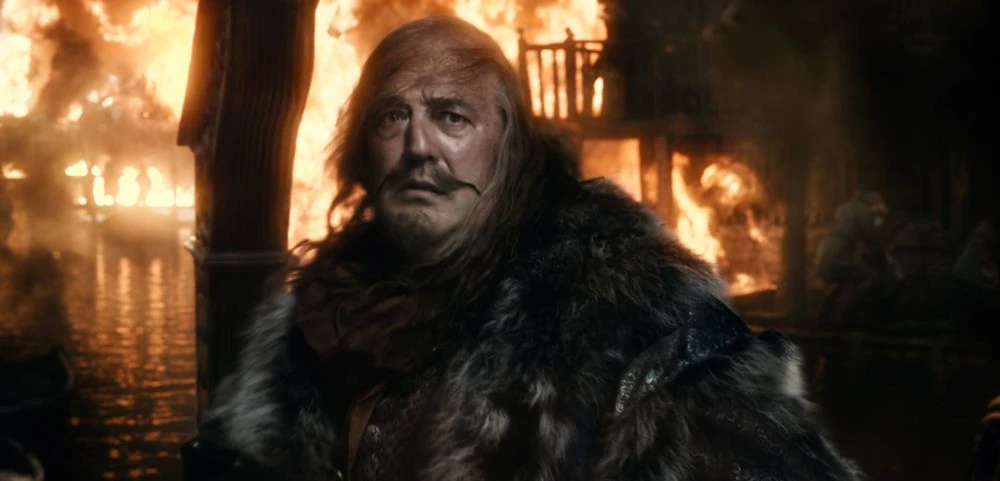
So dragon-sickness is not a special magical disease reserved for Dwarves, nor is Tolkien especially interested in cataloguing its symptoms. The idea is broader: treasure associated with a dragon brings out the desire simply to possess. That does not make gold intrinsically evil: the Dwarves work with it constantly, Bilbo accepts treasure, Bard uses wealth to rebuild Dale. The problem is not owning beautiful things, but becoming owned by them.
In that sense the dragon is the perfect image of possession without purpose. No creature possesses more completely, and no creature does less with what it possesses.
12. Could Dragons Still Exist in the Fourth Age?
Smaug dies in T.A. 2941. Does dragon-kind die with him? No text says so, and Gandalf’s discussion of the Rings of Power strongly suggests otherwise. Explaining to Frodo why dragon-fire could not now destroy the One Ring, Gandalf says:
“There is not now any dragon left on earth in which the old fire is hot enough… nor was there ever any dragon, not even Ancalagon the Black, who could have harmed the One Ring.”
Gandalf does not say no dragons are left; he says no dragon then remaining possessed sufficiently powerful fire, adding that even Ancalagon could not have done the job. Smaug is described in ways that mark him as the greatest dragon of his own time, and his death very likely removes one of the last truly great dragons from the board, but the greatest surviving dragon is not necessarily the last dragon.
The northern wastes are enormous. The Withered Heath had bred dragons before, and the Grey Mountains had suffered whole populations of them. Nothing in Tolkien requires us to imagine that every lesser worm conveniently died before the start of the Fourth Age. What became of them afterward is unknown: they may have diminished, retreated farther into the northern wastes, or simply dwindled like so many other creatures of the Elder Days until only stories remained.
Tolkien does not tell us, and perhaps that is the right ending for dragons. A world in which someone can confidently point to the last dragon dying on a particular Tuesday is a world that has become slightly less mythological.
Closing: Richer in Significance Than Gold
Tolkien’s dragon was ancient long before it entered Middle-earth: not because one single creature called the dragon passed unchanged from Babylon to Greece, from Greece to Scandinavia and from Scandinavia to Oxford, but because Tolkien inherited a collection of ancient ideas and combined them in his own way.
Perhaps what is most striking after following the dragon across all those centuries is how little it ever needed to become a single, clearly defined creature. Even Tolkien’s dragons resist that. Some fly and some do not; some breathe fire, one was even imagined with an icy breath, while others survive only as names in linguistic notes. They can be called dragons, drakes, worms and serpents, and the boundaries between those terms are rarely as tidy as we might like them to be. The dragon arrived in Middle-earth carrying thousands of years of ambiguity with it, and Tolkien never entirely tamed it. I suspect that was quite deliberate. And, honestly, I think that is completely as it should be. Dragons have always lived somewhere between creature and idea, changing shape whenever a culture found something new for them to guard, threaten or represent. Tolkien did not resolve that long history into a neat zoological specimen. He added another distinct chapter to it.
Tolkien wrote that a dragon was “no idle fancy” and that its significance was richer than its barrow was in gold. He had Glaurung and Smaug to prove it. He wasn’t kidding.
References and Further Reading
Tolkien, J.R.R. “Beowulf: The Monsters and the Critics.” Lecture delivered to the British Academy, 25 November 1936; later collected in The Monsters and the Critics and Other Essays, edited by Christopher Tolkien. London: George Allen & Unwin, 1983.
Liddell, H.G., and Robert Scott. A Greek-English Lexicon, s.v. δράκων (drakōn). The relationship to δέρκομαι (derkomai), “to see” or “see clearly”, is generally treated as probable rather than certain.
Tolkien, J.R.R. The Silmarillion, edited by Christopher Tolkien. London: George Allen & Unwin, 1977. See especially “Of the Return of the Noldor”, “Of the Fifth Battle: Nirnaeth Arnoediad”, “Of Túrin Turambar”, and “Of the Voyage of Eärendil and the War of Wrath”.
Tolkien, J.R.R. The Letters of J.R.R. Tolkien, edited by Humphrey Carpenter and Christopher Tolkien. London: George Allen & Unwin, 1981. Letter 153, draft letter to Peter Hastings, September 1954, on the distinction between true creation and the corruption or remodelling of pre-existing beings.
Tolkien, J.R.R. The Lord of the Rings. London: George Allen & Unwin, 1954–55. See The Fellowship of the Ring, “The Shadow of the Past” (Gandalf on the Seven Rings, dragon-fire, and Ancalagon), and The Return of the King, “The Tower of Cirith Ungol” (Frodo on the Shadow that “can only mock”) and Appendix A, “The House of Eorl” and “Durin’s Folk” (Fram, Scatha, Dáin I, Frór, and the dragon attacks upon the Grey Mountains).
Tolkien, J.R.R. The Hobbit. London: George Allen & Unwin, 1937. See especially chapters 12–13 (“Inside Information”, “Not at Home”) for Smaug and Bilbo’s conversation, and chapters 15 and 19 (“The Gathering of the Clouds”, “The Last Stage”) for the power of the hoard and the Master of Lake-town’s dragon-sickness.
Tolkien, J.R.R. “177. Scatha the Worm (c. 1954–55).” In The Collected Poems of J.R.R. Tolkien, Vol. III, edited by Christina Scull and Wayne G. Hammond, pp. 1284–86. London: HarperCollins, 2024. An unpublished draft poem, first printed here, describing Scatha’s freezing breath.
Tolkien, J.R.R. The Lost Road and Other Writings, edited by Christopher Tolkien. London: George Allen & Unwin, 1987. See “The Etymologies”, especially LOK- for Qenya lingwilóke “fish-dragon, sea-serpent”, fealóke “spark-dragon” and rámalóke “winged dragon”; PHAY- for the element associated with radiating or sending out rays of light; GOS-/THĒ- for Gostir “dread-glance”, identified as a dragon-name; and STAK- for Lhamthanc “forked tongue”, identified as a serpent-name.
Tolkien, J.R.R. “Words, Phrases and Passages in Various Tongues in The Lord of the Rings.” In Parma Eldalamberon XVII, edited by Christopher Gilson, 2007, p. 181. The later linguistic material includes föalócë, a form built with föa “breath”, illustrating Tolkien’s continued revision of dragon terminology.
Rateliff, John D. The History of The Hobbit. London: HarperCollins, 2007. See the early drafts of “An Unexpected Party” for the development of Bilbo’s “Were-worms” from the earlier “Wild Wire worms of the Chinese”.
Fonstad, Karen Wynn. The Atlas of Middle-earth. Revised edition. Boston: Houghton Mifflin, 1991. See the reconstruction of Thangorodrim and northern Beleriand. Fonstad’s calculated dimensions are used here only as a speculative reconstruction based upon Tolkien’s geographical and pictorial evidence, not as canonical measurements supplied by Tolkien.
Primary mythological sources consulted or discussed include the Poetic Edda and Völsunga saga (Fáfnir); Beowulf, especially lines c. 2200–3182 (the dragon episode); the Enūma Eliš (Tiamat and Marduk); the Rigveda (Indra and Vṛtra); the Hebrew Bible, especially Job 41, Psalms 74 and 104, and Isaiah 27 (Leviathan and related sea-monster traditions); and Revelation 12 (the Christian identification of dragon, serpent and Satan). Comparative traditions discussed in the article also include the Cherokee Uktena, Mesoamerican feathered-serpent traditions associated with Quetzalcoatl and related figures, and Māori traditions concerning taniwha.
(*) A small scholarly disclaimer: Fram was, no doubt, an excellent fellow, for one of the race of Men. This article is an old piece that I have worked on, set aside, picked up again and set aside again over several years. Somewhere between ancient serpents, linguistic dragons, several thousand years of mythology and the aerodynamics of Ancalagon, I decided the occasional bit of Dwarf-partisan humour was necessary to catch one’s breath between the scholarly deep dives. No legendary Fram was harmed in the writing of this article.