The Return of Durin! / Tumblr Contest

UPDATE 31st May: Please confirm your entry via message on tumblr (more info here)


Brewing ale has always been a passion of mine. Yet for many years it was only something that happened in books for me, and occasionally via some sort of home-brewing-kit, usually (and to my despair) with foul-tasting results.  The dream I had of brewing a “dwarvish” ale seemed like it would never happen.

Luckily I live in Belgium, a country filled to the brim with sensational breweries and top-notch brewers. So, one day, while “sampling” ales with a few friends at a local pub, I met a one-of-a-kind brewer, who would not only teach me much more than any book on brewing ever had, but liked my idea of brewing a “dwarvish” ale.

When we discussed in great detail what this “dwarvish” ale would taste like we eventually came to a passage in The Hobbit which became our flavors list.

“Some called for ale, and some for porter, and one for coffee, and all of them for cakes . . . A big jug of coffee had just been set in the hearth, the seed-cakes were gone, and the dwarves were starting on a round of buttered scones . . . ‘And raspberry jam and apple-tart,’ said Bifur. // … ‘And more cakes — and ale — and coffee, if you don’t mind,’ called the other dwarves through the door.” – An Unexpected Party, The Hobbit, by J.R.R. Tolkien.

For us the above piece left little argument that the Dwarves had a sweet tooth for cakes and anything fruity.  Hence we decided the ale should have just such flavors. While ensuring we also made it heavy on the burnt malt and alcohol flavors; which is a link to the old Norse Dwarves where Tolkien got quite a bit of his inspiration.

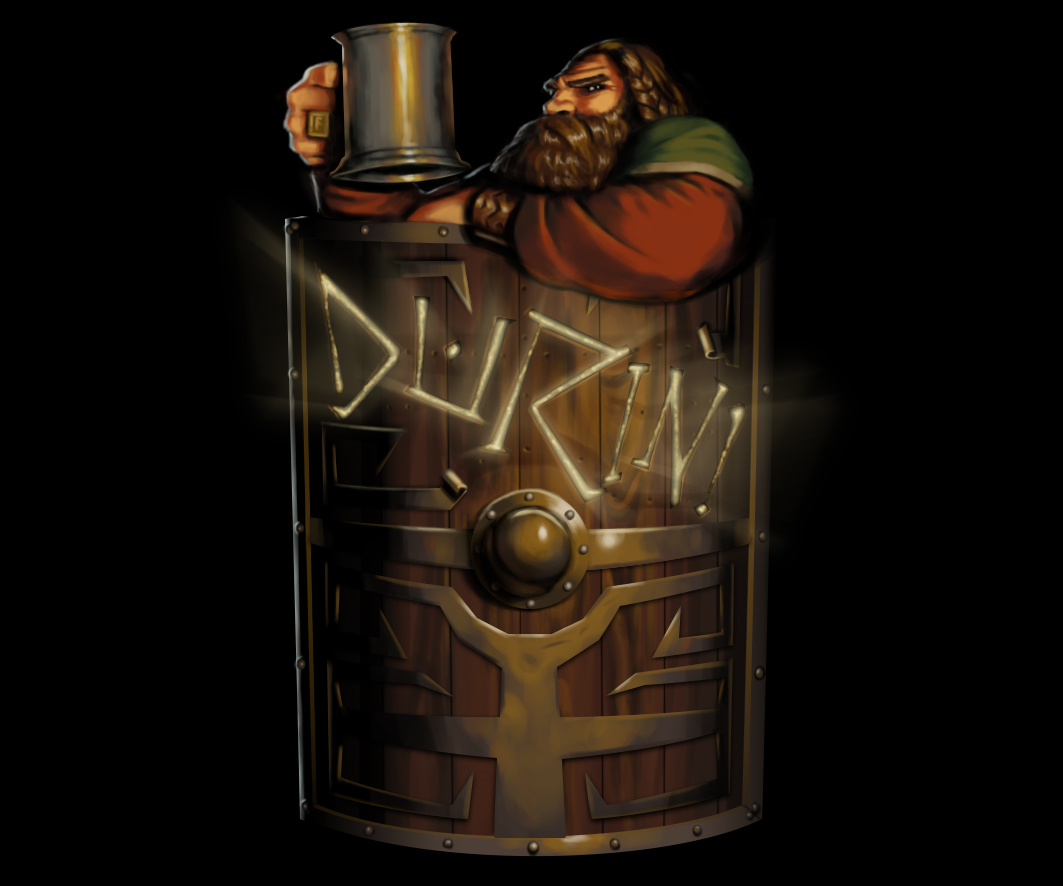
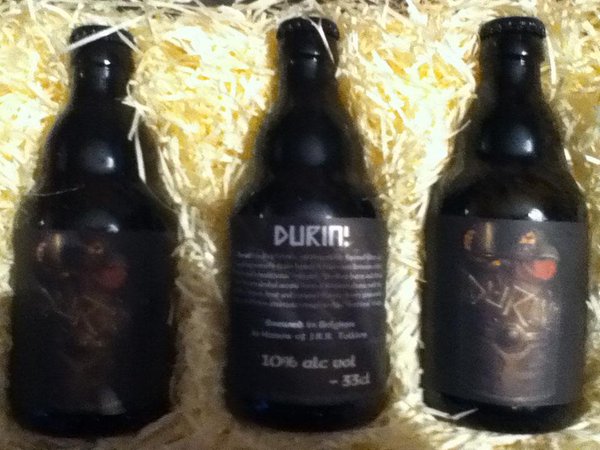
Ending up with a cross between a Stout and a Belgian Trappist… which we named Durin!

durinfront2

Durin! – Front label


By now you are likely wondering, what about this “return” and “contest” you’ve mentioned in the title of this article. Well, seeing that Durin! is a non-profit exclusive sample product, never to be sold, I occasionally hand it out to select friends and benefactors.

The time has come to once again hand it out, this time in the form of a dwarvish literary contest via tumblr.  If you wish to win yourself a selection* of Durin!, sent to your home, have a look at the below contest rules.

* I say “selection” here because I know it can be difficult to ship alcohol to specific countries, and some countries have limits of what can be sent. But you can be sure that I will again aim to provide what I can and won’t be stingy.

durinback2

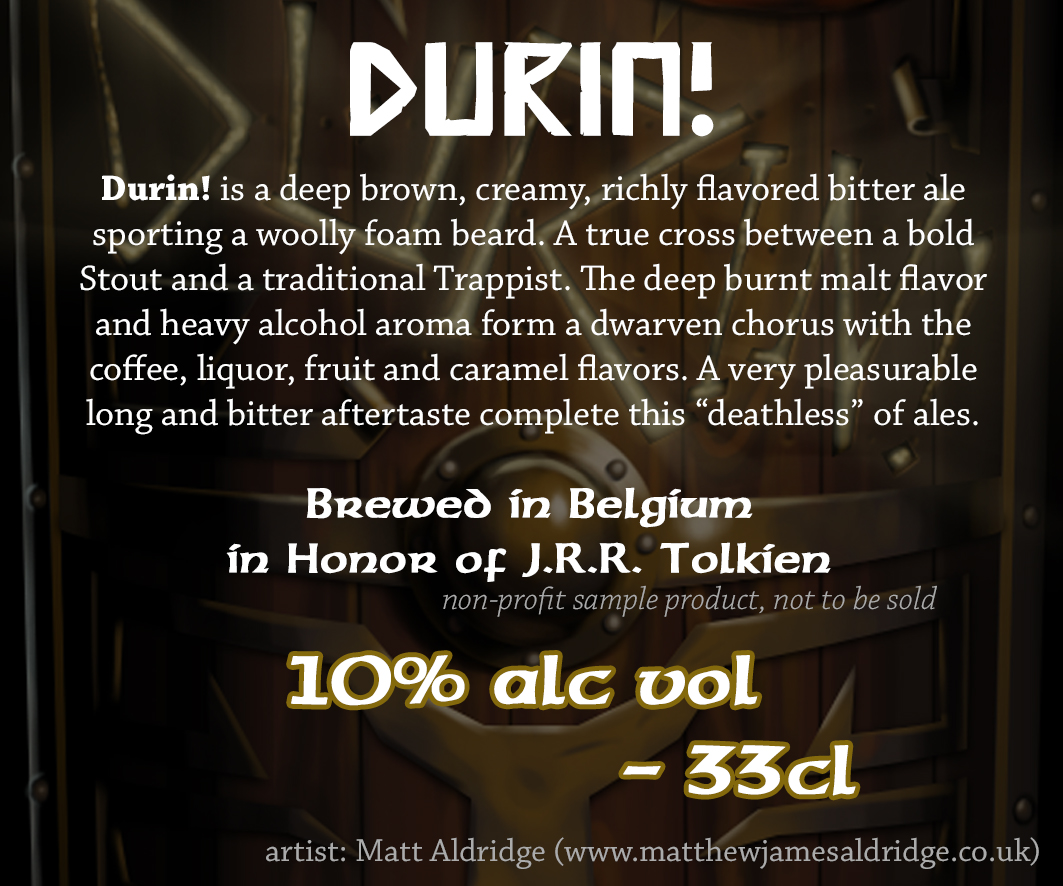
Durin! Back label

Competition rules

  • The written content must be an original short story, poem, haiku or similar art form, written in English and/or (Neo-)Khuzdul*, and is no longer than 500 words.
  • The written content must be set in J.R.R. Tolkien’s Middle Earth and must be related to the topic of “ale” in some way.
  • Content can only be entered by posting it on tumblr and tagging it with #Durin!  (you can add as many other tags as you like too, as long as this one is in there).
  • Pictures or drawings of any kind are not allowed, only text.
  • Writers are allowed to post as many entries as they see fit.
  • The contest starts NOW (april 25th 2016) and is open to all that have a tumblr account (takes two minutes and is very easily done if you don’t have one yet).
  • Writers have until Tuesday 31st of May 2016 to post their content via tumblr.
  • Once posted you may alter your posted text, yet content will be considered final on Tuesday 31st of May.
  • All entries will be reviewed between 31st of May and June 5th.
  • The winner of the contest will be revealed on Sunday June 5th 2016.

**You are free to write it entirely in English if you wish, or entirely in Neo-Khuzdul, or a mix of both (one line of Neo-Khuzdul is fine as well for instance). The Neo-Khuzdul version used must be that which can be found via this blog.

Note: seeing that the prize of this competition contains alcohol this directly means that all writers entering this competition must in fact be of the legal age (in their country of residence) to drink beer.

durin-inbox

Other than the above mentioned “rules” I don’t wish to constrain anyone’s creativity.
I look forward to reading your stories, poems and the likes.

Any questions ? Feel free to ask via tumblr

Happy writing and good luck!


Posted in Uncategorized | 2 Comments

Khuzdul in the Battle of Five Armies Movie

Hello my friends,

Many people have asked me over the past year or so to translate the Dwarvish lines spoken in the Battle of the Five armies movie. Though it took a tremendous amount of time to translate these (for the simple reason that there is no transcript available, nor are some of these lines pronounced very clearly either) I’ve made an attempt at it here:

This is my personal interpretation of these lines spoken in the Battle of the Five Armies film, based on all the knowledge available to me.


Further information on each translated line:

1) “Yanâd Durinul”, (Sons of Durin) from David Salo’s [YND] birth/son, as in “ênâd” (birth) – Ereb. Khuzdul: “Yand” (son), “Yanâd” (sons). This meaning will be added shortly to the updated Neo-Khuzdul dictionaries. “Durinul”, meaning “of Durin” is the Possessive Descriptive/Lineage marker as seen in “Balin Fundinul” (Balin, son “of Fundin”)

2) “Ihgirî ni-hun!” (Go right into them) I consider this line the most doubtful of all, as I have mixed feelings about the radicals used in the first word (it isn’t quite clearly pronounced unfortunately). After much consideration I went with the listed translation. Reason for this is that [HGR] is used in my Neo-Khuzdul for “right, to go right”. Ni is attested as “in” in Salo’s Neo-Khuzdul, while “hun” is the logical plural of “hu” (he/it), making it “them” (a colloquial masculine/neuter alternative for the more formal “izd”).

3) “Ifridî!” (Make Ready). Plural imperative form (iCCiCî structure), attested on David Salo’s site: http://midgardsmal.com/

4) See 3

5) “Baruk Khazâd!” (Axes of the Dwarves) – Original Khuzdul by J.R.R. Tolkien, first half of the famous battle-cry as uttered by Gimli during the Battle of the Hornburg.

6) “Ansaru, bekâr!” (Company, weapons!) – Shortened version of David Salo’s: “Ansaru kitnul, ifridî bekâr!” (Centre company, ready weapons!) attested on David Salo’s site: http://midgardsmal.com/

7) “Rakân, bekâr!” (Rows (lines), weapons!) – Though “bekâr” is attested (arms, weapons), “rakân” is not, yet is seems logical that this word means “rows” or “lines”. It takes the plural structure CaCâC as seen in many Neo-Khuzdul noun types. Furthermore the radicals [RKN] seems to link to the consonants found in the Proto-Germanic *rai(h)waz, meaning “row”. This meaning will be added shortly to the updated Neo-Khuzdul dictionaries.

8) “Ai-rusê” (Upon the filth!). This was a tricky one to say the least, again as the pronunciation is far from clear. “ai-” is from Tolkien’s original “aya”, as seen in “ai-mênu” (upon them). “rusê” is from the radicals [RSY] from Proto-Germanic *drohs- (dirt, dregs), using the CuCaC form, as seen in the original Tolkien “duban”, forming “rusay”, which becomes “rusê” through monophthongization. This meaning will be added shortly to the updated Neo-Khuzdul dictionaries.

9) “Idmi d’dum” (Welcome to the Hall). A novel way of welcoming someone to say the least. “Idmi” is the singular imperative form of “to welcome”, using the same radicals as seen in the word “dum” (mansion, hall). “d’ ” is the syncopated form of “du”, meaning “to”. While “dum”, is original Tolkien Khuzdul, as seen in “Khazad-dûm” (mansions of the dwarves, Dwarrowdelf).

10) See 5

11) “Khazâd ai-mênu!!” (The Dwarves are upon you) – Original Khuzdul by J.R.R. Tolkien, second half of the famous battle-cry as uttered by Gimli during the Battle of the Hornburg.

12) Singular form as seen in 2. Note: It is hard to tell if Billy Connolly utters a “hg” or “k”, this may have been “Ikrid ni-hu”, which would translate as “believe (trust) in him (it)!”, this may refer to either Durin, Thorin or even their weapons. May very well apply to the translation in line two as well.

13) Du-bekâr! (“To arms!”), attested on David Salo’s site: http://midgardsmal.com/

Disclaimer:

— Translations by The Dwarrow Scholar –

Khuzdul is the language of the Dwarvesin J.R.R. Tolkien’s legendarium set in Middle-earth.  For these Neo-khuzdul/Khuzdul translations both the original Tolkien material and  David Salo’s Neo-Khuzdul have been used.

This is my personal interpretation of these lines spoken in tBotFA film, I do not claim this  content to be canon, nor do I claim ownership of any material. 

This video is an interpretation of Tolkien’s work and any Khuzdul related material, all rights are reserved for their proper owners. Any reference to any brand name is not meant to claim ownership of material. 

Footage from The Hobbit: The Battle of the Five Armies and The Battle of the Five Armies Extended Edition, Courtesy of Warner Bros, all rights reserved.

Posted in Uncategorized | 6 Comments

Tolkien Language Haiku Contest on Middle-Earth News

It is with great pride and excitement I can announce that I will be one of the judges at the first ever Tolkien Language Haiku Contest on Middle-Earth News, as part of the Tolkien Week celebrations.

Professor J.R.R. Tolkien

Professor J.R.R. Tolkien

As Middle-Earth finds its origins in the languages created by Professor J. R. R. Tolkien, I find this contest a truly unique way to honor Tolkien’s passion for languages, which in turn sparked a similar passion in my own heart.

Some time ago, during the Midsummer Moot haiku contest, by Middle-Earth News, I entered a haiku in Neo-Khuzdul. To my surprise it won the contest. Seeing that I wasn’t in it to win anything though (truth be told I just wanted to try my hand at another Neo-Khuzdul haiku and had no idea there were prizes involved), I decided to suggest to Middle-earth News they could perhaps use these wonderful prizes for a new haiku contest. To my joy they agreed.

I’ll be joined by my good friend dreamingfifi (of realelvish.net), an expert in Tolkien’s elvish languages.

It’s good to know that the contest not only allows for Tolkien’s original languages and the constructed languages based on these (such as Neo-Khuzdul), but is also allows real word languages (such as Old English, Old Norse or Gothic) used by Tolkien to render his imaginary languages (Rohirric, Dalish, etc..).

Full rules and details of the contest can be found HERE.

The winner will receive a canvas art print by artist Joe Gilronan. The winner may choose any painting from the collection (and they are stunning!). And if that wasn’t enough a lovely book too: “The Hobbit: The Desolation of Smaug Chronicles: Cloaks and Daggers.”

I look forward to judging your entries my friends, have fun creating that original haiku!

Posted in Uncategorized | 3 Comments

Translation Tool, Updated Dictionaries… and a tired Dwarrow Scholar

Hail friends!

Firstly, I fear this will be a long post, so bear with me.

Here’s the short version for those eager to get started in all that is new.

Quite a few people have been very appreciative about the dictionaries (and thank you for that my friends), but let’s face, I’ve made them very large… as a result, almost impossible to use with ease.

The main reason I have chosen to include all declensions and conjugations was merely to ensure fan-fiction writers would have all the words at their finger tips.

When I hear however that most people have tremendous difficulty using these large documents, it means I need to provide another solution, something faster, something easier to use and something that might even assist in the building of sentences.

Hence…

DS Neo-Khuzdul Translation Tool

KhuzdulTool1

This tool will allow anyone (with Microsoft Excel) and basic knowledge of Neo-Khuzdul to create their own lines in Neo-Khuzdul.

Word of warning though… this is a language tool, it’s not Google Translate (without being too critical about Google Translate, maybe that’s not a bad thing). What I mean is that you still need to have some basic understanding about Neo-Khuzdul to use it.  Word order for instance is determined by the user, not the tool.

If you are looking for a magical tool that will translate not only words, but also set the perfect word-order, while taking into account all possible conjugational forms and nuances this may very well disappoint.  If however you are familiar with Neo-Khuzdul, have tried your hand at translations in the past, but find the dictionaries cumbersome and not fast enough to work with… then you’ll likely be pleased with this tool.

Some things to take into account when using:

  • You must enable macros when using the excel, or it will NOT work (Tools, Macro, Security, Enable all)
  • The excel contains over 200.000 search values, it is recommended to close other applications while running it to ensure the search goes faster. Slower systems might have a bigger impact due to this.
  • When searching for words, try to be specific. For instance, if you are searching for the word “win”, it is best to look for “to win” if you are looking for a conjugated form of the verb or “win ” (with a space) if you are looking for the noun “the win”. Doing so will exclude words like “wind, wine, wink, swing, twine, etc..”, making the search faster.
  • Final translations in English use standards forms, not indicating the personal forms (for instance: “to drink”, instead of “he drinks”). This is meant to be this way, the personal form after all is selected in the” construct page”.

KhuzdulTool3

The tool itself has a handy (yet concise)  step-by-step on how to use it.

Download the Translation tool HERE

Before creating this tool I had to update the dictionaries, including several support documents. You’ll find those usual place HERE

Now, the long version… or in other words, what has changed/been added exactly.

Below, in Italics is a list of the changes/additions made to the dictionaries:

  • Direct changes:
    Added Past Participle Perfect / Present Participle
    “Familiar FORM” now correctly called “disrespectful (contemptuous) FORM”
    changed ending of imperative plural from “i” to “î” in tri-radical roots (was already present in bi-radical roots)
    “ayi” changes to “ê” in compounds
    added many new radicals based on recently released information from David Salo
    changed “portent” from “SD” to “NTHN” radical
    changed “shard” from “KRK” to “KFK” radical
    changed type 10 3-radical plural from “CaCâC” to “aCaCâC” – including construct state (aCaCuC)
    changed type 15 3-radical plural from “aCaCâC” to “aCâCaC” – including construct state (aCâCuC)
    added “ay” to “ê” crasis on type 15 plurals and singular and plurals in the constructed form.
    changed HRN to SHRG radicals for “lie”
    changed “trust” from KRT to KRD, and “beat” from KRD to KRT, added “drum” to KRT
    added duzu./duzi and d’zu./d’zi. in pronouns
    crasis for “w”-combinations established
    added causative form (including causative transitive)
    changed “lift (rise)” from “TRZ” to “_LZ”.
    added “to grow” and “to cultivate” to MHL verb of “to raise”
    added SHRD, as “to swing”
    added “brother” to KhRM (kinsmen) – in addition to keeping brother NDD
    changed “treason” from HFR to ShNKh
    “To be” documentation added (verb “tati”)
    added adjective type 11 (related to volume, density, substance, resistance or mass) “sherek”, and ul-type clarified (+ document on adjectives)
    added plural adjective forms
    changed “wife” to “partner” and used derived noun forms (-ûn/-ûna,…) for “wife, husband, etc..”.
    updated document 21 (usage of “-ul” and “-u”) to include “-im-“
    changed “swoon” from “DRB” to “DRD”
    removed “stop” from “‘KhZ” and added to “DRB”
    added “ThMR” for “retreat”, removed “retreat” from “NNK”
    added “yîr” and “tîr” as alternatives for “there”
    changed “yonder” to “yonder place”
    added “bi” as alternative for “from”
    added “zû” as alternative for “now”
    clarified the difference between “alarm (feeling)”, linked to  and “alarm (device)”
    merged “dawn” and “morning”, added “alarm (device)” to BKN
    added “sighted” as adjective
    removed “to watch” and “to keep watch” from “to see”, and added to “TRD”
    removed “to summon” from “ThHR” and added as causative to “to come”
    added “bikûr” and “dukûr” as “whence” and “whither”.
    added new document conserning interrogative words.
    changed “KLT” from “sound” to “hearing” and added “ZMR” as “sound (noise)”
    changed “forget” from “GBY” to “NThR”
    added “iy” to “î” crasis
    changed “burn” from “MHR”, to “RSR”, which was in fact an initial mistake from myself as it always was meant to be “RSR” (linked to ‘urs which is “fire”).
    added “KBR” as EredM. for “beast”
    changed “aim” to “shooting at” and added “to aim” along with “target” as “TLZ” (from the Gothic “tila” – to aim)
    formed type 26 EredM. to accomodate “kobor” as a new form.

E-K Cover

  • Adapted concepts:
    I had rather a challenge with Salo’s “gelekh” meaning “occasion (time)”.  The CeCeC is a pattern I’ve always used for non-metal materials [like Tolkien’s “glass” (kheled)].
    So, this meant I had to accept this concept as being a non-metalic fabric.  I normally would have gone with aCCâC for this kind of abstract words [like Tolkien’s “language” (aglâb)]
    Eventually, after thinking long and hard about this, I accepted this concept as being “a moment in the -fabric- of time”, hence accepted the CeCeC pattern.
    I could however not accept the G-L-Kh radicals, seeing that I had already used them for a different (rather prominent) concept (“good”,”well”, etc..).
    Hence I purposely changed Salo’s GLKh to GLK in my neo-Khuzdul version.
    It was one of the only Salo’s concepts I was unable to fit in directly as is.
  • Another concept I didn’t directly adopt, was “YBTh” for “weave”, as I had “BBN” which came from a mix between the Old High German “weban” and “vefur” (both “web”)
    Reason for this is that “YBTh”, used for “spider”, could have a second meaning in my version as “young crawler”, also meaning “spider”.
    So I found there was no direct reason to change it.
    I had thought about changing it to “YBTh”, but was in the end more pleased with the structure of incarnates then an entirely invented structure (CêCiC).
  • Also, the Neo-Khuzdul/English dictionary has now been sorted based on the alphabetic order of the Neo-Khuzdul radicals (much like dictionary word order in other Semitic languages).

Support Documents Cover

  • Lastly the following support documents have been updated:
    The Dwarrow Scholar – Neo-Khuzdul Support Documents – Index
    The Dwarrow Scholar – Neo-Khuzdul Support Documents N-01 – Personal Pronouns
    The Dwarrow Scholar – Neo-Khuzdul Support Documents N-02 – The Verb
    The Dwarrow Scholar – Neo-Khuzdul Support Documents N-03 – Verb Forms
    The Dwarrow Scholar – Neo-Khuzdul Support Documents N-04 – Noun Types
    The Dwarrow Scholar – Neo-Khuzdul Support Documents N-05 – Construct State Rules
    The Dwarrow Scholar – Neo-Khuzdul Support Documents N-07 – Usage of negation and affirmation
    The Dwarrow Scholar – Neo-Khuzdul Support Documents N-10 – Conjunctions
    The Dwarrow Scholar – Neo-Khuzdul Support Documents N-14 – Monophthongization and vowel crasis
    The Dwarrow Scholar – Neo-Khuzdul Support Documents N-18 – To be-To Have
    The Dwarrow Scholar – Neo-Khuzdul Support Documents N-21 – When to use UL-U
    The Dwarrow Scholar – Neo-Khuzdul Support Documents N-27 – Lesson Plan
    The Dwarrow Scholar – Neo-Khuzdul Support Documents N-30 – Measurement Units Distance
    The Dwarrow Scholar – Neo-Khuzdul Support Documents N-31 – Measurement Units Weights
    The Dwarrow Scholar – Neo-Khuzdul Support Documents N-32 – Measurement Units Volume
    The Dwarrow Scholar – Neo-Khuzdul Support Documents N-33 – Idioms and Expressions
    The Dwarrow Scholar – Neo-Khuzdul Support Documents N-34 – Radical Index
    The Dwarrow Scholar – Neo-Khuzdul Support Documents N-35 – Parts of the Body
    The Dwarrow Scholar – Neo-Khuzdul Support Documents N-38 – Imperative and Jussive
    The Dwarrow Scholar – Neo-Khuzdul Support Documents N-39 – Seasons and Feasts
    The Dwarrow Scholar – Neo-Khuzdul Support Documents N-41 – Sentences
    The Dwarrow Scholar – Neo-Khuzdul Support Documents N-42 – Forms of Politeness
  • New documents:
    The Dwarrow Scholar – Neo-Khuzdul Support Documents N-43 – Adjective Types
    The Dwarrow Scholar – Neo-Khuzdul Support Documents N-44 – Interrogative Words
    The Dwarrow Scholar – Neo-Khuzdul Support Documents N-44 – Insults

With all this update and creation work… I think I’ll take a little break from Neo-Khuzdul for a few weeks… as I’m so tired I’m confusing dwarves with dwarfs…

Is that the Dwarrow Scholar sleeping?

Is that the Dwarrow Scholar sleeping?

Ever at your service

Posted in Uncategorized | 11 Comments

Fancy LotRO RP in Neo-Khuzdul? Now you can!

Update: The plugin-in should actually work on a Mac.

Hail!

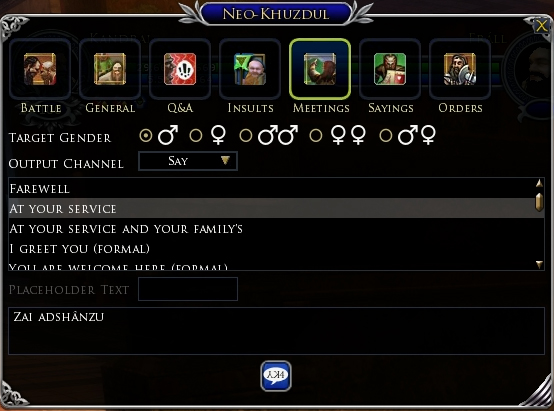
Remember I spoke about a tool for LotRO Dwarf RPers, allowing them to speak Dwarvish with the click of a button (or two)…. well, without further ado, I present to you:

The Neo-Khuzdul Tool LotRO plugin

The Neo-Khuzdul Tool plugin is an vital tool for LotRO Dwarf RP-ers that wish to immerse themselves in the language of dwarves (without the need to plough through dictionaries or grammar documents).

Neo-Khuzdul Tool Plugin

Background

The Neo-Khuzdul Tool plugin was long a wish of mine, ever since I first started giving Neo-Khuzdul lessons in Lotro. As I felt there had to be an easier way for dwarf RPers to speak the language of their kind.

Back in February this year I got in touch with Simbo, the hobbit who created the fantastic Poetical tool I frequently used for my dwarf RP. I pitched this idea to him about a plugin for dwarf RPers, that would assist the RPer in speaking Neo-Khuzdul. To my astonishment he jumped on board and before I knew a first version was ready to be tested.

Without the hard work of Simbo, there simply would not be such a plugin… and it would likely still have been an unfulfilled wish of mine. So there you go, proof again that Dwarves need Hobbits when it matters!

A tremendous thank you to Simbo from myself and (I’m sure) the Dwarf RP-community of Lotro.

About the translations.

The latest updated material and dictionaries have been used to form the content of this tool.

Khuzdul is the language of the Dwarves in J.R.R. Tolkien’s legendarium set in Middle-earth. For this Neo-khuzdul Tool plugin both the original Tolkien material, David Salo’s Neo-Khuzdul and Khuzdul used in Turbine’s LoTRO have been used. This is my personal interpretation of Tolkien’s dwarven language, I do not claim this content to be canon.   This document is an interpretation of Tolkien’s work and any Khuzdul related material, all rights are reserved for their proper owners. Any reference to The Lord of the Rings Online or any other brand name is not meant to claim ownership of material.

In most cases I have opted for informal language, though in many translations found in this tool you will find both formal and informal versions.

How to install?

Drop the “Simbo” folder in your Lord of the Rings Online “plugins” folder. In case you already have a plugin by Simbo (which you really should have to be honest), you’ll have to drop the contents of it into the already existing Simbo folder.

How to use?

Simbo has really done his best to make the tool as user friendly as possible and I think he has done a brilliant job at that.

When you get started there are a few things to keep in mind.

  • Always think WHO you are speaking to, and ensure you select the proper “target audience” In English the pronoun “you” can be used for males, females, individuals or groups, not so in Khuzdul, where you have several forms. Hence it is important you always select the proper target audience in the tool before you press the “speak” button, otherwise your given translation may be incorrect.
  • Some lines mention (m) or (f), this indicates the line is speaking about a male or female (or intended for a male or female)
  • Some lines contain a field “___” to enter a name, feel free to type what you wish to say in the designated box.
  • Ensure you have the right channel selected “say, kinship, fellowship or raid”.

This tool is meant for mature RPers that have an affinity with lore, as such please take into account that Khuzdul was spoken among Dwarves ONLY (with the exception of place names and battle cries). It goes without saying that this is not to be used for spamming your fellow RPers.

Future?

Let’s see how this works out for everyone first…

Though I can already tell you that the Neo-Khuzdul Tool might in the months to come get an Elvish sister (oooh, exciting stuff but -hush- don’t tell anyone yet!)

Also, some of the saying might not be very clear at first glance, hence in a future version of the plugin you will be getting a little “extra information” box (that you’ll be able to show or hide) with some extra need-to-know info about these lines.

The files

UPDATE: Version 1.3 (3/3/2016)

Download UPDATED LotRO Plugin HERE

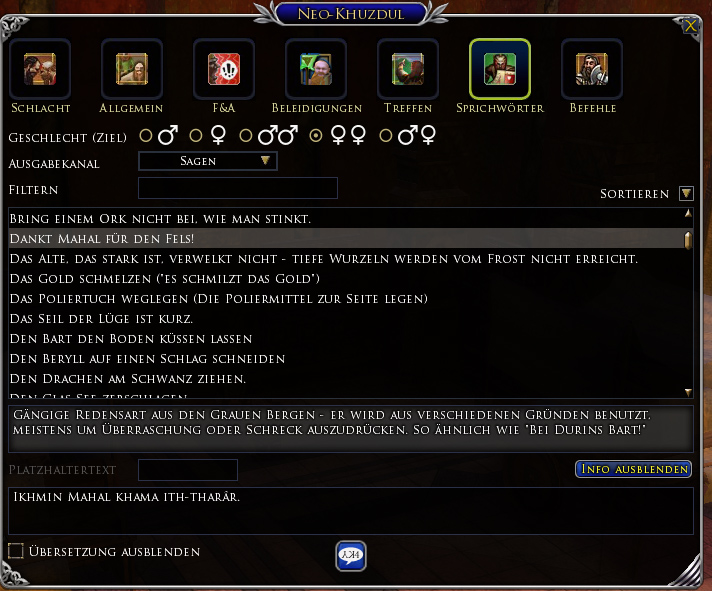
  • Adds German Translation (Translations by Grunior)
  • Adds “sort” button, to alphabetically sort all phrases in a section.
  • Adds “hide translation” button
  • Plugin will now remember it’s last position (open/closed)
  • Additional translations added.

NKpluginGerman

IMPORTANT NOTE: It is recommended to remove the previous plugin version before updating to this version.

A tremendous thank you again to Grunior for his enormous efforts in translating the existing plugin phrases to German and for spending much of his time on testing the new update.


UPDATE: Version 1.2 (17/09/2015)

  • Adds “filter” search box (As requested by many users. We hope this will benefit the user when looking for lines in categories with lots of phrases in it. Merely type in the box and only phrases containing the filter text will be listed)
  • Fixed issue with “hide” and “toggle”
  • Added French and German commands for “/say”, “/f” and “/k” (note: translation are still in English, not in French or German, this however allows usage on French or German clients)*
  • “Show Info” button has been moved below the phrases, this to ensure there would be no confusion with the new “filter” search box.
  • Translations added and placed in more accurate groups.


UPDATE: Version 1.1

  • Adds “extra information” button
  • Translations added and placed in more accurate groups.

Short video of the updated plugin:

Disclaimers

Some things to note:

  • The plugin has not been tested with the German and French client of LotRO. At present it is only available in English, yet other versions can be made (those interested in translating the English text to German or French, don’t hesitate to let us know).
  • The plugin-in should actually work on a Mac.
  • The plugin has however only been tested in Windows 7 and 8. If you run into problems with other operating systems, please let us know.

Let us know what you think!

How does the tool work for you? Does it work in your RP sessions? Are there bugs, are there suggestions for improvements? Please let us know! Just add your reply to this post and we’ll be sure to follow it up.

Posted in Language, LoTRO | 12 Comments

Updates to come

As some of you may have noticed, David Salo (the linguist responsible for the Neo-Khuzdul in the Hobbit movies) has recently released (and continues to do so) much of his notes related to these films on his wonderful site midgardsmal.

Though the vast majority of these notes is in line with the structures and patterns used in the version of Neo-Khuzdul I have worked on, I believe some adaptations need to be made.

Hence, I wanted to let you all know that in the weeks to come, an updated version of the dictionaries and support documents will be released (update is already in full swing).

Seeing that I wish to focus my available time on this in the weeks to come some translations requests have been put on hold. I do hope all will appreciate that requests and questions will be answered at the earliest convenience once the updated material has been released.

At the same time an excel tool will be made available (frequently requested) that should facilitate the searching of words in the dictionaries.

And lastly, a very talented hobbit friend of mine is currently developing a LUA plugin for LoTRO, aimed at dwarf-RPers, that will enable these players to speak Neo-Khuzdul in game, with just a few clicks of their mouse button. We are in the testing phase now and are updating and adding the various translations.

More news on this to follow.

Posted in Language, LoTRO | 6 Comments

Spreading the News among the Dwarrow…

Hello friends,

After months of preparation and work, I’m very pleased to announce the Dwarven community of LoTRO now has his own newspaper: “The Tablets of Khazadgund”.

Tablets of Khazadgund
The Tablets of Khazadgund will provide you with dwarven related news, trade info, notices, tasty recipes, fabulous art, entombment info and an events calendar. Everything you would expect from a dwarf newspaper basically.

You will find a direct a link to The Tablets of Khazadgund HERE

A tremendous thank you to our writers: Hilfar, Augir, Fryjpora and Midarin!
And a super thank you to our hobbit friend Speckles Tookburrow for creating this website for our community.

Are you a dwarf RPer or dwarven storywriter on LoTRO and you wish to join us as writer, or have some good ideas for articles or new pieces all are welcomed to send them to kstrongbeard[at]aol.com

Posted in LoTRO | Tagged , , , , , , , , | 1 Comment

Translations, Tattoos and Prayers

Hello my friends,

It has been quite some time since the last post here. Though it must be said the reason for that is nothing but good news (in my view). As I have been spending this time mainly on Neo-Khuzdul, both new documentation, video lessons, as well as some applications. So you can expect quite a bit of new info heading your way in the weeks and months to come.

This morning in fact I published the second installment of the Neo-Khuzdul video lessons, which you can watch HERE

I wanted to use this post also as an opportunity to talk about translation requests. Every now and then, either on this very blog or via email I get translation requests.  I have always said that my goal concerning this blog is to ensure people get all the information they could ever need concerning J.R.R. Tolkien’s dwarves, whether concerns their culture, language or history, so obviously my mailbox is always open for such requests.

At times though I do get requests from (mainly) writers of fan-fiction to translate words or sentences into Neo-Khuzdul.  I’m always grateful to get these and happy to work on the translation if time permits. Some of those requests are brilliant phrases that would be a great addition for the document on sayings, or words that previously  I had not added to the dictionaries.   At other times people ask me to translate poems or longer pieces of literature. I remember I once got a request to translate “The Hobbit” into Neo-Khuzdul. Though perhaps one day (when I’m retired) I might find the time, spirit and energy to start on such a massive job, at present that time isn’t here yet. So do take that into account when sending translation requests.   Any reasonable request will of course be translated, as always free of any charge, just send them to kstrongbeard[at]aol.com where, with a bit of patience, you’ll get your request translated.

When it comes to translations for tattoos (and I do get a few of those), I do want to stress that you must always take into account of course that Neo-Khuzdul, is not original Tolkien Khuzdul. It obviously uses all that Tolkien published on the language, yet much of it are inventions of myself based on my understanding of Tolkien’s work and Semitic Languages.

It’s important that all understand that before they would have anything inked permanently on their skin that they might regret later. In addition, I generally do not respond to request on tattoos on this blog, as I think the matter is a private one, hence anyone that has such requests should think of sending these to the email address listed above.

In closing, I wanted to share with you all a heartrending request I got recently from a reader in Brazil.  This reader had told me that his brother was in hospital going through a terrible ordeal. And as his brother and him were such great fans of Dwarves and Neo-Khuzdul in particular he had kindly asked me to translate “The Lord’s Prayer” into Neo-Khuzdul, so he could pray for his brother’s speedy recovery in very personal way.   I obviously could not refuse such a touching request and send him the text below, along with the best wishes of myself and my family.


Uzbadul Agrâf (The Lord’s Prayer)
‘Adadmâ ni khulthu, (Our Father in heaven,)
mailgin akhrâmzu. (hallowed be your name.)
Zibdînzu nekha, (Your kingdom come,)
amnâdzu muhula, (your will be done,)
ai-kâmin, azafr ni khulthu, (on earth, as it is in heaven.)
Ikhjim mâ ‘ala nurt hamdmâ nurtul (Give us this day our daily bread,)
ra latunsu mâ shakâdmâ, (and forgive us our debts,)
azafr ya lutunmâ ushkâdmâ. (as we also have forgiven our debtors.)
Ra ma sazbadi mâ ni ansâkh, (And lead us not into temptation,)
ini mahsansisi mâ udu ‘azn. (but deliver us from evil.)


Posted in General Updates, Language | Tagged , , | 9 Comments

TBOTFA SPOILER – Love is all you need

Updated 30/12/2014

SPOILER ALERT

Before you read on, if you haven’t seen The Hobbit: The Battle of The Five Armies and don’t want to spoil it for yourself, come back when you’ve seen it.

If you have seen the film, or feel confident you can handle a bit of a spoiler, read on.

Literally the day after I saw the film I got this question via email from Emily: Early in the movie we see our favorite hottie dwarf Kili say something in Khuzdul (or is it Elvish?) to Tauriel.  I think I’ve got a good idea what he is saying to her, but want to be sure. Can you tell me what he says to her?

Images from The Hobbit: The Battle of the Five Armies main trailer -  all rights reserved

Images from The Hobbit: The Battle of the Five Armies main trailer – all rights reserved

Emily wasn’t the only one sending me this question, as I got many similar ones in the hours that followed.

So, without further ado, this is my view on that line.

Kíli says to Tauriel “amrâlimê”, which I’m pretty sure is David Salo’s Neo-Khuzdul. Tauriel says she doesn’t understand it, so it’s very clear it isn’t Sindarin.

I believe the word consists of three parts “amrâl”, “im” and “ê”

amrâlimê

“amrâl”  – means “love”. It used the abstract construction aCCâC as seen in the Tolkien original khuzdul words such as “aglâb”.  The radicals in amrâl, MRL are faintly reminiscent of the Quenya “melmë” (love) and “mírima” (very lovely), and of the Sindarin “meleth” (love), while also hinting at the latin “amorem” (love).

“im” – Updated:  based on a screenshot from the video Appendices for DoS, provided by one of the readers of this blog (thank you Maite), it seems clear this is a genitive marker, indicating “of”. So, likely not a female indicator as previously assumed.

“ê” – is the first person possessive pronoun “my”, also use for “me”.

Putting all of this together we get “love-of-me”

Images from The Hobbit: The Battle of the Five Armies main trailer -  all rights reserved

Images from The Hobbit: The Battle of the Five Armies main trailer – all rights reserved

So, as a result we get: “My Love”

Again, this is my assumption based on Salo’s earlier writings, provided screenshots from the video Appendices for DoS (with thanks to Maite) and my study of neo-khuzdul.

I hope we’ll get it confirmed in the days and weeks to come.

I hope that answers your question Emily.

Posted in Language | Tagged , , , , , , , , , , | 51 Comments

Uncle Bob or Cousin Bofur?

For those unfamiliar with the details of Tolkien’s Middle Earth, the dwarves (at first glance) appear to be short, plump, grumpy men with big noses and long beards – much like my uncle Bob come to think of it, but I digress.

Sure, they are stocky, quite a bit shorter and have long beards that can be tucked into their belts.  But they still have a human form, unlike some of the talking beings of Tolkien’s world, such a dragons or ents for example.

So the question posted here today is… “What really makes a dwarf a dwarf?”

Could we for instance, sitting at a table in the Prancing Pony, mistake a stocky chubby strong-armed man with a long white beard (aka uncle Bob) for a dwarf ? I guess we could, but might quickly identify his true form when we took a closer look and talked to him for a bit, taking into account the following characteristics that perhaps might not all be that obvious at first.

* ANATOMY / PROPORTIONS

There are no sources to suggest dwarves have a radically different anatomy to that of men.  No extra ribs, toes, or the likes.  They also reproduce in the manner of men (just as elves, hobbits or even orcs would), so have the required “equipment” for reproducing children.  The proportions of dwarves are quite different to those of average men though.  Their nose, ears, feet and hands are much more prominent than with average men.  On average 50% bigger (though in some cases double the size – especially true for noses and ears) which is the reason the actors of the Hobbit movies were wearing so many prosthetics. Adding to the fact that their torso, legs and arms are on average 25% broader, yet 25% shorter than your average man, this gives us our typical dwarf look.   The big question of course is… “Why, do they look the way they do?”.  Well, we have the Vala Mahal (Aüle) – the creator of the dwarves – to thank for that.  His impatience lead him to a guess as to what the children of Iluvatar would look like.  Not a bad guess I would say, after all he could have given them fur, claws and a camel hump.

Seriously though, if you look at the dwarves in The Hobbit movies their centre-point is very low compared to that of men, mainly due to their weight/muscle vs. height ratio, hence they walk very grounded.  Something I believe they’ve done exceptionally well in The Hobbit Movies (Compliments to Terry Notary , movement coach).

behindthescenesdwarfinundies

Image from The Hobbit – behind the scenes.

* STURDINESS

Their ability to withstand force, stress or even evil without being distorted or damaged is likely one of the key elements of being a dwarf. Mahal (Aulë) made the dwarves at a time when the World outside Aman still lay under the dominion of Melkor, and so he made them sturdy and hard to survive the dangers and hardships of that time.

* STRENGHT

The dwarves were made strong and unyielding (see sturdiness), and make light of heavy burdens which makes them stronger than most men or elves.  Working in the mines and forging will surely give you greater upper body strength as well than you would have by playing the tambourine all day, so most dwarves would undoubtedly posses greater physical strength than most men or elves.  The fact that Mahal (Aüle) made them unyielding to the powers of Melkor, not willing to endure the domination of others, means they have a great mental strength to resist domination, yet at the same time the same mental strength is worthless in matters of material greed.

* RESISTANCE AGAINST COLD AND HEAT

Dwarves have great endurance, especially in the ability to resist heat and cold.

So, to what extent could dwarves resist heat?

“Azaghal and his people were the only ones able to withstand the fire and heat from Glaurung’s breath.”

Able to withstand dragon fire… if you consider the fact that dragon fire consumed four of the seven rings of power of the dwarves, that’s quite a feat, as gold melts at temperatures round 900°C (1600°F).

In comparison men would get third degree burns with ambient air temperatures that are a fraction of that.

Of course, Professor Tolkien is not stating that the dwarves are right in the line of fire (literally), though they might very well be, yet still, an amazing feat.  Which makes one think….  the Burned Dwarves*1, (after the battle of Azanulbizar) must have burned for a very long time before their ashes gradually started to disperse by the wind in the valley.  There was a great felling of trees in the valley, which remained bare ever after, and the reek of the burning was seen in Lórien”  [The Return of the King, LoTR Appendix A, Annals of the Kings and Rulers: Durin’s Folk]

In the real world there are animals that would rival the dwarves when it comes to being heat-resistance.

The tail end of the Pompei worm (Living in the most hellish, deepest and darkest places on Earth) can resist a water temperate as high as 80 degrees centigrade, making the Pompeii worm the most heat-tolerant complex animal known to science.

pompeiworm

Photo: National Science Foundation (University of Delaware College of Marine Studies)

Strangely enough we see that, though dwarves are able to withstand extreme temperatures, they seem to be the first to moan about a morning chill:   ‘My very bones are chilled,’ said Gimli, flapping his arms and stamping his feet. Day had come at last. – (J.R.R. Tolkien, “The White Rider”, The Lord of the Rings: The Two Towers).   My guess here is that dwarves enjoy a good moan every now and then, though their bodies would in fact have little problem with either cold or heat.

* RESISTANCE AGAINST PAIN AND MALNUTRITION

The Naugrim were made “stone-hard, stubborn, fast in friendship and enemity, and they suffered toil and hunger and hurt of body more hardily than other speaking peoples.” The Silmarillion.

Yet at the same time when Thorin’s company and Bilbo continue their trek through Mirkwood the dwarves seem as hungry as our Hobbit (who is used to six meals a day).   “That night they ate their very last scraps and crumbs of food; and next morning when they woke the first thing they noticed was that they were still gnawingly hungry” – The Hobbit

So, what does this tell us really? Dwarves are able to survive with little food for a longer time than most speaking races, yet they complain about hunger just as much as any of us would.  Very similar to their reaction to cold or heat in fact.

Though we have no evidence that the same applies for pain, one could argue that hunger is a sort of pain, so we can assume that a dwarf with a stubbed toe might indeed whine about it, though in fact their bodies would have little discomfort.

* RESISTANCE AGAINST ILLNESS

Sickness was almost unknown to the Dwarves, as they were immune to human diseases. Corpulence, however, could effect them. In prosperous circumstances, many grew fat by the age of 200 and became physically inept.*3

“Sickness was almost unknown to Dwarves” might just be a reference to the “Dragon-Sickness”. Dragon sickness, being more than an illness, was in fact a disease – as J.R.R. Tolkien described it in the Hobbit: The old Master had come to a bad end. Bard had given him much gold for the help of the Lake-people, but being of the kind that easily catches such disease he fell under the dragon-sickness, and took most of the gold and fled with it, and died of starvation in the Waste, deserted by his companions. The Last Stage, The Hobbit

It is a disease one catches. Likely spread by the Dragon through the gold itself. Dwarves were known to be especially susceptible to dragon-sickness. Gold has been the foundation of empires throughout history and its lure seems no less great in Middle Earth. Yet Dragon-sickness goes beyond a furious greed for gold, it seemingly makes you lose all reason as you slowly become obsessed by an ever-growing unquenchable lust for gold. To the point you would even forfeit your own life for the sake of spending your last minutes with it.  Though one must take into account that its affects are not alike for all, and some are more susceptible to it than others. Bilbo for instance is a prime example of one not effected by Dragon-sickness.

* HAIR (COLOR AND FORM)

One colourful fact about the dwarves is evident when you read the first chapter of The Hobbit. Apart from their colourful hoods they also have delightfully colourful beards. Examples are the yellow beard of Fili and the blue beard of Dwalin.

Now, I have often wondered is their hair really yellow and blue, or is it blond and black (with a bluish shine), perhaps grey (steel-blue is after all a shade of grey and blue is a name often given to grey fur animals, esp. cats – so there are a few arguments)

I believe the main reason for these rather odd hair-colours is the same reason why you’ll only find these hair-colours mentioned in The Hobbit, not in TLoR nor The Silmarillion.  The Hobbit was after all a children’s book, so the use of colourful characters is a logical one (even if their hair colour was blond in truth, it is far more amusing for a child to imagine “yellow hair”).  Dwalin though is not the only dwarf to ever be described as having a blue beard in Professor Tolkien’s works though, there is also one Fangluin Bluebeard, mentioned in ‘The Nauglafring’ in BoLT 2.

DwalinbyToniFoti

 “Dwalin” by Toni Foti (Fantasy Flight Games and Middle Earth Enterprises)

* VOICE

If we hear the dwarves in the Jackson film adaptations they not seldom have a rather deep voice.

Is this something that was added or was it indeed the case?

After all one could assume that the smaller you are the more high pitched your voice will sound.

There is however little doubt most dwarves would have a deeper voice than most men.

Their fast-growing thick beards indicate that their bodies are filled with testosterone, also noticeable with greater muscle mass and their competitive (and at times somewhat aggressive) spirit.  One other obvious result of a testosterone filled body is a deeper voice. We know dwarven women (and to a lesser extent even children) had a beard, hence: “…Dwarven women were alike in manner, voice and appearance to their menfolk”.  Hence I believe it is safe to say that all physically adult dwarves in general had a deep voice (deeper than men, elves and hobbits).

* AGE

The life-expectancy of dwarves, and their manner of aging, is radically different from men or hobbits.

Dwarves not seldom reaching 250 years (if not struck down in battle), yet only physically reach “old age” about ten years before their passing.  More details on the age of dwarves can be found here.

 * MANNER OF SPEAKING

In Professor Tolkien’s works dwarves generally speak in a well spoken dignified manner.  However, is this the case for most dwarves?  Hard to say really, as about 85 % of all lines in Tolkien’s works spoken by dwarves are either spoken by Gimli or Thorin Oakenshield (who both come from a Royal line) and are known for their ability to speak in such a manner.

So, let’s look at the other 15% shall we, hopefully that will tell us if this well spoken dignified manner of speaking is common or just reserved for a select few important dwarves.

Some examples:

Balin:

A little beer would suit me better, if it is all the same to you, my good sir,”

-“Well, it is the first time that even a mouse has crept along carefully and quietly under my very nose and not been spotted,” said Balin, “and I take off my hood to you.” Which he did.

-“Good-bye and good luck, wherever you fare!” said Balin at last. “If ever you visit us again, when our halls are made fair once more, then the feast shall indeed be splendid!”

Fili:

– “Give me another length of rope and another hook,” said Fili

– “Get in now,” said Fili 

Neither of the above Fili examples very polite I would say (no “please”, but then again they were in a hurry).

Bofur:

“And mince-pies and cheese,” said Bofur. (no “please here as well, in fact rather rude).

There are many more examples in Tolkien’s works but I tried to pick those that jumped out clearly. As you can see both very polite and rather rude is all part of the dwarven manner of speech. In the end, like with men, hobbits, or elves, it all depends on personal character and upbringing.

Meaning that not all dwarves are very well spoken, yet when introducing themselves, or when making their farewells, dwarves generally attempt to be very polite and well spoken.

* WEAPONS

Another difference between other races and dwarves can be seen in some of the weapons they use.

Indeed many of those are the same (swords, shields and bows), some of them are usually seen with dwarves (axes), yet not exclusively.  There are however weapons which apparently are only seen with dwarves.  The clearest example being the war-mattock. The War Mattock is a heavy broad bladed pole-weapon often confused with a pickaxe.*2  – “In battle they wielded heavy two-handed mattocks; but each of them had also a short broad sword at his side and a round shield slung at his back.” 

bofur and war-mattock

Bofur and his war-mattock from The Hobbit movies

* ATTIRE

Concerning attire, there seems to be, at first glance, a difference between the dwarves of old, those mentioned in The Hobbit and those mentioned in Lord of the Rings.  Something perhaps to be expected as fashion changes frequently.

It is clear that at the time of The Hobbit hoods were all the fashion, as it seems no longer common at the time of the Lord of the Rings to sport such colourful hoods when in a travelling company (as there is no mention of colourful hoods worn by any of the dwarves in Lord of the Rings).

It might be as well that colourful hoods were more common with travelling companies, yet that seems unlikely.  When we glance at the brief mentions of attire of the dwarves of old (Azaghâl, Durin, etc..) it concerns their attire for war (chainmail, helms, armour and war-masks) and unfortunately no mention at all of their common attire. Is the attire of dwarves all that different from that of men? Apart from the fact that they have a passion for hoods and belts – used in some cases to tuck their beards in – (though both may have been a passing fashion trend) I see little difference.  Would dwarves make their own attire, or would they be inclined to buy their clothes from men as they would with much of their food?  I’m inclined to believe they would make their own attire and likely would have one or two tailors in a large mining settlement.  Clothes after all are apt to shred easily in the mines, especially with hardy dwarves working long hours.  Their stitching would therefore likely be double, and even more likely triple stitched.  Dwarves have a passion for crafting, for all things made by their hands, clothes would be no different. For that reason it is difficult to see that they would pay non-dwarves to make clothes for them.

triplestitching

Triple stitching on leather boots.

* NATURE, GREED AND ACCRIMEMENT OF WEALTH

In nature, the typical Dwarf is stubborn and secretive. Though once you befriend them they are loyal and good friends. They are also a proud and stern race. They do not suffer grievance or insult, and their enmity is long-lasting. They are said to be quick to learn new skills.

It is known Dwarves are greedy by nature, protective of their own and see the accruement of wealth as a priority in their lives.

The seven rings of the dwarves did not dominate them as Mahal (Aulë) made them strong and unyielding to domination by others, yet it enflamed their greed even more, as the rings sought to tempt their bearers according to their own nature (in the case of dwarves greed and the accruement of wealth).

 * USE OF MAGIC

Perhaps not something usually associated with dwarves, yet magic is clearly not unknown to them.  The dwarves of Thorin’s Company laid many spells on their buried treasure (“Then they brought up their ponies, and carried away the pots of gold, and buried them very secretly not far from the track by the river, putting a great many spells over them, just in case they ever had the chance to come back and recover them“.).

Now is this actual magic, or merely a superstitious belief of bringing bad luck to those that steal your treasure?  Considering it’s not the only form of magic the dwarves have experience with, I would say this is an actual form of magic, not mere superstition.

The other form of magic I’m referring to are the magical toys of the dwarves. J.R.R. Tolkien unfortunately never tells us much of the toys made or sold in Dale and Erebor. There are three references to magical toys in Tolkien’s books.

In the Hobbit Thorin Oakenshield recounts the story of his family’s history: “…Altogether those were good days for us, and the poorest of us had money to spend and to lend, and leisure to make beautiful things just for the.fun of it, not to speak of the most marvellous and magical toys, the like of which is not to be found in the world now-a-days.” In The Lord of the Rings these magical toys are mentioned twice, firstly right before Gandalf begins his fireworks display:

“On this occasion the presents were unusually good. The hobbit-children were so excited that for a while they almost forgot about eating. There were toys the like of which they had never seen before, all beautiful and some obviously magical. Many of them had indeed been ordered a year before, and had come all the way from the Mountain and from Dale, and were of real dwarf-make.”

The second instance magical toys are mentioned happens in the middle of Bilbo’s farewell speech: …Noises of trumpets and horns, pipes and flutes, and other musical instruments. There were, as has been said, many young hobbits present. Hundreds of musical crackers had been pulled. Most of them bore the mark DALE on them; which did not convey much to most of the hobbits, but they all agreed they were marvellous crackers. They contained instruments, small, but of perfect make and enchanting tones. Indeed, in one corner some of the young Tooks and Brandybucks, supposing Uncle Bilbo to have finished (since he had plainly said all that was necessary), now got up an impromptu orchestra, and began a merry dance-tune. Master Everard Took and Miss Melilot Brandybuck got on a table and with bells in their hands began to dance the Springle-ring: a pretty dance, but rather vigorous.

The crackers mentioned are likely paper crackers which pop when you pull them, at which a (magical) toy falls out. The “other musical instruments” may have been small bells, like the ones Everard and Melilot used.

Based on the above quotes it would seem the magical toys were indeed made by the Dwarves, either in their entirety or merely the enchanted components.  In what way were they magical though, and how did they make them magical? That remains a mystery unfortunately.

Yet there should be no doubt that dwarven toy makers knew very well the art of enchanting their creations, which makes you wonder why they would not use some form of magic on their tools or weapons.  Perhaps the dwarven magic was a rather limited form, meant for entertainment mainly, instead of bestowing great powers on tools and weapons.

Yet it could be argued that the Axe of Durin, a famed heirloom of the Longbeards, could perhaps have possessed some form of magical powers. Note though that various Old Norse stories mention weapons that talk, sing or bestow great powers on those that wield them.  Seeing Tolkien regularly used Old Norse stories as an inspiration for the dwarves, it would at least not surprise me if the Axe of Durin would posses such magic.

runekeeperlotro

LoTRO: A Dwarf Runekeeper, wielding a magical rune-stone.

* SKILLS

Probably the aspect most renowned of the dwarvish character are their master skills in the working of metal and stone, derived from Mahal (Aulë) their maker, the Vala whose province these things were. In ancient times, they were said to have preferred working with copper and iron, though in later days they wrought gold and silver, and from the second age onward the mithril they found in the Mines of Khazad-dûm.

In closing, I hope that next time you’re sitting at a table in the Prancing Pony you won’t mistake my stocky chubby strong-armed uncle with a long white beard (aka Bob) for a dwarf.

———–

Notes:

 * 1 – By custom, the Dwarves would lay their dead in tombs of stone, but so many were slain in the battle of Azanulbizar that their people broke tradition and instead burned their bodies on flaming pyres. From that day the phrase ‘burned Dwarf’ became a title of honour, used of those who had fallen avenging Thrór in the Battle of Azanulbizar. [TheReturn of the King, LoTR Appendix A, Annals of the Kings and Rulers: Durin’s Folk]

*2 – An axe cuts vertically with the blade vertical but an adze or mattock cuts horizontally with a horizontal blade which is ideally used for digging, carving and chopping. The are two main styles of mattocks: the pick mattock (pick and mattock) and cutter mattock (axe and mattock).

*3 – J.R.R. Tolkien, Christopher Tolkien (ed.), The Peoples of Middle-earth, “The Making of Appendix A”: (iv) “Durin’s Folk”   Years later, it was reported by Glóin that Bombur was “so fat that he could not move himself from his couch to his chair at table, and it took six young dwarves to lift him.”

Posted in Uncategorized | 6 Comments