In 2012 I gathered the scattered references Tolkien gives to Dwarves, the Moon and the stars and came away with a fairly modest picture. There was the lunar calendar, Durin’s Day and the Crown of Durin, and for a people who lived beneath the earth that seemed to be most of what Tolkien had left us.
My recent look at Durin’s Day sent me back to some of those older questions. Publishing this on 13 October, the reconstructed Durin’s Day for 2026, seemed a good excuse to look beyond the date itself and ask a broader question: what do Tolkien’s scattered references actually tell us about Dwarvish astronomy?
Tolkien gives us no Dwarvish astronomer, no observatory and no table of phases. What he gives us is objects: runes that appear under a particular moon, a door that opens to a particular sunset, gates that shine in starlight, an emblem of seven stars. This article has a closer look at all of these things and asks what they add up to. As in my more recent work, I will try to make clear where I move beyond Tolkien’s text into reconstruction. Read together, they form a pattern that may also explain what Thorin actually means when he admits that such a calculation “passes our skill in these days.”
Beneath the mountains
The obvious objection is that Dwarves live underground and stars do not. That assumes astronomy must be a habit of the many, practised by anyone who steps outside in the evening. But Dwarves travelled widely. They traded over great distances, crossed mountains and wilderness, maintained roads and fought campaigns in the open. A culture can live mostly under stone and still need people who understand the sky, and living underground may make such specialists more necessary. Someone has to decide when a lunar month begins, record what is seen and carry the result to those below. High peaks and exposed terraces offer horizons that halls do not, while records can be kept safe inside the mountain. Travellers need direction, and the seasons still govern trade, herding and the passes.
Tolkien never shows us such a specialist, and he describes no observatory. But he does give Khazad-dûm a tower on the summit of Zirakzigil, Durin’s Tower, reached by the Endless Stair, and a mountain-top tower is the kind of place such a person would work. (In my reconstruction of the Dwarvish calendar I treat it as the fixed observation point, which is reconstruction, not canon.) Simply put, most of what we can use to understand Dwarvish astronomy comes from the things the Dwarves made and the traditions they preserved. So let’s look at those more closely first.
Things that answer to the sky
Moon-letters are a Dwarvish invention: runes that show only when moonlight shines through them. The cunning kind can be read only under the same phase of the Moon, and at the same time of year, as when they were written. A scribe who writes them must make the message readable only under a repeatable astronomical condition, so that phase and season together act as a key. Thrór’s map carried writing of this kind, and it was Elrond who read it.
What the letters say is a second piece of sky-keyed craft. Thorin explains that the Dwarves’ New Year begins on the first day of the last moon of autumn, on the threshold of winter, and that they still call it Durin’s Day when that moon and the Sun are in the sky together. The message directs the reader to a hidden door in the side of Erebor, whose keyhole will be lit by the last light of the setting Sun on Durin’s Day. The door asks for more than Thorin’s definition does, since the definition needs only Sun and Moon in the sky together while the map wants the setting Sun at a particular place. Place, season, lunar phase and solar position all have to coincide. The message is locked by the Moon, the door by the Sun and the season, and someone designed both.
The Doors of Durin give us another example. Narvi made the doors himself, while Celebrimbor drew the signs upon them in ithildin, the Elvish substance that can only be seen by reflected starlight and moonlight. So this is not purely Dwarvish craft, but it is still a Dwarvish gate built in collaboration with the Elves, and celestial light is part of how it works.
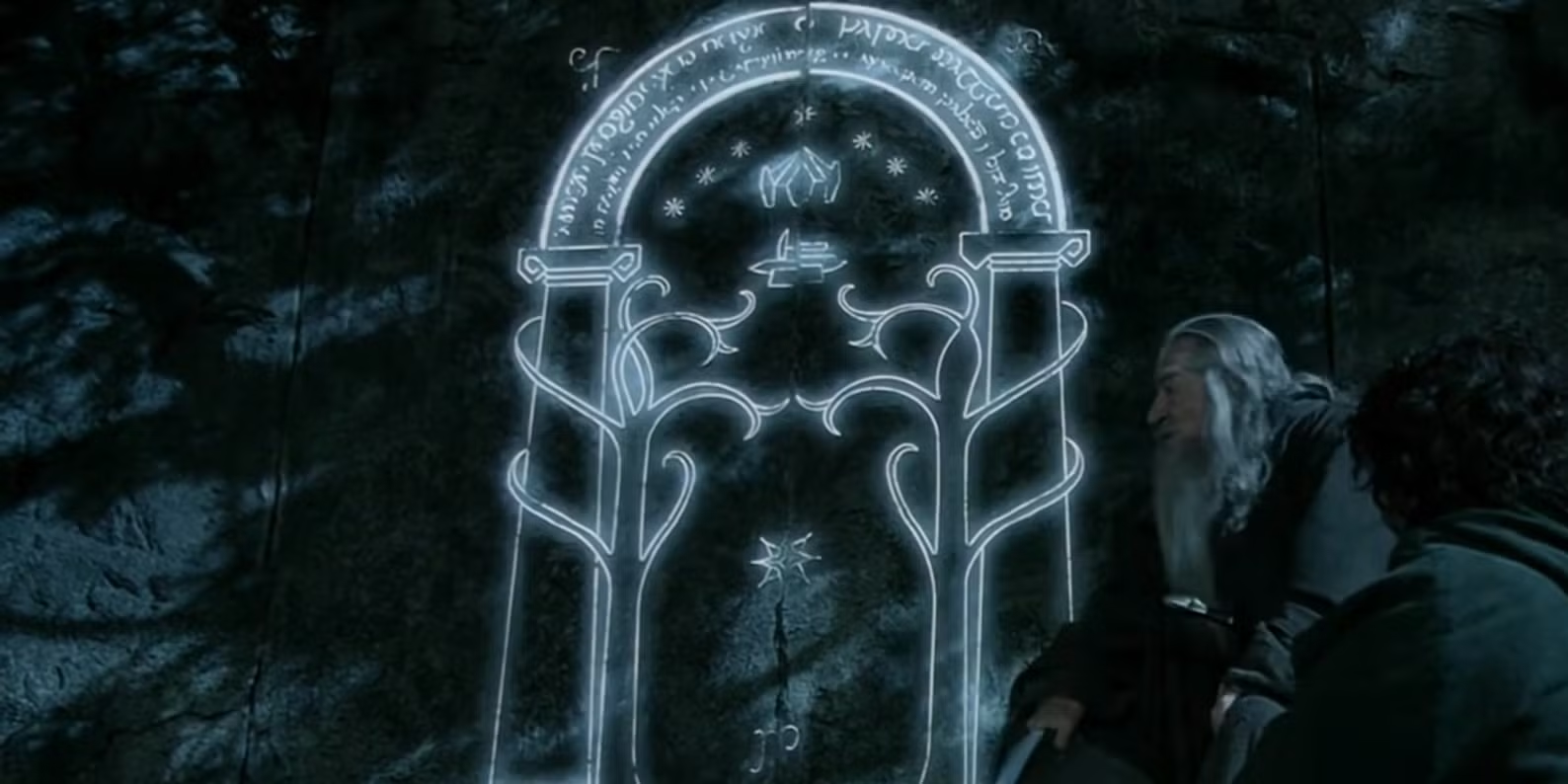
We find the same connection in the Song of Durin. Gimli remembers ancient Khazad-dûm lit by “the light of sun and star and moon / In shining lamps of crystal hewn.” Tolkien does not explain what those lamps actually did, and the lines are poetry rather than a technical description, but the image is striking: even beneath the mountain, the Dwarves remembered their greatest halls in terms of the lights of the sky.
Set these side by side and a pattern begins to appear. The moon-letters, the keyhole and the calendar are all fixed to the Sun, the Moon and the seasons. The ithildin answers to starlight and moonlight, but to starlight in general, not to any named star. In Tolkien’s surviving descriptions, none of the Dwarvish mechanisms that depend on the heavens is keyed to the position of a particular star. That is a small body of evidence, so the absence should not be pushed too far, but it is worth testing against the astronomy.
What keeps working
Tolkien treated Middle-earth as our own world in a remote past, and his estimates of how long ago it was do not quite agree, from about 6,000 years before his own day in 1958 to the longer chronology of a 1960 essay. Averaging them, as I did when reconstructing Durin’s Day, puts the Quest of Erebor in 7341 BCE, some nine thousand years before us.
Over such spans the sky changes, because the Earth’s axis wheels through a cycle of about 26,000 years. By 7341 BCE the heavens had turned roughly 130° from where we see them. The constellations kept their shapes, but they stood differently against the pole, the horizon and the seasons. By my rough calculation Polaris lay more than forty degrees from the pole, and no bright star marked it; the pole lay in Hercules. The stars also slip against the seasons at about a day every seventy years: a few days in a Dwarf’s lifetime, and some forty over the three thousand years of the Third Age.
I do not think the Dwarves chose their references to dodge this drift. A lunar calendar, a seasonal door and a moon-letter are keyed to the Moon and Sun because those are what they measure. But precession shows that the choice was also a durable one. A moon-letter does not wait for the Moon to stand at some fixed place among the stars. It waits for a particular phase at a particular season, and however many years pass those conditions still define the same key. A device that depended on a precise stellar position would gradually go out of alignment as the centuries passed.
A folk with long lives and archives spanning centuries would very likely have been particularly well placed to notice that the stars were slowly shifting. Tolkien does not say they did. If they did, it would only have confirmed the sense of keying their craft to phase and season, and it fits their habits of record.
What the stars are for
If Sun and Moon were the more dependable tools for calendrical and architectural reckoning, the stars could carry another kind of importance as well, and there is one place in Dwarvish tradition where they matter a great deal. The Crown of Durin is where Dwarvish identity and the stars meet most directly. In the Song of Durin, Gimli recalls how Durin the Deathless came to Kheled-zâram:
He stooped and looked in Mirrormere,
And saw a crown of stars appear…
The West-gate of Moria bears a crown with seven stars, together with the hammer and anvil Gimli recognises as Durin’s emblems. Tolkien’s own addition to the Lord of the Rings Index identifies those seven stars as the Plough (see the note at the end of the article for what that Index is and how much weight the note carries). A similar addition at Elendil gives the Palantír ships seven five-rayed stars on their sails, so seven stars were a recurring emblem among Men as well as Dwarves. In Tolkien’s earliest writings, the stars of the Great Bear were sparks escaping from Mahal’s (Aulë’s) forge, an idea later abandoned but a neat link between the Plough and the Dwarves’ own maker.
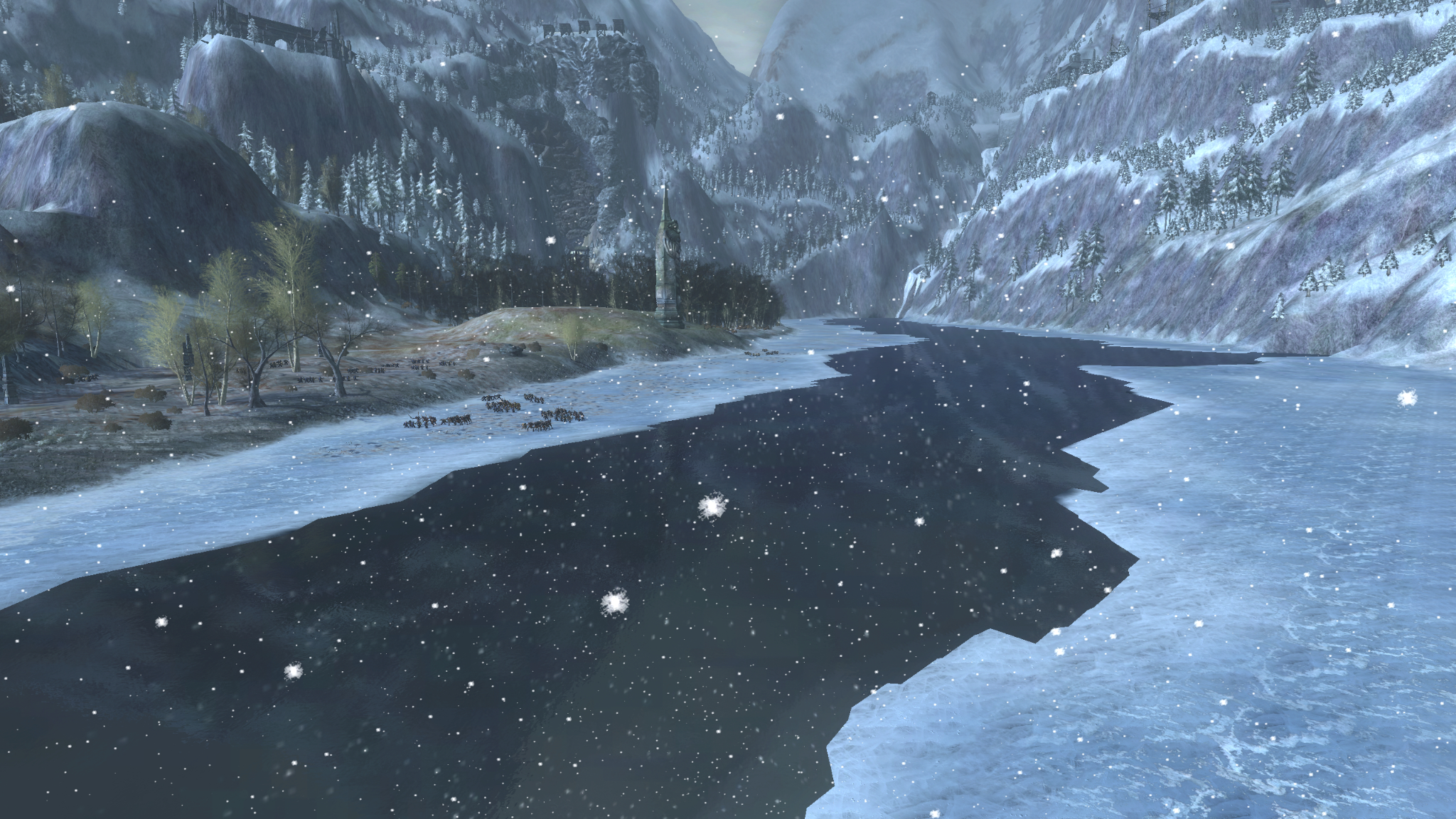
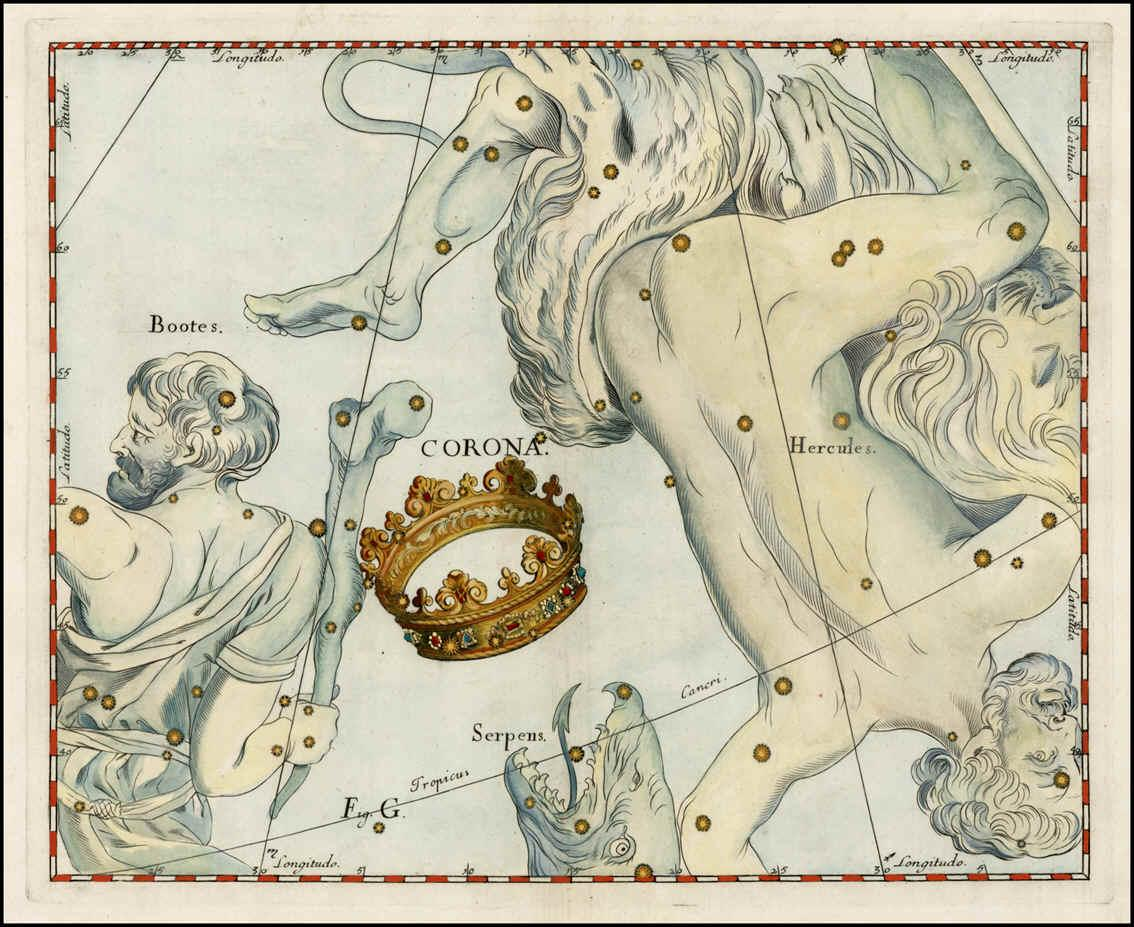
That note concerns the emblem, and it says nothing about the lake. In the 2012 article I favoured Corona Borealis for what Durin saw there, and it remains an attractive candidate, since its curved chain fits “gems upon a silver thread” far better than the Plough does. The two positions fit together once two questions are separated. Tolkien tells us which stars the emblem shows. He does not tell us what Durin saw, and the Mirrormere is no ordinary mirror: Gimli, Frodo and Sam see stars in its depths under a daylight sky, and no reflection of themselves. The Crown may be the seven stars, a supernatural manifestation of them, or something Tolkien never meant us to reduce to a constellation.
One consequence of the last section is, by my rough calculation, from the latitude of about 50.7° N where I place Khazad-dûm, that both Corona Borealis and the Plough were circumpolar at the time of the Quest. Corona Borealis circled the pole without setting, which it does not do today, and the Plough never set either, though its lowest stars dipped to within five to ten degrees of the horizon. Either way, the sign was always in the sky.
That suits the Crown’s role. It is not used to tell the time. It stands at the foundation of Khazad-dûm, and the Dwarves preserved its place: Durin’s Stone marks the exact spot where he looked into the water, and Gimli insists on visiting it even as the Fellowship flees Moria. It becomes heraldry, is remembered across the Ages, and is tied to the Dwarvish conviction that Durin will one day awake again. A symbolic constellation does not need to line up with a particular date. It can remain meaningful for thousands of years even though precession shifts where and when it appears in the sky. A door mechanism, however, has to work under a very specific astronomical condition, so timing really is vital here. So, as far as the evidence goes, the Dwarves clearly measured with the Sun and Moon and appear to have remembered with the stars.
A sign is not automatically an omen, of course. After the Company’s escape from the Elvenking’s halls, Thorin says they ought to “thank our stars and Mr. Baggins.” That may be nothing more than an ordinary English expression, though the phrase itself comes from the old idea that the stars can influence a person’s fortune. I would not build much on that one line, but neither would I rule Dwarvish astrology out. We already have a people who use the Moon to reckon time, preserve the memory of Durin through a crown of stars and build objects that respond to celestial conditions. It would hardly be surprising if they also attached meaning to particular stars or configurations in the sky. Tolkien simply does not tell us enough to know. The same caution applies to other named stars. No text I know of gives Eärendil’s Star a special place in Dwarvish tradition, but that does not mean it had none. The Dwarves lived alongside Elves and Men with extensive star-lore of their own, so there is plenty of room for traditions Tolkien never recorded.
The traditions behind Tolkien’s Dwarves
Tolkien’s Dwarves have two well-documented roots, and both touch on the sky. Neither is a source for their astronomy, but both show what he was working with.
The first is Norse. The names of Thorin, Durin, Dvalin and most of the Company of The Hobbit come from the Dvergatal, the catalogue of dwarves in Völuspá. In the Prose Edda, four dwarves named for the four directions, Austri, Vestri, Norðri and Suðri, are placed beneath the four corners of the sky. In Alvíssmál, a dwarf lists the names that different peoples give to the Sun, Moon and other parts of the world; among these dwarves of Norse legend the Sun is called “Dvalin’s toy” (some translators render it “deceiver of Dvalin”). Thor keeps Alvíss talking until dawn overtakes him, with the clear implication that daylight turns him to stone. Tolkien did not carry all this over. In The Hobbit it is his trolls who turn to stone in the Sun, while his Dwarves make a door that opens to it. The creature that dies in sunlight in the Edda has become one that puts sunlight to work.
The second root is Jewish. In Letter 176, written to Naomi Mitchison in 1955, Tolkien says he thinks of the Dwarves like the Jews, a people “native and alien” in their homes, speaking the language of the country with an accent from a private tongue. Khuzdul follows this, built on Semitic models, chiefly Hebrew. The comparison concerns their situation as a people in exile with a language of their own, and it has drawn serious criticism, notably Renée Vink’s study of anti-Semitic stereotyping in Tolkien Studies. I bring it up for one limited reason. The Jewish calendar is lunisolar, and in antiquity the beginning of months was established from observations of the new Moon, alongside an increasingly sophisticated system of calculation; over time calculation came to replace the observational procedure. A people whose traditional reckoning of time depends on the Moon, and who have lost part of the machinery that kept it, is not far from Thorin’s “in these days.” Tolkien never states that specific connection, but the parallel is unmistakable.
Durin’s Day
Durin’s Day has now appeared in three different roles: as a reckoning, as a name and as an event.
As a reckoning, it begins with the Dwarves’ New Year, the first day of the last moon of autumn, and becomes Durin’s Day when the young Moon and the Sun share the sky, so it is the sky used as an instrument. As a name, it belongs to Durin the Deathless, whose sign is a crown of stars, so it is the sky used as a symbol. As an event, it is the moment a door made by his people opens, so it is the sky used as a key. It is not a date that simply comes round. Whether the condition holds depends on where one stands, and at Erebor’s latitude it can fail altogether, as it does in 2026 on the reconstruction in my Durin’s Day article. The door waits for the condition, not for the calendar.
That is why Thorin’s confession is less bleak than it sounds. He says that it passes the skill of the Dwarves “in these days” to guess when such a day will come again, because simply counting the years would not tell them when the right combination of Moon, Sun and place would return. It has gone with the kingdoms that kept it. Khazad-dûm and Erebor are lost, and archives, specialists and the institutions that sustained them have vanished with the halls that housed them. On my reconstruction, the observer who fixed the calendar stood on Durin’s Tower, so losing Khazad-dûm would have cost the Dwarves their calendar’s observation point as well as their home. In that context, Thorin’s “in these days” may refer as much to lost institutions and knowledge as to lost skill.
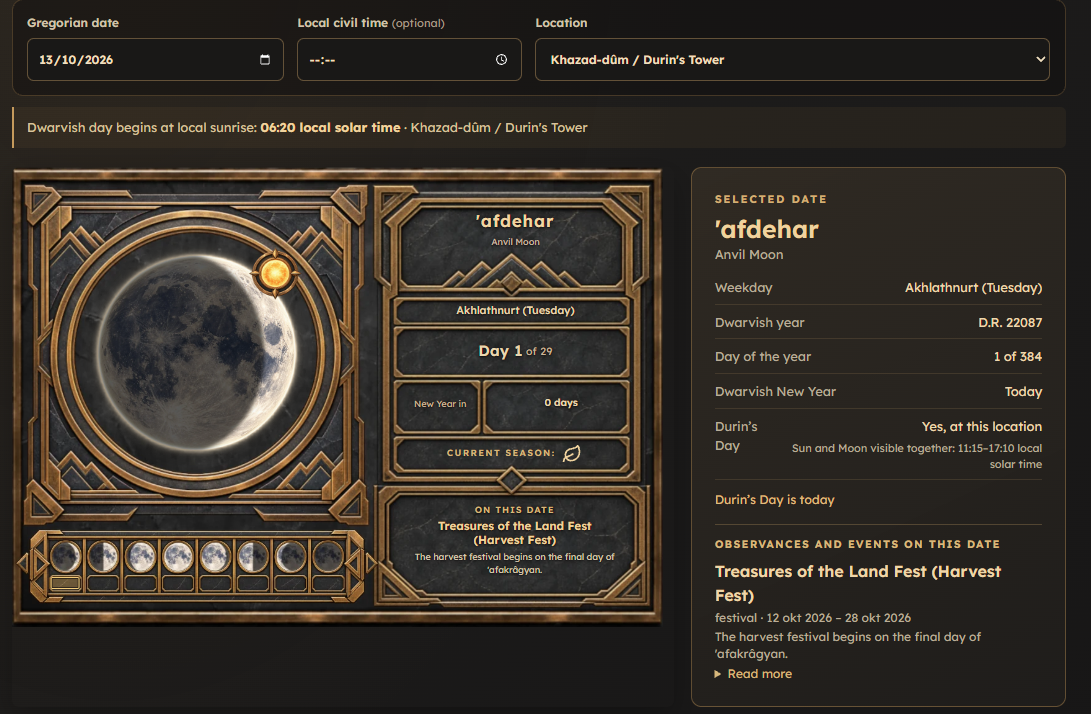
What survived, though, were the conditions built into the objects themselves. A moon-letter did not need anyone left alive who could calculate the right night; it simply waited for that night to return. The keyhole did the same with the setting Sun. Thorin could no longer predict Durin’s Day, and the Company waited for it on the mountainside. When the sky finally matched the old conditions, the work of his ancestors still answered to it.
Put all of these scattered references together, and I think we get a fairly clear picture of how Dwarvish astronomy may have worked. It was not only a matter of watching the sky, but of using what they understood about it in calendars, craft, architecture and tradition. What survives is scattered among the things the Dwarves made and remembered, while the kingdoms and institutions that might once have brought that knowledge together were lost.
For a people so strongly associated with mountains and underground halls, the Dwarves were clearly paying close attention to the sky. Tolkien leaves enough scattered pieces to show that the Sun, Moon and stars indeed had practical, symbolic and traditional importance in Dwarvish life.
A note on the Index
The Index to The Lord of the Rings was not compiled by Tolkien. The first, published in 1965, revised a list compiled by Nancy Smith in 1958 to Tolkien’s specifications, combined with an index of songs and verses by Baillie Klass. For the 1966 second edition, Tolkien added notes, translations and citations. In 2005 Wayne Hammond and Christina Scull compiled a new Index and kept Tolkien’s additions in square brackets. The Durin I entry therefore contains a bracketed note in Tolkien’s own voice: the emblem’s seven stars, each with eight rays, above a crown and anvil, represent the Plough.
The note is brief, but it is Tolkien’s identification, and it concerns the emblem, not the lake. The Encyclopedia of Arda says there is no direct evidence for the Plough, which suggests its authors were not working from the bracketed note.
References and further reading
Primary Tolkien sources
J.R.R. Tolkien, The Hobbit:
- Chapter III, “A Short Rest”: moon-letters; the requirement of the same Moon shape and season; the definition of Durin’s Day; “passes our skill in these days to guess.”
- Chapter X, “A Warm Welcome”: Thorin’s “thank our stars and Mr. Baggins.”
- Chapter XI, “On the Doorstep”: the setting Sun’s last light revealing the keyhole; the Company waiting at the hidden door.
J.R.R. Tolkien, The Lord of the Rings: The Fellowship of the Ring:
- Book II, Chapter IV, “A Journey in the Dark”: the Doors of Durin, ithildin and the Song of Durin.
- Book II, Chapter VI, “Lothlórien”: Gimli, Frodo and Sam looking into Kheled-zâram and seeing the Crown beneath a daylight sky.
J.R.R. Tolkien, The Lord of the Rings: The Two Towers:
- Book III, Chapter V, “The White Rider”: Gandalf’s account of the Endless Stair and Durin’s Tower on Zirakzigil.
J.R.R. Tolkien, The Lord of the Rings, Index, in Wayne G. Hammond and Christina Scull (comps.), 2005 edition: entries Durin I and Elendil, with Tolkien’s bracketed notes.
J.R.R. Tolkien, The Letters of J.R.R. Tolkien, Letter 176 (to Naomi Mitchison, 8 December 1955) and Letter 211 (to Rhona Beare, 14 October 1958).
J.R.R. Tolkien, “The Awaking of the Quendi”, in The Nature of Middle-earth, ed. Carl F. Hostetter (2021), Part One: “Time and Ageing”, VI.
J.R.R. Tolkien, Christopher Tolkien (ed.), The Peoples of Middle-earth, Part One, IX, “The Making of Appendix A”, (iv) “Durin’s Folk”, pp. 284–285, quoting the “Notes on Chronology of Durin’s Line,” for the average Dwarvish lifespan of about 250 years.
J.R.R. Tolkien, Christopher Tolkien (ed.), The Book of Lost Tales, Part One, “The Coming of the Elves and the Making of Kôr”, commentary on the early tradition of the Seven Stars and Aulë’s forge.
Norse sources
- Völuspá (the Dvergatal), Gylfaginning and Alvíssmál.
Secondary material
- Didier Willis, “La ‘Couronne de Durin’ à l’épreuve de l’archéoastronomie”, Tolkiendil. A detailed examination of the Crown of Durin, including earlier proposed identifications and Tolkien’s index reference to the Plough.
- Jorge Quiñonez and Ned Raggett, “Nólë i Meneldilo: Lore of the Astronomer”, Vinyar Tengwar 12, for discussion of astronomical identifications in Tolkien’s legendarium.
- Renée Vink, “‘Jewish’ Dwarves: Tolkien and Anti-Semitic Stereotyping,” Tolkien Studies 10 (2013): 123–145.
- The Encyclopedia of Arda, “Crown of Durin”, for an overview of the proposed identifications. The entry does not reflect Tolkien’s bracketed note in the Index.
- The Dwarrow Scholar, “Durin’s Day 2026: Finding the Last Moon of Autumn (… again)”, 30 September 2026, for the calendar reconstruction, the Khazad-dûm reference point and the dating of the Quest of Erebor used here.
- The Dwarrow Scholar, “Dwarven Astronomy”, 26 October 2012. The earlier article on which this one builds.


