Every autumn, the same question comes back around: when is Durin’s Day this year?
It sounds like it should have a simple answer: find the New Moon nearest the end of autumn, check a calendar, done. But Tolkien never gave us a fixed date. He gave us something to watch for in the sky, and over the years I’ve kept refining how I work that out, pulling together what Tolkien actually wrote, his own later notes on the story’s timeline, the older meaning of some of his key words, an Old English calendar tradition, and modern astronomy. This year I want to push that further still: not only asking a better question than “when’s the next New Moon” (when does the sky actually match what Tolkien describes?), but also settling on a consistent method I can simply re-run each year from now on, rather than re-litigating the whole argument every autumn.
What Tolkien actually tells us
Everything starts with Thorin’s line in The Hobbit:
“The first day of the Dwarves’ New Year is, as all should know, the first day of the last moon of Autumn on the threshold of Winter. We still call it Durin’s Day when the last moon of Autumn and the sun are in the sky together.”
That’s three separate claims packed into two sentences. The Dwarvish year begins on the first day of the last moon of autumn. That moon falls right at the edge of winter. And Durin’s Day is that New Year’s Day when the young Moon and the Sun are in the sky together. The little word “it” is doing a lot of work here: grammatically, “we still call it Durin’s Day” points back most naturally to the first day of the Dwarves’ New Year. So Durin’s Day is very likely not a second date that can simply arrive two or three days later (as I reasoned in earlier years). In the simplest reading, New Year’s Day either meets Thorin’s additional sky condition and is Durin’s Day, or it doesn’t.
A lot of people land on Encyclopedia of Arda’s Durin’s Day page looking for a quick answer, and it’s a genuinely useful resource. It neatly lists projected Dwarvish New Year dates stretching into the 2030s, giving 10 October for 2026, and it also distinguishes New Year from Durin’s Day. Its table answers a different part of the problem: which lunar cycle is relevant. What it doesn’t do is test the local observational condition in Thorin’s second sentence. That needs a separate visibility calculation.
What did Tolkien mean by “new moon”?
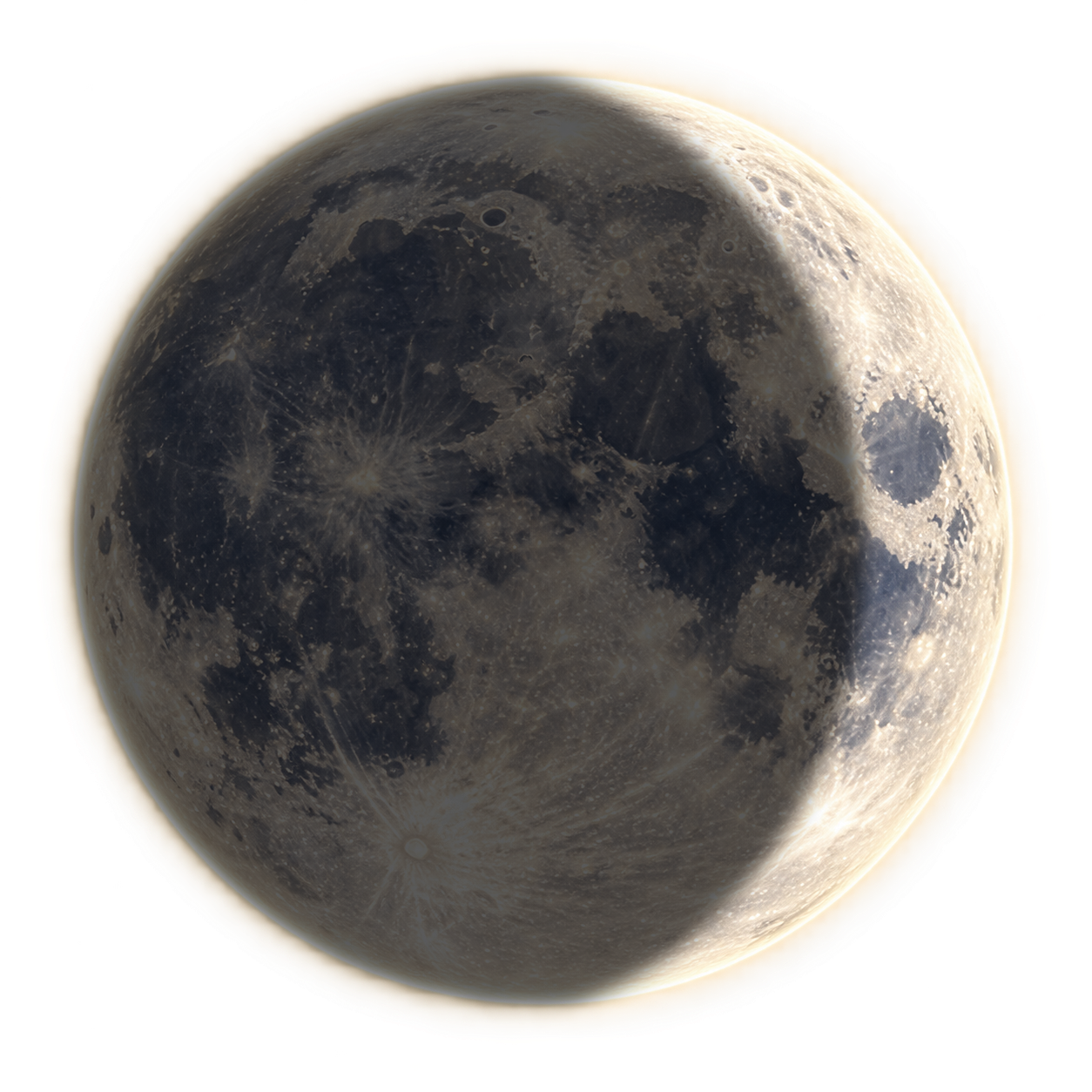
Today, “New Moon” has a very precise scientific meaning: the exact moment the Moon passes almost directly between Earth and the Sun, at which point it’s essentially invisible, its lit side facing away from us. But that’s a modern technical usage. The 1933 Oxford English Dictionary, a useful guide to the English Tolkien himself knew, also gives an older sense: the Moon “when first seen as a slender crescent shortly after conjunction.” In other words, “new moon” could mean the newly visible sliver, not merely the invisible instant beforehand.
Tolkien’s own writing backs this up. At the Doorstep, waiting outside Erebor, Bilbo sees “pale and faint… a thin new moon above the rim of Earth.” That’s a moon you can see. So there’s no reason to assume Tolkien’s “new moon” must mean the invisible astronomical conjunction. His own usage clearly includes the young, visible crescent.
For working this out, it helps to keep three things distinct: the astronomical conjunction, which is the mathematical start of a lunar cycle; the “new moon” in Tolkien’s older, visible sense; and whether that crescent is actually visible to the naked eye from a specific place at a specific time. These don’t necessarily fall on the same date, and mixing them up is where a lot of Durin’s Day calculations (including some of my own past ones) have gone wrong.
Calculation, not just watching the sky
Thorin says that working out when this will happen “passes our skill in these days to guess,” which suggests something closer to calculation than simply looking outside and hoping. We can calculate the Moon’s age, its distance from the Sun, its altitude, the Sun’s altitude, and when both bodies rise and set. The difficult part is visibility. A very young crescent can be geometrically above the horizon and still disappear into a bright sky. Sadly, there’s no reliable shortcut like “New Moon plus one day equals visible crescent.” The first genuinely visible crescent depends on exact geometry, the observer’s location and elevation, and atmospheric conditions. For a calendar, though, actual weather can’t be allowed to move the month from one day to the next, so the relevant question is when the crescent should be reliably visible to the naked eye under clear-sky conditions.
That last point changes how many treat the calculation of Durin’s Day. A young crescent doesn’t have to wait until sunset to become visible. Under favourable geometry it can be seen while the Sun is still well above the horizon. Thorin only says that Moon and Sun are “in the sky together”; he doesn’t say the Sun has to be setting.
Setting the seasonal boundary: when does “autumn” end?
Before we can find “the last moon of autumn,” we need a rough sense of where autumn ends and winter begins, something Tolkien never pins down explicitly.
One well-documented option comes from Anglo-Saxon England. The eighth-century monk Bede, in his work The Reckoning of Time, records an older seasonal reckoning that places the beginning of winter on 8 November. The Old English Menologium likewise marks the coming of winter in early November. Given that Tolkien spent his career immersed in Old English language and literature, this gives us a plausible historical backdrop for “the threshold of Winter.” His own prose also sits comfortably with a boundary later than 1 November: in The Lord of the Rings he describes 1 November as the “fag-end of autumn,” and elsewhere lets November pass with “the last shreds of autumn.”
So rather than treating 31 October/1 November as a hard modern line, as I did in previous years, I’m using 7 November, the last day before Bede’s 8 November boundary, as the working absolute edge of autumn for this reconstruction. Tolkien never states that date himself; it is, however, a verifiable, historically grounded working boundary.
Finding the right lunar cycle
With that boundary in place, the first question is which lunation supplies the last moon of autumn. In 2026, the relevant astronomical conjunctions are 10 October and 9 November. The November conjunction comes after the 7 November working boundary, so the October lunation is the one we’re interested in.
That does not automatically make 10 October the first day of the Dwarvish month. The conjunction simply tells us where the new lunar cycle begins astronomically. A conjunction is the moment when the Moon passes between the Earth and the Sun, with its illuminated side turned away from us, so the Moon is essentially invisible. Tolkien never tells us that the Dwarves began their month at that exact instant.
For this reconstruction, I therefore use the first visible crescent instead. Day 1 begins at sunrise on the first day when the young Moon should become reliably visible to the naked eye from the fixed calendar reference point at Khazad-dûm (more on that location later). This is a calculated date rather than one based on somebody actually spotting the Moon, so clouds or haze on the day do not change the calendar. We simply assume suitable clear skies.
There is one more complication: a crescent can be above the horizon and still be too faint to see. A very young Moon can disappear into the brightness of the surrounding sky. So the calculation does not just ask, “Is the Moon up?” It also considers how high the Moon is, how high the Sun is, how much of the crescent is illuminated, and the observer’s elevation. Together, those factors tell us when the new crescent should actually become visible to the naked eye.
For this reconstruction I use the Özlem visibility criterion at its 50% probability level. The Özlem criterion is a mathematical model designed to estimate whether a very young crescent should actually be detectable by the naked eye under favourable conditions, rather than merely whether the Moon is physically above the horizon. It’s particularly useful here because it can also model crescent visibility while the Sun is still above the horizon, exactly the sort of situation Durin’s Day may require.
In simple terms, the calculation asks whether the crescent has developed enough, and stands sufficiently clear of the Sun’s glare, that a person with good eyesight could realistically pick it out without binoculars or a telescope.
There’s also a particularly Dwarvish consideration here. Tolkien gives us a small but useful clue in The Hobbit: Thorin remarks that his eyesight is no longer what it was a hundred years earlier, while Fíli, the youngest member of the Company, is specifically said to have the best sight. So although we don’t know how Dwarvish astronomers actually organised such observations, it seems quite reasonable to imagine younger Dwarves with sharper eyesight being used to confirm the first sighting of an exceptionally faint crescent, especially if the senior astronomers were considerably older. That last detail is reconstruction rather than something Tolkien tells us directly, but it fits the evidence rather neatly.
Does the Sun have to be setting?
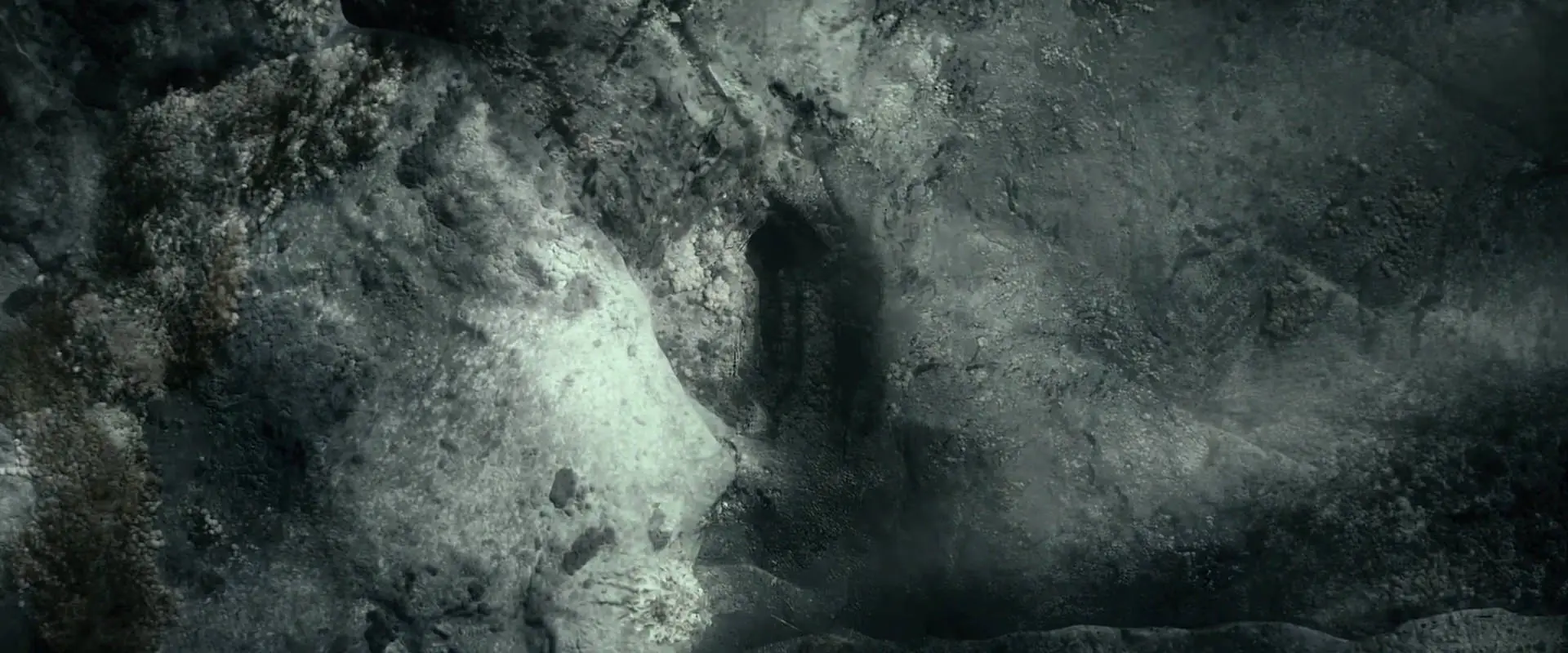
The Doorstep scene is wonderfully specific: the Sun is sinking in the west, a thin new Moon is visible above the horizon, and the last light reveals the keyhole. That scene gives us one vivid example of Sun and Moon sharing the sky. It doesn’t, however, add “at sunset” to Thorin’s definition of Durin’s Day.
The definition itself is broader: the last moon of autumn and the Sun must be in the sky together. If a sufficiently young crescent is genuinely visible at two o’clock in the afternoon while the Sun is also above the horizon, the words themselves don’t exclude it. This is an additional test for Durin’s Day, though, not the rule that starts every Dwarvish month. A month can begin on a day when the crescent first becomes visible only after sunset; that New Year would simply not qualify as Durin’s Day at that location.
That difference sounds small, but mathematically it is anything but. The month-start calculation asks whether the young crescent becomes reliably visible at any point during the candidate Dwarvish civil day at the fixed calendar reference point. The Durin’s Day calculation asks the narrower, local question: on that same New Year’s Day, is there also a sustained period when the crescent is visible while the Sun is above the horizon?
Where to watch from
Khazad-dûm as the calendar reference. For the reconstructed calendar itself, I’m using Khazad-dûm, specifically the tradition of observing from Durin’s Tower on Zirakzigil, as the fixed astronomical reference.
The height is not a trivial thing, because crescent visibility is affected by the observer’s elevation. From higher ground you’re looking through less of the dense lower atmosphere, with generally less haze and scattered sunlight obscuring an extremely faint crescent, and the visible horizon is slightly extended. In other words, placing the observer high on Zirakzigil isn’t simply a bit of Dwarvish flavour; it actually changes the astronomical visibility calculation.
We obviously can’t go to Khazad-dûm or climb Durin’s Tower to make the observation ourselves. What we can do is estimate where Khazad-dûm would fall on a real-world map if Tolkien’s map of Middle-earth is overlaid onto Europe. Tolkien left us several geographical clues linking places in Middle-earth with real-world latitudes and regions, including Hobbiton and Oxford, Minas Tirith and the latitude of Ravenna with its position further east towards the Balkans, and southern reference points around Umbar and Jerusalem. These don’t line up perfectly if any one of them is treated as an exact fixed coordinate, so I use them as control points for a best-fit overlay rather than forcing Middle-earth onto Europe at a single point.
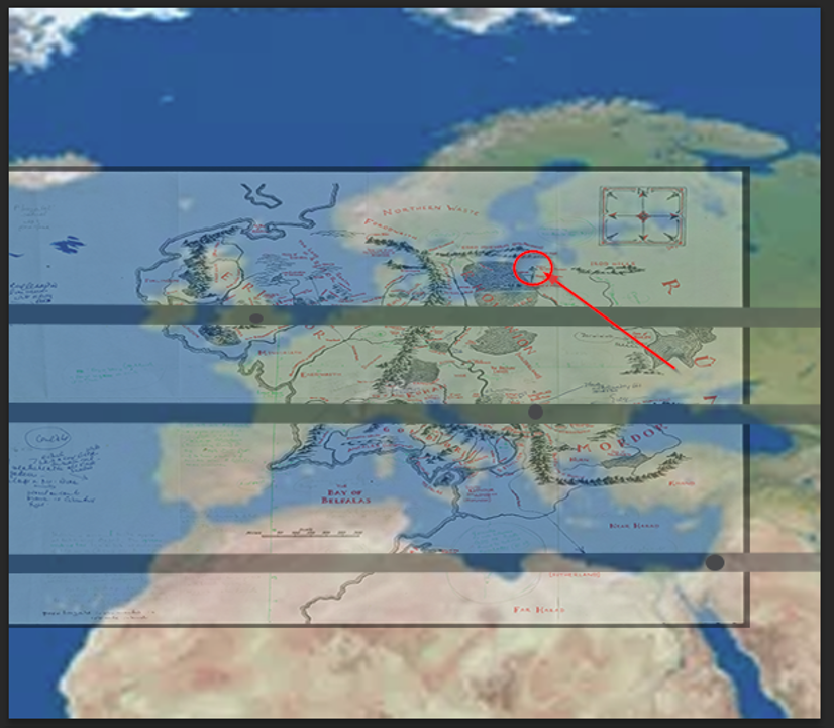
On that reconstruction, Khazad-dûm falls at approximately 50.7° N, 10.6° E, around Steinbach-Hallenberg in Thüringen, Germany.
For the observing height, I use a reconstructed elevation of about 4,384 metres: roughly 4,334 metres for Zirakzigil itself, about 1,000 metres lower than Barazinbar, with another 50 metres allowed for Durin’s Tower. Tolkien never gives us these measurements, so both the precise location and the elevation are reconstruction rather than canon. What they give us is a consistent real-world reference point from which the astronomical calculations can actually be made.
Tolkien also never gives us a formal rule for calculating the beginning of a Dwarvish month; that too is part of the reconstruction. From this one fixed reference point, the calendar predicts the first civil day on which each young crescent should be reliably visible. That fixes the common Dwarvish month starts, and therefore the Dwarvish New Year, for everyone.
Erebor as the comparison. Erebor remains the most important comparison because it’s where Tolkien’s Doorstep scene actually takes place. The same best-fit map reconstruction places Erebor at approximately 56.51° N, 21.01° E, on the Latvian Baltic coast.
That deserves a little clarification, because some overlays place Erebor further south, in northern Poland. You get that result if Hobbiton is pinned directly to Oxford and Minas Tirith directly to the Belgrade point on a modern European map. Tolkien’s geographical clues don’t all line up perfectly that way, however: Umbar also has to sit around Jerusalem’s latitude, and those reference points can’t all be made exact at once without distorting the overlay. I therefore use a best-fit alignment across the available markers rather than forcing any single pair to coincide exactly. On that fit, the Minas Tirith marker ends up several hundred miles from literal Belgrade on the overlapping European map. Carried through the rest of the reconstruction, Erebor falls at Liepāja, Latvia and Khazad-dûm around Steinbach-Hallenberg in Thüringen.
These are obviously reconstructed observation points, not modern coordinates Tolkien himself assigned to either place.
One calendar, many skies
This gives us one shared Dwarvish calendar but many possible skies. The date of the Dwarvish New Year is fixed from the Khazad-dûm reference point and is common to everyone.
Durin’s Day visibility, however, is local. A New Year’s Day that qualifies as Durin’s Day at Khazad-dûm doesn’t automatically qualify at Erebor, or anywhere else. The calendar date is shared; whether the Sun and the young Moon are actually visible together on that day depends on the observer’s location.
Following the Moon through October 2026
The astronomical conjunction falls on 10 October 2026. At that point the Moon is effectively invisible, so 10 October is an astronomical anchor rather than automatically Day 1 of the Dwarvish month.
11 October is still too early. Under the adopted clear-sky naked-eye visibility test, the crescent doesn’t reach the threshold at the Khazad-dûm reference point, so it can’t be Day 1.
12 October is the critical date. By then the Moon is about 3–4% illuminated, so at first glance it might seem old enough to count. But illumination alone is not enough. We need to know whether that thin crescent would actually stand out against the bright sky. Using the Özlem extended crescent-visibility criterion, with P = 50 (the model’s 50% visibility setting), the best result reached at the Khazad-dûm reference point is about 2.14. To qualify, it needs to reach 3.9, so the crescent still falls well short. I also checked it with the Odeh visibility criterion, a widely used method for estimating whether a young crescent should be visible to the naked eye around sunset. Odeh looks mainly at the Moon’s position relative to the Sun and horizon. It is less useful for Durin’s Day itself because the Özlem model can also test visibility while the Sun is still above the horizon, but it makes a useful second check here. Both methods point to the same conclusion: on 12 October the crescent is still not reliably visible to the naked eye, so it does not begin the Dwarvish month.
13 October is different. The crescent has developed enough for the extended visibility model to cross the adopted threshold at Khazad-dûm at about 10:43 UTC, and it remains above that threshold for hours. At the first qualifying point the Moon is roughly 8.1% illuminated and about 8.7° above the horizon, while the Sun is still around 31° high. That makes 13 October the first civil day on which the young crescent is predicted to be reliably visible from the fixed calendar reference point. Under this reconstruction, Tuesday 13 October 2026 is the Dwarvish New Year’s Day.
Only after fixing that date do we ask whether it’s also Durin’s Day. At Khazad-dûm the answer is yes, and not merely because of a narrow sunset overlap: when the crescent first clears the adopted visibility threshold, the Sun is still high in the sky, and the model leaves several hours in which both are simultaneously above the horizon and the Moon remains visible. So at Khazad-dûm’s location, 13 October 2026 is both Dwarvish New Year’s Day and Durin’s Day.
One calendar, local Durin’s Day
There are two different questions here, but they shouldn’t be turned into two different calendar dates. The Dwarvish New Year is the first day of the last moon of autumn. Durin’s Day is that same New Year’s Day when the additional Sun-and-visible-Moon condition is met.
This also corrects the way I described the relationship in earlier articles. I previously treated the Dwarvish New Year and Durin’s Day as potentially consecutive festival days: first New Year, then Durin’s Day once the young Moon could be seen with the Sun. I no longer think Tolkien’s wording lets us state that so confidently, and I want to correct it here. Thorin says that the first day of the New Year is the first day of the last moon of autumn, and then says “we still call it Durin’s Day” when that moon and the Sun are in the sky together. The simplest reading is that Durin’s Day is a special name for New Year’s Day when the additional astronomical condition is fulfilled, not a second day that automatically follows it.
That distinction gives us a particularly useful 2026 example. The shared Dwarvish New Year begins on 13 October, because that is the first day on which the young crescent reaches the calendar’s visibility threshold at Khazad-dûm. There, the additional requirement for Durin’s Day is also met: the crescent becomes visible while the Sun is still above the horizon. So at Khazad-dûm, New Year’s Day is also Durin’s Day.
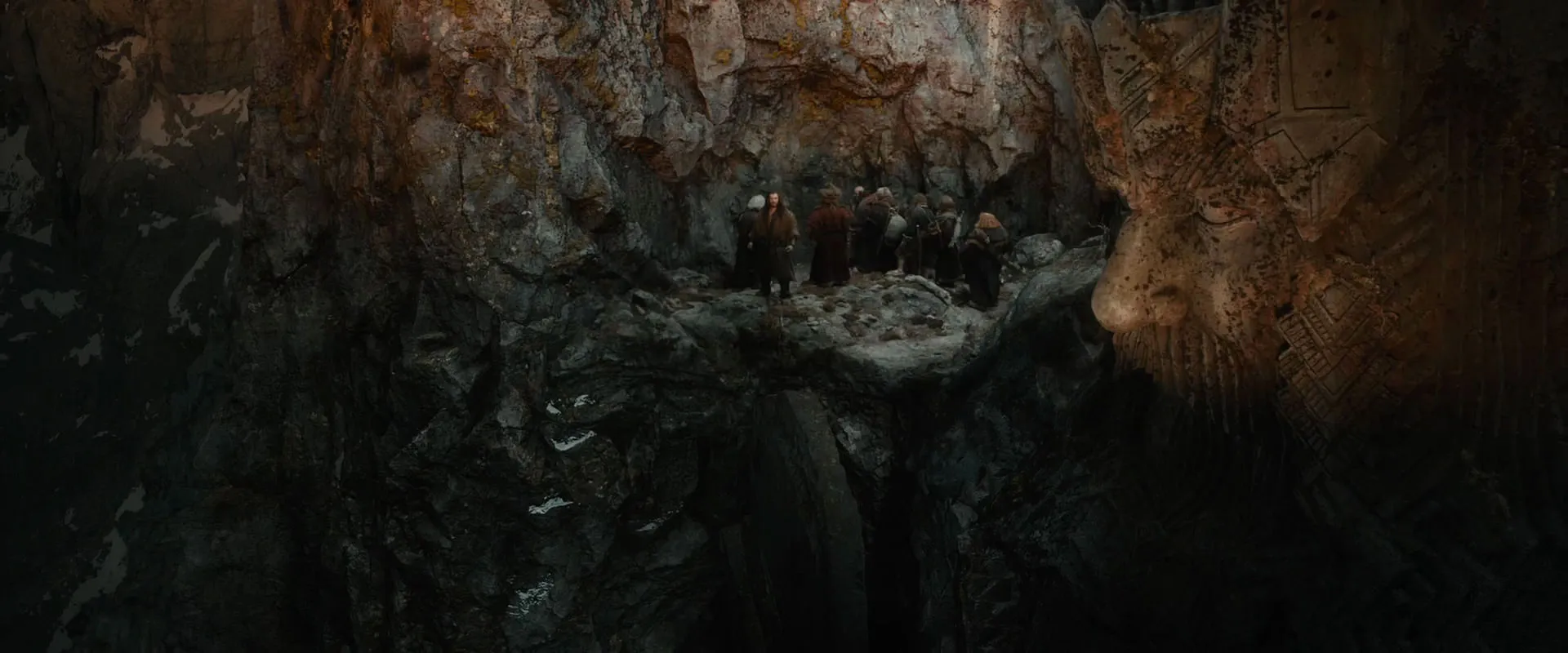
Erebor is different, largely because it lies farther north. At northern latitudes in autumn, a young crescent tends to remain lower in the sky, making it harder to see against daylight while the Sun is still above the horizon. In general, the farther north we move, the less often those two conditions line up well enough for Durin’s Day. At latitudes comparable to Iceland or Alaska, several years can pass without a qualifying New Year at all. For Erebor itself, using a reconstructed observation height of 2,000 metres, the best result on 13 October reaches about 3.51 on the adopted P = 50 visibility test, short of the required 3.9. In simple terms, the crescent is there, but it is still not quite strong enough against the daylight sky to count as reliably visible. Tolkien never gives us Erebor’s exact height, and modern reconstructions vary, so 2,000 metres is only a reasonable working estimate rather than a canonical figure. If we instead test from the nearby real-world comparison point of Liepāja at sea level, the result drops further, to about 2.15. By 14 October the crescent is much easier to see at Erebor, but that does not move Durin’s Day forward by a day. New Year’s Day was already the 13th. Under this reconstruction, Erebor therefore simply does not experience Durin’s Day in 2026.
| Dwarvish New Year | Durin’s Day | |
|---|---|---|
| What it is | The first day of the last moon of autumn | That same New Year’s Day when the visible young Moon and Sun share the sky |
| Calendar trigger | First reliably visible young crescent at the fixed calendar reference | No separate calendar trigger |
| Local condition | None, the date is universal | Young crescent genuinely visible while the Sun is above the horizon, at the observation location |
| 2026 date | Tuesday, 13 October 2026 | 13 October at Khazad-dûm; Erebor does not qualify that year under the adopted threshold |
| What 10 October is | The invisible astronomical conjunction, the lunar anchor | Not Durin’s Day nor the Dwarvish New Year on its own |
What about Tolkien’s own 19 October?
In his later, unfinished attempt to bring The Hobbit‘s timeline into line with The Lord of the Rings, published in The History of the Hobbit, Tolkien himself placed that story’s Durin’s Day on 19 October. That doesn’t make 19 October a fixed annual date (a lunar event necessarily drifts against the solar calendar from year to year), but it’s useful evidence that Tolkien imagined the event in October. The chronology was never fully resolved, so I’d treat the date as evidence for his conception rather than a rule that can simply be carried over to 2026.
How confident should you be in 13 October 2026?
Within the reconstruction set out here, 13 October is the clear result for the Dwarvish New Year. The date follows from a stated chain of assumptions rather than from a surviving Tolkien calendar: the October lunation is selected by the 7 November working seasonal boundary; month Day 1 is the first civil day on which a young crescent is predicted to be reliably naked-eye visible, through scientific measurement, at the fixed Khazad-dûm reference point; and the adopted visibility threshold is then applied consistently across the candidate dates. On those terms, 11 and 12 October simply fail and 13 October qualifies.
Durin’s Day is the local second step, not a second date. On that already-fixed New Year’s Day, Khazad-dûm qualifies comfortably, because the crescent is visible while the Sun is still well above the horizon. Erebor doesn’t quite qualify under the same standard. So the most precise 2026 conclusion isn’t simply “Durin’s Day is 13 October everywhere,” but: the Dwarvish New Year begins on 13 October 2026; at Khazad-dûm that New Year’s Day is also Durin’s Day, while at Erebor it isn’t.
An Interactive Dwarvish Calendar
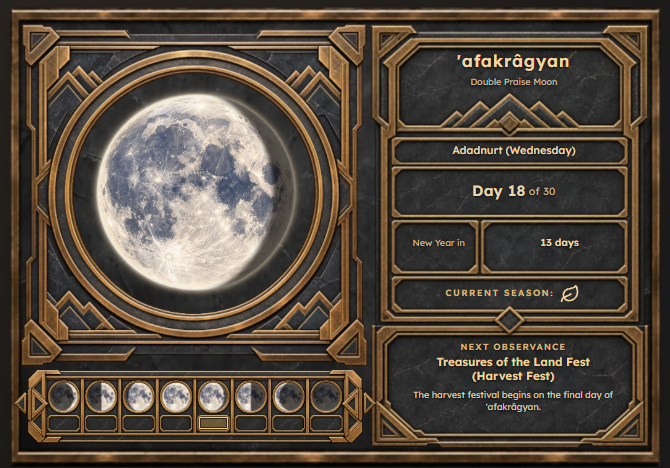
A calculation with this many moving parts deserves something better than one long post a year, which is why I’ve built a detailed interactive Dwarvish Calendar for the site. Behind it sits a large precomputed astronomical dataset covering the Dwarvish months, New Year dates, Moon phases, sunrise times and local crescent-visibility results. It means you can choose a date and location and let the calendar do all of the awkward astronomical work behind the scenes.
But it has grown into rather more than a Durin’s Day calculator. You can explore the full Dwarvish year, move through its lunar months, seasons, festivals and observances (some worldbuilding there on my part), convert between Gregorian and Dwarvish dates, and even work with reconstructed Middle-earth dates and Dwarvish Reckoning. The calendar also accounts for the sunrise-to-sunrise Dwarvish day, including the change of date before local sunrise.
Durin’s Day obviously remains one of its main features. The calendar keeps the shared Dwarvish New Year separate from the local Durin’s Day test, so the same New Year can be checked from Khazad-dûm, Erebor and a large selection of real-world locations. It will tell you whether the selected day qualifies there and how long remains until the next qualifying Durin’s Day, rather than pretending that everyone beneath a different sky sees the same thing.
There is also an accompanying FAQ explaining the reconstruction and the choices behind it, including why the calendar uses a visible crescent, why autumn ends where it does in this system, and why Durin’s Day can occur at one location but not another.
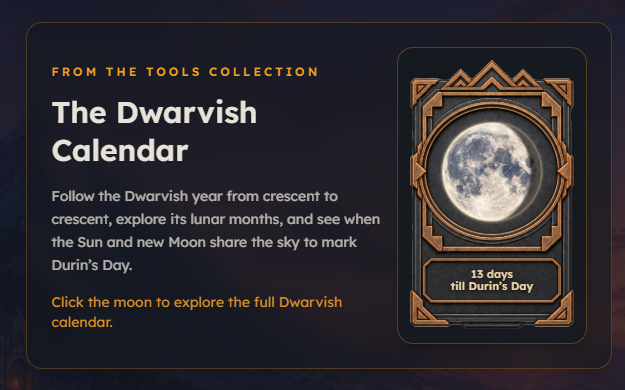
You’ll find it on the homepage at www.dwarrowscholar.com: click the mini-tool moon to open the full calendar tool, which also includes the FAQ explaining the reconstruction and how Durin’s Day is determined.
Watching it yourself
If you want to watch the 2026 event yourself, use the Dwarvish Calendar first, that is exactly what the location check is there for. Select your own location and see whether 13 October qualifies there, rather than assuming your sky will match Khazad-dûm. Daylight crescent visibility is strongly location-dependent, and even Erebor fails the adopted threshold that day.
If your location does qualify, there is also no need to wait for the final minutes before sunset. Thorin’s definition only requires the young Moon to be genuinely visible while the Sun is also in the sky. Depending on latitude, elevation and geometry, the strongest viewing window may begin much earlier in the day.
One safety point though: never use binoculars, a telescope or any other optical aid to search for the crescent while the Sun is above the horizon. Accidental solar viewing is real and can cause permanent eye damage. If attempting the observation before sunset, look only with the unaided eye and take care never to look directly at the Sun.
A closing thought
Tolkien did not leave us a modern astronomical algorithm. He left us a rather baffling phenomenon and very little about how the Dwarves actually reckoned it. For this reconstruction, I have therefore used one consistent rule: Day 1 is the first civil day on which the young crescent should be reliably visible from the fixed Khazad-dûm reference point.
For 2026, that rule gives us the result already discussed: the Dwarvish New Year begins on 13 October. At Khazad-dûm that same day also qualifies as Durin’s Day; at Erebor (or other real-world locations at that lattitude or further North) it does not.
Placing that day within a wider Dwarvish chronology needs a word of explanation first, or the year number that follows will look like it’s been pulled out of thin air. Alongside the lunar calendar, I use a separate, continuous Dwarven Reckoning (D.R.), a Dwarvish counterpart to Tolkien’s own F.A., S.A. and T.A., beginning roughly with the creation of Durin and running forward into our own time. Anchoring that reckoning to the present day means estimating how much time separates us from the events of The Lord of the Rings, something Tolkien himself commented on more than once, with slightly different figures each time. Rather than picking whichever figure suited the result best, I used an average across them. On that basis, 13 October 2026 opens D.R. 22087, and the Quest of Erebor, T.A. 2941, falls in 7341 BCE.
There was, however, one final test I wanted to make. If the same lunar rules used for 2026 are applied to 7341 BCE, when would the Dwarvish New Year fall?
The answer is: 19 October 7341 BCE.
That is striking because 19 October is also the exact date Tolkien later gave for Durin’s Day in his revised chronology of The Hobbit. The two parts of the reconstruction were worked out independently: one from Tolkien’s comments about elapsed time, the other from lunar visibility at Khazad-dûm. Neither calculation was designed to produce 19 October.
A lunar cycle is about 29½ days long, so as a very rough comparison, landing on one particular date is of the order of one chance in thirty. That is not a formal probability that the reconstruction is correct, and it certainly does not prove Tolkien made the same calculation. The chronology itself is approximate, and the lunar dates are constrained by real astronomy rather than random chance. Even so, the exact match is difficult not to enjoy.
The main result for 2026 stands on its own regardless: the Dwarvish New Year begins on 13 October, opening D.R. 22087. At Khazad-dûm it is also Durin’s Day; at Erebor it is not. That the same reconstruction, carried back across more than nine thousand years by an entirely separate route, lands on Tolkien’s own 19 October proves nothing by itself. But it’s exactly the kind of coincidence that makes a reconstruction like this worth doing at all.
Lastly, a small word of thanks to Atanalcar, whose email following last year’s Durin’s Day article brought several older pieces back to mind and helped push this reconstruction towards a clearer final direction.
Êrâs nar gêdul! Nurt Durinul gêdul!
Ever at your service,
The Dwarrow Scholar
References
Primary sources
- Tolkien, J.R.R. The Hobbit. 1937.
- Tolkien, J.R.R. The Lord of the Rings. 1954–55.
- Rateliff, John D., ed. The History of the Hobbit (incorporating J.R.R. Tolkien’s later, unfinished chronological revisions). HarperCollins, 2007.
- Tolkien’s annotated map of Middle-earth for illustrator Pauline Baynes, held in the Bodleian Libraries collection: source for the Hobbiton/Oxford, Minas Tirith/Ravenna, and Jerusalem/Umbar/Cyprus latitude clues.
Historical and linguistic sources
- The Oxford English Dictionary, 1933 edition, vol. 7: entry for “new moon.”
- Bede. De Temporum Ratione (“The Reckoning of Time”). 8th century.
- The Old English Menologium (prose and verse).
Reference and community sources
- Encyclopedia of Arda, “Durin’s Day”: encyclopedia-of-arda.com/d/durinsday.html
- Tolkien Gateway, “Durin’s Day”
Astronomical method
- Odeh, M. Sh. “New Criterion for Lunar Crescent Visibility.” Experimental Astronomy 18 (2004): 39–64.
- Özlem, A. “A Simplified Crescent Visibility Criterion.” 2014.


Pingback: The Dwarrow Calendar | The Dwarrow Scholar
Pingback: Happy New Year… on October 15th!?! | The Dwarrow Scholar
Pingback: Is Durin’s Day upon us ? | The Dwarrow Scholar
Pingback: Dwarvish Astronomy: Under Stone, Under Stars | The Dwarrow Scholar