What Dwarvish speech in the Common Tongue may reveal about Khuzdul
Introduction
Tolkien gives us no extended dialogue in Khuzdul itself. What survives is a small collection of words, names and short expressions. Most of what we actually hear from Dwarves is in the Common Tongue. So, at first glance, there seems to be very little we can use to say anything about how Khuzdul functioned socially, how Dwarves were polite in it, or how they used it in more formal situations.
Appendix F tells us that Khuzdul had become a ‘tongue of lore rather than a cradle-speech’, carefully preserved and guarded as a treasure of the past. Tolkien is more specific elsewhere. In ‘Of Dwarves and Men’, an essay published in The Peoples of Middle-earth, he says that among the Longbeard Dwarves of the West it had ceased to be their native tongue and had become a ‘book-language’, taught deliberately to their children from an early age.
So Thorin, Gimli and other Longbeard Dwarves of the Third Age should not be treated as native Khuzdul speakers whose Westron simply shows traces of their first language. For the Longbeards, and likely the Firebeards and Broadbeams too, Khuzdul had become something different: a guarded language of lore, identity and tradition. The question then becomes whether that language could still influence the way Dwarves spoke in the Common Tongue. I think the answer is yes. The words may be Common Tongue, but some of the formulas, metaphors and habits behind them may still come from Khuzdul, or from the Dwarvish culture that preserved it.
1. Can Khuzdul Show Through the Common Tongue?
1.1 A real-world parallel: diglossia
There is a useful real-world comparison for this: diglossia. In simple terms, this is what happens when a community uses one form of speech for ordinary daily life and keeps another, more highly valued form for formal, literary, religious or traditional use. The term was developed in its modern linguistic sense by Charles A. Ferguson, an American linguist who studied how communities use different forms of language in different social settings. In his classic 1959 study, he described situations where people use an everyday spoken variety for ordinary conversation, while a more formal and highly valued variety is learned alongside it and used for writing, ceremony, education or other specialised purposes. He called these two roles High and Low, though these labels refer to function, not worth. The everyday language is not ‘lesser’; it simply does a different job.
Ferguson originally applied the idea to different varieties of the same language. Khuzdul and Westron are obviously not that. Joshua Fishman, an American sociolinguist best known for his work on multilingual communities, later broadened the idea to include communities where two separate languages fill those different roles (Fishman 1967). That wider version is a much better comparison for Tolkien’s Longbeard Dwarves*: a Mannish language used in everyday life alongside Khuzdul, deliberately taught and preserved for lore, identity and guarded use among Dwarves themselves.
Diglossia is only part of the picture, however. The Longbeard situation also reflects language shift: Mannish speech had become the everyday vernacular, while Khuzdul was deliberately maintained as an ancestral language of lore.
There is another useful point in Ferguson’s work. He notes that expressions associated with the more formal variety, including proverbs and politeness formulas, can still appear inside otherwise ordinary conversation (Ferguson 1959). So a language does not have to be spoken all day, every day, to leave traces in how people speak at particular moments. That gives us a useful real-world parallel for the possibility that certain Dwarvish formulas or ways of speaking might survive in the Common Tongue even though Khuzdul was no longer the everyday mother tongue of the western Dwarves considered here.
Influence of that kind is often called pragmatic transfer: habits of politeness, social meaning or appropriate expression associated with one language influencing how another language is used.
The discussion below also draws loosely on ideas from Penelope Brown and Stephen Levinson, two linguists whose influential work on politeness examined how speakers soften requests, avoid offence, show deference and protect another person’s social standing (Brown & Levinson 1987). Their insights are useful for describing some of the Dwarvish behaviour we see, even though the Dwarves themselves clearly do not fit neatly into any single real-world model.
Tolkien’s Dwarves are not a perfect copy of any real diglossic community. Khuzdul is far more secret than most prestige or formal languages, and its special status is directed inward rather than towards the whole society. Even so, the basic pattern is very similar: an everyday Mannish language on one side, and an inherited language kept alive by tradition, identity and circumstance on the other.
* A note on “Khuzdul as a language of lore”
Throughout this article I refer to Khuzdul as a language of lore rather than an everyday cradle-speech. This should be understood primarily as a description of the linguistic situation among the Longbeards in the later Third Age, not necessarily as a condition shared by every Dwarven clan throughout their history.
For the Longbeards, this shift had likely taken place by the period following the loss of Khazad-dûm, and certainly seems to fit the increasingly dispersed communities that followed the later loss of Erebor to Smaug. Living for generations among Mannish-speaking peoples would naturally have favoured the adoption of local Mannish languages for everyday use, while Khuzdul remained deliberately taught and preserved as a language of ancestry, identity and lore.
It is worth noting that this is not simply a modern sociolinguistic model imposed on Tolkien’s world after the fact. Tolkien invited the comparison himself. In a 1955 letter to Naomi Mitchison, he wrote that he thought of the Dwarves ‘like Jews’, ‘at once native and alien in their habitations’, speaking the language of wherever they lived while carrying the accent of a private tongue of their own. In a 1964 BBC radio interview he went further, saying that the Dwarves’ words are ‘Semitic, obviously, constructed to be Semitic’, and in a letter that same year to W. R. Matthews he described Khuzdul as ‘Semitic in cast, leaning phonetically to Hebrew’. Tolkien scholars, including John Rateliff, have connected this directly to the historical experience of the Jewish diaspora: a people scattered among other nations, fluent in the languages around them, yet privately preserving a language, a script and a body of lore of their own. The guarded, dispersed, lore-preserving Khuzdul described in this article is therefore not only a plausible sociolinguistic reconstruction; it appears to be very close to a comparison Tolkien himself made explicitly when discussing the Dwarves and their language.
The Firebeards and Broadbeams probably underwent much the same development. From the Second Age onward many of their people were living among, or closely alongside, Longbeard communities, making a similar linguistic outcome quite plausible.
The situation of the four eastern clans, however, may have been very different. They remained far removed from the western Dwarven centres and we know comparatively little about their linguistic history. There is no strong reason to assume that Khuzdul had ceased to function as an ordinary spoken or cradle language among them to the same extent. It is entirely possible, and indeed seems likely to me, that some eastern Dwarven communities preserved Khuzdul as a living everyday language.
Accordingly, references in this article to Khuzdul as a guarded language of lore should be read chiefly in the context of the western Dwarves, and especially the Longbeards, represented in Tolkien’s narratives.
There is also a practical limitation to the evidence used here: almost all the Dwarvish speech available to us comes from the western Dwarven communities represented by Thorin’s Company. Although Bifur, Bofur and Bombur were not of Durin’s line, they were descended from the Dwarves of Khazad-dûm and shared the same western Dwarvish environment. Their limited dialogue shows no obvious pragmatic contrast with the other members of the Company; indeed, they use some of the same courtesy conventions. Whatever linguistic habits survived among the four eastern clans remain almost entirely outside Tolkien’s narrative record.
1.2 What we are looking for
There are really two separate ideas in this article. The first is about how Dwarves speak in formal situations: their etiquette, fixed expressions, indirectness and the sort of wording they choose when respect or social standing is involved. Some of that may reflect habits connected with Khuzdul. The second is about vocabulary itself: words from mining, stone and craft may have developed wider, figurative meanings in Khuzdul simply because those ideas sit so close to the centre of Dwarvish culture. Diglossia helps us most with the first idea. The second comes mainly from the way Tolkien repeatedly lets Dwarves think and speak through the language of stone, mines, gems and craft.
There is also a noticeable pattern in where the strongest examples appear. They are not scattered through ordinary practical conversation. They turn up in ceremonial greetings, a formal letter, an audience with the Great Goblin, Gimli’s gift-exchange with Galadriel, and other moments of solemn praise, formality and guarded diplomacy.
That is exactly where we would expect an inherited formal tradition to show itself most clearly. It does not mean every unusual Westron phrase used by a Dwarf is a direct translation from Khuzdul. Some may simply belong to a recognisably Dwarvish way of speaking the Common Tongue. We cannot always separate the two. What we can do is look at the repeated pattern, the imagery involved, and the places where Tolkien himself tells us how a Dwarvish expression is meant to function.
It helps to keep three things separate:
- Khuzdul itself: a guarded Dwarvish language of lore and heritage, deliberately taught and only sparsely attested in Tolkien’s writings.
- Dwarvish social habits: how Dwarves show respect, frame requests, avoid offence, praise others, guard information and use familiar Dwarvish imagery. These habits do not have to belong to one language only.
- The Common Tongue: the everyday language through which we hear most Dwarven speech. In formal situations it may also carry formulas, images or habits inherited from Dwarvish tradition and perhaps from Khuzdul itself.
So the safest place to look is not at missing endings or syntax, but at the way Dwarves handle politeness, metaphor, restraint, secrecy and formal address.
2. Khuzdul as a Guarded Language of Lore
As mentioned earlier, Appendix F adds another important piece to the picture above: Khuzdul was not simply preserved, it was guarded. Tolkien says that very few outsiders ever learned it. The same secrecy surrounded Dwarvish personal names. Dwarves did not reveal their true inner names to outsiders, nor even carve them on their tombs. Gimli, like the other Dwarves we meet, is known to us by a Mannish name, not by his secret Khuzdul one.
Guardedness, then, is not something we need to invent for the Dwarves. Tolkien gives it to us directly. That does not prove that they also spoke indirectly about more delicate social matters like debt, hospitality or honour, but it gives that suggestion a clear cultural background: some culturally important things connected with identity and inherited knowledge are simply not exposed too plainly.
There is another useful detail. Gimli freely gives Khuzdul place-names such as Khazad-dûm and the mountain-names at the Redhorn Gate, while personal names remain secret. So Khuzdul is not simply either ‘secret’ or ‘public’. Some things can be shared and others cannot. I find that sort of selective use fits well with the idea of a language whose role changes with the situation.
3. Stone, Mining and Craft Do a Surprising Amount of Work
3.1 A likely hidden characteristic
For a people whose history, art, economy and identity are so closely tied to stone and craft, it would be surprising if the language of mining stayed only in the mine. Words for digging, cutting, striking, forging, ore, gems and depth could quite naturally pick up wider meanings over time.
Once that happens, the speaker may no longer think of the expression as a metaphor at all. A phrase that began in the mines can simply become the normal way to talk about all sorts of matters, like investigating something, finding the important part, recognising value, being precise, or failing to find anything worthwhile.
3.2 Tolkien’s examples
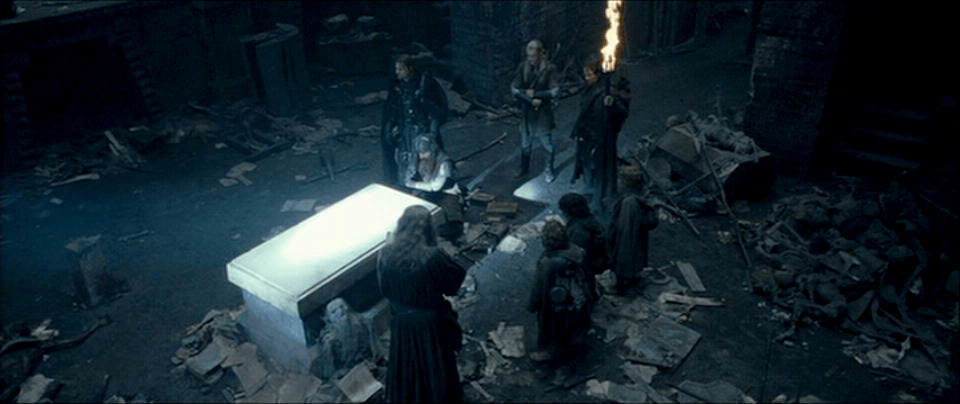
Thorin’s letter to Bilbo. In The Hobbit, Chapter 2, ‘Roast Mutton’, Thorin’s very formal letter ends with the wonderfully Dwarvish ‘Yours deeply’. The joke is obvious, but it is also useful. A normal polite closing has been given a Dwarvish shape through the idea of depth. Nothing is literally deep here; the concept has simply become part of a social formula. Its appearance in a formal letter is especially interesting, since written correspondence is exactly the kind of marked setting in which an inherited formal register might remain visible.
Gimli before Galadriel. In The Fellowship of the Ring, Book II, Chapter 8, ‘Farewell to Lórien’, Gimli does something similar in a much more serious setting. When he tries to describe the beauty of Galadriel’s hair, he reaches for ‘the gold of the earth’ and ‘the gems of the mine’. He then imagines setting the hair in ‘imperishable crystal’ and keeping it as an heirloom of his house, a pledge between ‘the Mountain and the Wood’. This is not casual conversation either. It is a formal gift-exchange with enormous emotional and social weight.
The imagery tells us quite a lot. Words like gold, gems, crystal, craft, house and mountain are doing far more than describing physical objects. They are being used to speak about beauty, memory, lineage, friendship and diplomacy. We cannot say that Gimli is translating fixed Khuzdul phrases, but we can see very clearly the conceptual world from which such phrases could have grown.
3.3 The Glittering Caves of Aglarond
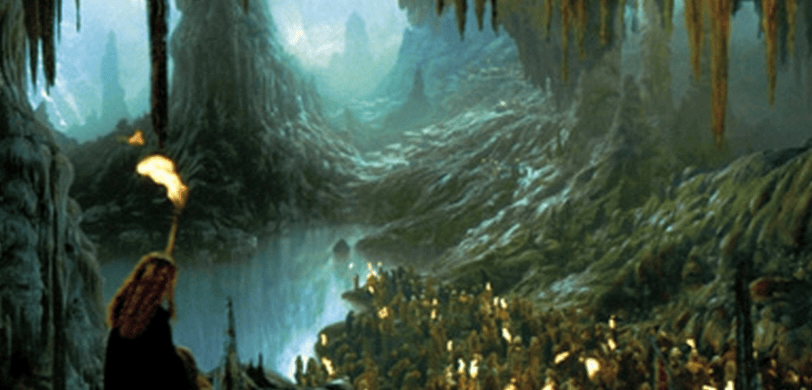
The Glittering Caves give us a different angle. In The Two Towers, Book III, Chapter 8, ‘The Road to Isengard’, Gimli is not turning stone into a metaphor. Instead, he refuses to let a wonder of stone be reduced to money or raw material.
When Legolas worries that Dwarves might simply mine the caves for profit, Gimli answers that no Dwarf could be unmoved by their beauty, and that none of Durin’s race would mine them for stone or ore even for diamonds and gold. He describes the caves almost as one might describe a cathedral or a great work of art, speaking of ore and crystal under torchlight and even comparing the translucent marble, glowing in that torchlight, to the living hands of Galadriel.
That gives the mining section some useful balance. Stone, ore and crystal are not merely commercial things to a Dwarf. They can carry beauty, reverence and emotional value even when they are being spoken of literally. The comparison with Galadriel also links this scene back to Lórien. Gimli uses the same elevated, aesthetic way of speaking about stone in two very different situations, which makes it much harder to dismiss the earlier passage as a one-off flourish caused by the emotion of the gift-exchange.
3.4 Neo-Khuzdul developments
The Neo-Khuzdul I have developed takes that repeated Dwarvish habit a step further. The expressions below are not Tolkien’s Khuzdul, but they are intended as natural extensions of the conceptual pattern Tolkien gives us.
| Neo-Khuzdul | Literal sense | Idiomatic development | Function |
| Tagnadi ‘ubzarul / bizral | To dig deeper / deeply | To investigate further (like in English); to look beneath the obvious; to examine something thoroughly | Mining vocabulary extended to thought and enquiry |
| Ta’khati | To dig down | A related image of deliberately going beneath the surface | The basis for a family of idioms about hidden causes or deeper layers |
| Tadhari kuk | To strike the vein | To find the crucial point, reach the valuable core, or discover what one was seeking | A mining action lexicalised as discovery or insight |
Tadhari kuk is perhaps the clearest of the three. If a Dwarf says that someone has ‘struck the vein’, there need not be any ore in sight. The image is easy to understand: after all the searching and cutting, the vein is the point where you finally reach something worth finding. From there, ‘to strike the vein’ can quite naturally become ‘to find the crucial point’ or ‘to get to the heart of it’.
4. Humility through Dwarvish Metaphor
4.1 A likely formal habit
Formal Dwarvish could easily express humility through images Dwarves know well: rough stone, unfinished work, halls and the worth of a household. One of the Neo-Khuzdul examples in Section 4.5 below shows the idea clearly: ‘My words are uncut stone beside yours.’ Taken literally, that sounds strongly self-deprecating. As an established courtesy, however, it could simply be a respectful way of placing the other person’s words above one’s own.
4.2 Gimli’s reluctance before Galadriel
Gimli’s exchange with Galadriel is probably the best example we have of this kind of restraint. When she offers him a gift, he first refuses one completely, saying that seeing her and hearing her words is enough. Only after Galadriel presses him does he finally ask for a strand of her hair.
Notice how the scene develops. Gimli does not begin with a modest request and then ask for more. He refuses, hesitates, and only then names something unexpectedly bold. Yet he loses none of his dignity in doing so. Galadriel herself recognises the request as both bold and courteous.
And again, the language around that courtesy is thoroughly Dwarvish. Gimli speaks through gold, gems, crystal, workmanship, house and mountain. His humility is not separate from Dwarvish material culture; it is expressed through it.
4.3 A convention shared beyond Durin’s line
Bifur, Bofur and Bombur are useful here for a different reason. They were not of Durin’s line, but Tolkien tells us in Appendix A that they were descended from the Dwarves of Moria, and thus with possible ancestry among the Firebeards or Broadbeams, the two western clans who had joined Durin’s people in Khazad-dûm early in the Second Age, would fit that background well, although Tolkien never states this outright.
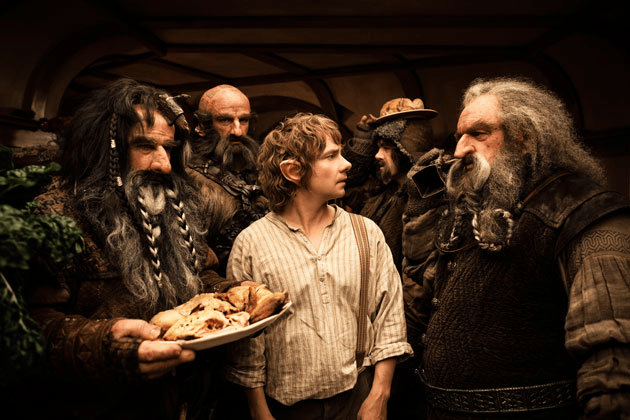
On arrival at Bag End, all three greet Bilbo with ‘at your service’, exactly as the Longbeard members of the Company do, while Thorin conspicuously does not. That already shows that the formula was not restricted to Durin’s line. Bombur later gives a sharper example, in Chapter 16, ‘A Thief in the Night’. Complaining to Bilbo about Thorin during the siege of the Mountain, he is careful not to say outright that he disagrees with his leader. He inserts the blessing ‘may his beard grow ever longer’ before allowing himself, only then, to call Thorin stubborn. This fits the broader pattern seen in Sections 4.1 and 4.2: deference and restraint appearing before socially delicate speech. Bombur is not of Durin’s line, and Tolkien gives him a markedly informal, food-and-comfort-driven personality elsewhere, which makes this small moment of formal deference stand out rather than blend in.
Taken together, these details do not show a contrast between Durin’s line and the other western Dwarves represented in the Company. They point instead towards a shared western Dwarvish etiquette within Thorin’s wider community. If Bifur, Bofur and Bombur were descendants of Firebeard or Broadbeam migrants, as their Moria ancestry may suggest, that shared etiquette could have been reinforced by the long period in which these communities lived together in Khazad-dûm. If they were instead non-royal Longbeards, the narrower conclusion still holds: these conventions were not restricted to Durin’s dynastic line.
4.4 ‘At your service’ as a fixed courtesy
The repeated Dwarvish greeting ‘at your service’ gives us another useful model, although the full evidence for the phrase is detailed in Section 5 below. Taken literally, the speaker is offering himself in service to the person addressed; Tolkien explicitly shows that this is not always what the formula actually means. It is therefore a good parallel for formal expressions whose literal wording sounds much more submissive than their ordinary social meaning. Whether such a formula began in Khuzdul, in Dwarvish Westron, or through long contact between the two cannot be settled from the surviving material.
4.5 Neo-Khuzdul expressions of formal humility
Galabîyê tâtîn ’abban binkharsh durathkhzu. My words are uncut stone beside yours.
Here the speaker lowers the value of his own words beside those of the person addressed. It would fit especially well when speaking to an elder, teacher, counsellor or someone known for wisdom or eloquence.
Amzârê tâti ’abban thurur durathkhzu. My work is rough stone beside yours.
This does the same through craftsmanship. The speaker acknowledges another person’s greater skill without literally claiming that his own work is poor.
’Ala tâti bingaldulu dumzu. This is unworthy of your hall.
Here the hall stands for more than a location. It represents the household, standing and dignity of the person receiving the gift or offering.
5. Dwarvish Politeness Can Become Wonderfully Indirect
5.1 Politeness does not always mean saying things plainly
Tolkien’s Dwarves are often much more courteous and formally spoken than later fantasy stereotypes would suggest. Their speech can be direct when the situation calls for it, but there is no reason to assume that bluntness was their normal social default.
What becomes interesting instead is how carefully they sometimes avoid saying the most sensitive thing outright. Matters involving honour, hospitality, rank, skill, obligation or danger may be approached through fixed formulas, euphemism, silence or culturally familiar metaphor.
So the pattern proposed here is not a contrast between a normally blunt Dwarf and an unexpectedly polite one. It is a broader Dwarvish habit of choosing the degree of directness according to the situation.
5.2 Thorin before the Great Goblin: courtesy even in hostile hands
One of the strongest examples comes from The Hobbit, Chapter 4, ‘Over Hill and Under Hill’. Thorin and the Company have been captured by Goblins, dragged into their stronghold and brought before the Great Goblin. They are prisoners, they are among enemies, and they have already been treated roughly.
Yet when the Great Goblin demands to know who they are, Thorin still introduces himself with the familiar formula: ‘Thorin the dwarf at your service!’
Tolkien then adds that it was ‘merely a polite nothing’.
That comment is especially valuable because Tolkien himself separates the literal wording from the social function. Thorin is obviously not offering to serve the Great Goblin. The phrase is simply the expected courtesy.
The situation makes the example even stronger. Thorin is not greeting a host, addressing a friend or speaking at a peaceful gathering. He is standing before an enemy who has taken him prisoner, and he still observes the formula.
That suggests that ‘at your service’ was not merely friendly politeness used when relations were good. It seems to belong to a more deeply established formal way of addressing someone, one that remains appropriate even in a hostile situation.
Thorin then continues in careful, non-confrontational language. Some of that is undoubtedly strategic, so I would not treat the whole speech as evidence for a Dwarvish politeness rule. The greeting itself is different, because Tolkien explicitly tells us that it is a ‘polite nothing’, even when genuine goodwill is clearly absent.
5.3 Beorn and the service formula
The meeting with Beorn in Chapter 7, ‘Queer Lodgings’, gives us another useful example. Thorin and Dori again present themselves ‘at your service’. Beorn replies that he does not need their service, but expects that they need his.
His response can be read in more than one way. Beorn may be deliberately playing with the literal wording of the expression, but he may just as easily be taking it at face value and answering it directly. Tolkien does not tell us which. Either way, the exchange draws attention to the gap between the words themselves and the polite function we already know the formula can have among Dwarves.
The same formula tells us something at Bag End from the opposite direction. When Thorin’s company first arrives, the other Dwarves greet Bilbo with ‘at your service’, one after another. Thorin does not. Tolkien marks his behaviour as haughty, which suggests that the greeting was something he was expected to offer but deliberately withheld.
The rest of the Company confirms this reading. Bifur, Bofur and Bombur, none of them of Durin’s line, all give the greeting normally when they arrive at Bag End (see Section 4.3), which shows that the formula was not restricted to Thorin’s dynastic kin.
Bilbo gives us an even more curious example. Decades later, at the beginning of The Lord of the Rings, he greets his birthday guests with ‘Bilbo Baggins, at your service, and your family’s.’ No other hobbit in the Shire is shown using it as ordinary hobbit manners. The simplest reading is that Bilbo picked up a piece of Dwarvish etiquette from Thorin’s company and kept it for the rest of his life.
This does not make Bilbo a carrier of Khuzdul, of course. It simply shows that a recognisably Dwarvish courtesy formula could pass into someone else’s Common Tongue through contact and imitation.
In linguistic terms, Bilbo’s adoption of the formula could be described as pragmatic borrowing: a socially meaningful expression passing from one speech community into another through contact.
When the Company later leaves Beorn, the greeting develops into a fuller form of respectful address: he is called the ‘master of the wide wooden halls’. Here the dwelling itself becomes part of the respect shown to its owner.
For Dwarves this feels especially natural. Halls and ancestral homes carry enormous cultural weight, so a person’s hall, hearth or threshold could quite naturally stand for the person and household in polite speech.
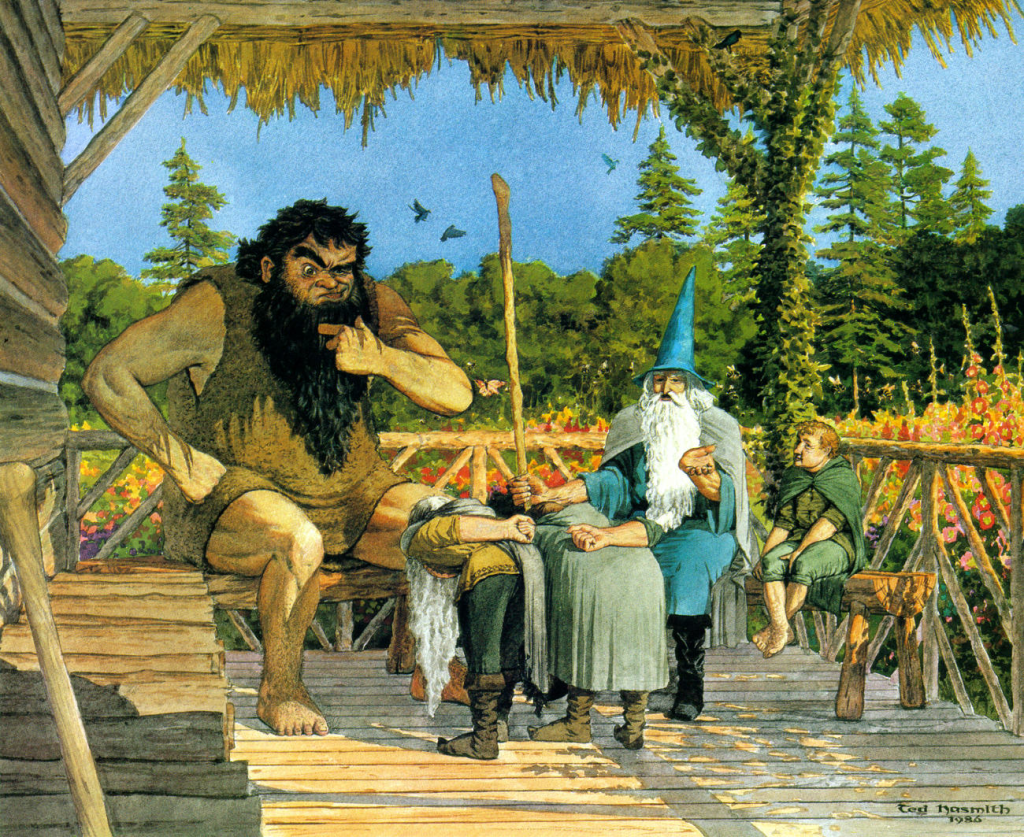
5.4 Thorin’s letter: making a simple thing ceremonious
Thorin’s letter to Bilbo gives us a much quieter example. The Company has simply left without waking him, yet Thorin wraps that fact in the phrase ‘esteemed repose’. The tone is comic, but the joke works because the Dwarves are using a recognisably formal style to make a very ordinary matter sound grander than it is.
5.5 Dáin and the messenger from Mordor
So far the indirectness has mostly been polite: soften a request, avoid sounding demanding, show respect. Dáin’s dealings with the messenger from Mordor, reported in The Fellowship of the Ring, Book II, Chapter 2, ‘The Council of Elrond’, show the same careful control of speech used for something much more serious.
The messenger comes to Erebor offering Dáin three Dwarf-rings and rule over Moria in exchange for information about hobbits and the Ring. Dáin does not accept, but he does not refuse either. His actual reply is ‘I say neither yea nor nay. I must consider this message and what it means under its fair cloak.’ Glóin then tells the Council plainly that they already knew the messenger’s words held both menace and deceit. The messenger returns twice more and still gets no definite answer, while Dáin quietly sends Glóin to Rivendell to find out more and warn Bilbo.
This is not politeness in the same sense as the earlier examples. Dáin is not trying to spare Mordor’s feelings. But the same basic skill is there: control what you say, and when you say it, so that your words do not commit you further than is safe. A culture already comfortable with formal restraint, fixed formulas and meanings that are not always stated outright would have no trouble using the same habits in diplomacy. Courtesy may simply be the most visible side of a broader Dwarvish preference for guarded, deliberate speech.
5.6 Where this indirectness would appear
Based on the above examples, Neo-Khuzdul therefore assumes that Dwarves become most indirect when a direct statement could damage someone’s standing, generosity, skill or honour, or when giving a direct answer could put the speaker or his people in danger.
The most likely areas are:
- wealth, debt and the condition of one’s stores or vaults;
- hospitality and the ability of a household to provide for guests;
- craftsmanship and criticism of another’s work;
- family, ancestry and household standing;
- obligations, dependence and the inability to fulfil a duty;
- personal honour and matters that imply failure, poverty or inadequacy;
- political allegiance and the proper response to an outside threat or offer, where an unconsidered answer could commit the speaker’s people to danger.
In those situations, a reference to the hearth, hall, stores, tools or workmanship may carry a message that another Dwarf understands perfectly well. Sometimes the most careful answer may even be no answer at all.
5.7 A Neo-Khuzdul example of indirect politeness
’Ursbarajzu amâz kufê duhû luknu malagalak. Your hearth may have enough burdens already.
The speaker never says ‘I do not wish to burden you’ or, worse, ‘perhaps you cannot afford to host me’. Instead the hearth stands for the household and everything it already has to carry. This gives the speaker a way to hesitate, decline or avoid imposing without openly questioning the host’s means or generosity.
The intended message is clear without ever being stated directly. That is the kind of circumlocution I would expect to find in a fuller Dwarvish politeness system.
6. What Kind of Dwarvish Speech Does This Suggest?
Put all of these examples together and a fairly consistent picture begins to appear:
- Depth, stone, mines, gems, mountains and craft give Dwarves a natural source of abstract and social language, rooted in genuine cultural and aesthetic attachment rather than simple economic value.
- Formal respect can involve restraint and self-lowering formulas whose social meaning is much lighter than their literal wording.
- The degree of directness in Dwarvish speech appears to depend strongly on the situation, with more indirect wording used around honour, hospitality, skill, obligation and other more sensitive matters.
- Guarded speech can serve caution as well as courtesy. The same reluctance to commit too much in words appears in Dáin’s dealings with Mordor and sits comfortably beside Tolkien’s wider picture of Dwarves guarding names, language and other significant information.
- Some Dwarvish etiquette is distinctive enough for outsiders to recognise and even borrow it. ‘At your service’ is the clearest example: Dwarves use it as an expected courtesy, Thorin can pointedly withhold it, and Bilbo later carries it into his own speech.
- The clearest single case for this is ‘at your service’ itself: Bifur, Bofur and Bombur, who are not of Durin’s line, use it exactly as the other members of the Company do, and Bombur independently shows the same broader use of deference when approaching socially delicate speech. The evidence available therefore points towards a shared western Dwarvish courtesy within Thorin’s milieu, while remaining insufficient to establish any wider Longbeard-versus-other-clans contrast.
These are the habits Neo-Khuzdul develops further: not as recovered Tolkien material, but as a fuller system built from the patterns above.
7. Where Neo-Khuzdul Comes In
There is obviously still a clear line between Tolkien’s material and Neo-Khuzdul reconstruction. Tolkien gives us the patterns: fixed courtesies, formal restraint, guarded answers, Dwarvish material imagery and a language of lore that was no longer the ordinary daily vernacular.
Neo-Khuzdul takes those patterns a step further by giving them actual formulas and idioms. The expressions used in this article are therefore obvious reconstructions, not lost Tolkien phrases. Their purpose is to show what a fuller Dwarvish system might look like if the habits seen in the texts were allowed to develop naturally.
Conclusion
Khuzdul remains hidden from us in two senses. Tolkien gives us very little of the language itself, and he also tells us that among the Longbeards of the West it had ceased to be an ordinary cradle-speech and was deliberately preserved as a guarded language of lore.
The Common Tongue scenes cannot simply be read as Khuzdul translated word for word, but they can still preserve something of Dwarvish linguistic culture. Again and again, the most distinctive behaviour appears when speech carries extra social weight: greetings, letters, gift-exchange, hospitality, diplomacy and solemn praise. In those moments we see ritual courtesy, restraint, guardedness, and a striking habit of thinking through depth, stone, craft, halls and material value.
None of that proves that every habit came directly from Khuzdul. But it gives us a coherent place to begin. At the moments when Dwarvish speech becomes formal or culturally charged, the guarded language behind that culture may still be showing through.
Tolkien Passages Discussed
Tolkien, J. R. R. The Hobbit, Chapter 1, ‘An Unexpected Party’. The Company’s arrival at Bag End: each Dwarf’s unprompted ‘at your service’, Bilbo’s correct reply and his earlier fumbled one, and Thorin’s pointed silence.
Tolkien, J. R. R. The Hobbit, Chapter 2, ‘Roast Mutton’. Thorin’s letter to Bilbo: elevated address, ‘esteemed repose’, and ‘Yours deeply’.
Tolkien, J. R. R. The Hobbit, Chapter 4, ‘Over Hill and Under Hill’. Thorin before the Great Goblin: ‘at your service’ and the narrator’s explicit gloss that the formula is ‘a polite nothing’.
Tolkien, J. R. R. The Hobbit, Chapter 7, ‘Queer Lodgings’. The Beorn exchanges: Beorn’s ambiguous response to the service formula, read either as wordplay or a literal answer, and the farewell address referring to his wide wooden halls.
Tolkien, J. R. R. The Fellowship of the Ring, Book II, Chapter 2, ‘The Council of Elrond’. Glóin’s account of Dáin’s dealings with the messenger from Mordor.
Tolkien, J. R. R. The Fellowship of the Ring, Book II, Chapter 8, ‘Farewell to Lórien’. Gimli’s initial refusal, restrained request, mining-and-gem imagery, crystal setting, and pledge between Mountain and Wood.
Tolkien, J. R. R. The Two Towers, Book III, Chapter 8, ‘The Road to Isengard’. Gimli’s description of the Glittering Caves of Aglarond to Legolas.
Tolkien, J. R. R. The Lord of the Rings, Appendix F, ‘The Languages and Peoples of the Third Age’. Khuzdul’s status as a tongue of lore rather than a cradle-speech, and the secrecy of Khuzdul and of Dwarvish true names.
Tolkien, J. R. R. ‘Of Dwarves and Men.’ In The Peoples of Middle-earth (The History of Middle-earth, vol. 12), edited by Christopher Tolkien. Khuzdul’s status as a taught ‘book-language’ among the Longbeard Dwarves of the West, no longer their native tongue but deliberately instructed to children from an early age.
Tolkien, J. R. R. The Lord of the Rings, Book I, Chapter 1, ‘A Long-expected Party’. Bilbo’s greeting to his guests, ‘at your service, and your family’s’, decades after learning the formula from Thorin’s company.
Tolkien, J. R. R. The Lord of the Rings, Appendix A, ‘Durin’s Folk’. Bifur, Bofur and Bombur identified as descended from the Dwarves of Moria but not of Durin’s line.
Tolkien, J. R. R. Letter to Naomi Mitchison, 8 December 1955 (The Letters of J. R. R. Tolkien, Letter 176). Dwarves compared to Jews: ‘at once native and alien in their habitations’.
Tolkien, J. R. R. Letter to W. R. Matthews, 1964. Khuzdul described as ‘Semitic in cast, leaning phonetically to Hebrew’.
Tolkien, J. R. R. BBC radio interview with Dennis Gueroult, recorded 1964. The Dwarves’ words described as ‘Semitic, obviously, constructed to be Semitic’.
Linguistic References
Brown, P., & Levinson, S. C. (1987). Politeness: Some Universals in Language Usage. Cambridge: Cambridge University Press.
Ferguson, C. A. (1959). ‘Diglossia.’ Word, 15(2), 325–340.
Fishman, J. A. (1967). ‘Bilingualism With and Without Diglossia; Diglossia With and Without Bilingualism.’ Journal of Social Issues, 23(2), 29–38.


