Introduction
This review examines the known and reconstructed words of Khuzdul one by one, looking for possible sources of inspiration behind Tolkien’s Dwarvish vocabulary. Each entry considers the form and meaning of a Khuzdul word and compares it, where a useful resemblance can be found, with Tolkien’s other invented languages and with real historical languages he knew or may have encountered. Particular attention is given to Semitic and Indo-European languages, although the search is not limited to them.
The purpose is not to claim that every Khuzdul word came from one identifiable source. Sometimes no convincing connection can be found, while in other cases Tolkien may have drawn upon several different ideas. The ratings indicate how closely each proposed comparison matches the Khuzdul word in sound, meaning and historical context.
Some linguistic terminology is used in the entries that follow. This is mainly to keep the individual discussions reasonably concise and avoid repeatedly explaining the same concepts. The article should nevertheless remain understandable without specialist knowledge, and unfamiliar terms can usually be understood from their immediate context.
One final caution is necessary. If enough languages are searched, chance similarities will inevitably appear. Two words resembling one another in sound or meaning does not prove that Tolkien connected them. The comparisons presented here should therefore be understood as possibilities of varying strength, not as established etymologies unless Tolkien’s own writings provide direct evidence.
Applied Ratings:
Five verdict levels are used throughout. No intermediate plus or minus gradations are used, and the rating assesses the proposed source or influence rather than the certainty of the Khuzdul gloss itself:
A – Compelling. Reserved for cases where Tolkien himself explicitly identifies a relationship or source, or where form, meaning and historical plausibility align so closely that coincidence is very difficult to sustain. A should be rare.
B – Strong probable influence. Requires at least one clear primary comparison with close form and meaning, plausible authorial access, and little phonetic or semantic strain. Several weaker resemblances do not combine to create a B.
C – Plausible. Worth recording, but at least one substantial uncertainty remains: the Khuzdul segmentation or meaning may be reconstructed, the phonetic or semantic fit may be imperfect, or the comparison may depend on analogy rather than direct correspondence. C means possible, not probable.
D – Weak or superficial. Some resemblance exists, but the proposal depends heavily on uncertain segmentation, substantial reshaping, semantic stretching, or contextual association. Coincidence is more likely than influence.
E – No convincing parallel identified. The search may produce loose echoes, but none is strong enough to support a serious claim of influence.
The review discusses the following attested forms, inferred elements and reconstructed lexical material: baraz, bark/baruk, bund, bizar, duban, dûm, dush, felek/felak, gabil, gamil, gathol, gund-/gundu/gunud, inbar, kibil, khuzd/Khazâd, nâla, narâg/Nargûn, shathûr, zâram, kheled, ûl, -ul, nâd, ân, aglâb, sigin, tarâg, uzbad, Rukhs/Rakhâs, Mahal, mazarb, *thark/Tharkûn, zigil, zirak, zahar, aya/ai, mênu, uzn/azan, Khîm, Mîm, Ibun, iglishmêk, sulûn/salôn, naruka, tumun/*tûm, Buzun-, Sharb-, Azaghâl, Nulu(k)-, Uruktharbun, Nar(u)kuthûn, and the possible ?-n / -ûn-form, together with several less certain elements.
Alphabetical Index of Entries and Ratings
Headwords with their final rating under the strict A–E scale defined above.
| ?-n / -ûn-form [C] | -ul [E] | aglâb [C] | aya / ai [C] |
| Azaghâl [C] | baraz [C] | bark / baruk [B] | bizar [D] |
| bund [C] | Buzun- [D] | duban [C] | dush [C] |
| dûm [B] | felek / felak [B] | gabil [C] | gamil [C] |
| gathol [C] | gunud / gundu [C] | Ibun [B] | iglishmêk [D] |
| inbar [C] | kheled [B] | khuzd / Khazâd [C] | Khîm [C] |
| kibil [B] | Mahal [C] | mazarb [B] | mênu [E] |
| Mîm [C] | Nar(u)kuthûn [C] | naruka [B] | narâg / Nargûn [C] |
| Nulu(k)- [D] | nâd [B] | nâla [B] | Rukhs / Rakhâs [B] |
| Sharb- [C] | shathûr [D] | sigin [C] | sulûn / salôn [B] |
| tarâg [D] | *thark / Tharkûn [C] | tumun / *tûm [C] | Uruktharbun [D] |
| uzbad [C] | uzn / azan [D] | zahar [C] | zigil [B] |
| zirak [C] | zâram [C] | ân [D] | ûl [C] |
Lexical Entries
baraz “red, ruddy”
Tolkien gives baraz as the Khuzdul adjective “red, ruddy” (radicals B-R-Z), attested in Baraz-inbar “Redhorn” and its short form Baraz, the name of Caradhras. The strongest comparison is the Indo-Iranian family built on shining and gleaming: Avestan brāza- “shining”, brāzaiti “to beam, shine”, and Sanskrit bhrāj- “shine, gleam”, all from Proto-Indo-European *bʰreh₁ǵ-. This provides a possible semantic route from brightness or gleaming to a warm colour, but none of these forms means “red” or “ruddy”. Separate European comparisons include Old French brese “ember” and Old English bræs “brass, bronze”; they should not be treated as a single established etymological family merely because both evoke glowing or metallic colour. Tolkien’s own Adûnaic pharaz “gold” (in Pharazôn) is also close in form, but any internal relationship remains unstated. The older Near Eastern parzillu/barzel “iron” family is weaker still, since it denotes the wrong concept and is itself generally treated as a loanword within Semitic.
Rating: C – the Indo-Iranian BRĀZ-/BHRĀJ- family is a genuine and attractive comparison, but it means “shine, gleam” rather than “red, ruddy”; the remaining parallels are independent and cannot collectively establish probable influence.
bark / baruk “axe / axes”
Tolkien gives bark as “axe” and baruk as its plural “axes,” most famously in Baruk Khazâd! “Axes of the Dwarves!” He cites this pair as an example of Khuzdul’s Arabic-influenced broken plural. The strongest lexical parallel is the Germanic axe-word represented by Old High German barta, Old Saxon/Old Dutch barda and Old Norse barða, “axe, broad axe,” surviving indirectly in halberd. The match in meaning is exact and the consonantal shape close, differing chiefly in the final stop (Germanic -t/-d versus Khuzdul -k). A secondary, purely formal resemblance appears in Hebrew bārūkh “blessed,” which shares the B-R-K skeleton of baruk but has an unrelated meaning and cannot explain “axe.” The more significant Semitic feature is not lexical but morphological: the internally vocalised plural bark → baruk itself imitates the broken-plural pattern typical of Arabic nouns.
Rating: B – the Germanic axe-words give a close lexical comparison, while Tolkien explicitly confirms the Semitic-style broken plural; the external lexical source itself remains unconfirmed.
bund “head” (of a mountain)
Tolkien explicitly gives bund “head”, with radicals B-N-D, in his analysis of Bundu-shathûr “Cloudy-head”. Its use is topographic, referring to a mountain’s head or summit, but the lexical gloss itself is not merely inferred from the compound. The strongest comparison is Proto-Celtic *bando- “peak, top”, reflected in Old Irish benn and Welsh bann, both meaning “peak, horn, summit”. The phonological match and identical topographic application make this attractive; Ancient Greek bounós “hill, mound” offers a weaker supporting echo. Germanic Bund “bond, binding” is phonetically close but semantically irrelevant.
Rating: C – the Celtic peak/top comparison is plausible and semantically apt, but it remains a reconstructed external comparison rather than a documented source.
bizar (element in Azanulbizar)
The internal analysis of Azanulbizar is uncertain. One reading takes bizar as “dale,” giving azanul-bizar “Shadowy Dale”; another treats duban as “valley” and reassigns bizar to the stream running through it. No convincing external parallel supports “dale, valley, hollow.” Under the “stream” reading, Biblical Hebrew Besor, the name of a stream or wadi, offers a closer formal match (B-Z-R against B-S/Ś-R), though Besor is a proper name whose traditional etymology belongs to an unrelated root (“bring news”), so any connection would be onomastic rather than lexical.
Rating: D – the meaning and segmentation are uncertain, and the Besor comparison works only under one interpretation and only as a proper-name resemblance; no convincing source emerges for the alternative “dale” reading.
duban “valley, dale”
An alternative first element of Azanulbizar. The best comparison lies in the Indo-European “bottom, ground” complex generally reconstructed around *bʰudʰ-m(e)n- and *bʰudʰ-no-, reflected in Sanskrit budhná-, Lithuanian dugnas and the Germanic ancestor of English bottom. The precise preform and the relationships among its extensions require caution, but the semantic path from “bottom, ground” to “valley” is natural. Tolkien also used comparable sound-meaning pairings elsewhere, including Elvish TUB “valley, depth” and Adûnaic DUB- “fall down”. No comparably close Semitic source has been identified.
Rating: C – the Indo-European “bottom, depth” family offers a plausible semantic route to “valley,” but the formal correspondence is not close enough to call probable.
dûm “hall(s), mansion(s), excavation(s)”
Attested in Khazad-dûm, “Dwarves’ Mansions.” The clearest external parallel is the Indo-European *dōm/*dem- “house, build” family: Latin domus, Greek dómos, Sanskrit dáma, Slavic dom. The phonetic match is close and the underlying sense of building or excavating fits Khazad-dûm particularly well. No comparably close Semitic D-M source for “house” or “hall” has been identified. Later suggestions that dûm reflects an underlying *tûm (based on Tumunzahar) are not supported by any explicit statement from Tolkien and should be treated as speculative rather than as an established derivation.
Rating: B – the ancient Indo-European *dem-/*dom- house/build family is close in both form and architectural meaning and requires little semantic strain, though Tolkien never confirms the source.
dush “black, dark”
Reconstructed chiefly from Buzundush “Blackroot,” with secondary support from the discarded mountain-name Udushinbar. The most useful external material is a loose cluster of Indo-European words associated with dark, dusky or dusty colouring, including English dusk, Old English dox “dark, swarthy,” Latin fuscus, and Sanskrit dhūsara “dust-coloured.” These should not be presented as though they necessarily form one direct cognate series. A related dus-/duš- shape carrying negative senses (“bad, ill”) appears elsewhere in Tolkien’s own invented languages, including Valarin Duš-, suggesting that he may independently have associated similar sound-shapes with darkness or negativity. No close Semitic lexical parallel has been found.
Rating: C – the dark/dusky comparisons are meaningful but diffuse, and the Khuzdul meaning itself is reconstructed; no single external form provides a decisive match.
felek / felak “hew rock”
Tolkien explicitly glosses felek as “hew rock” and felak as the chisel-like tool used for the purpose, in the epithet Felakgundu “Cave-hewer” (> Sindarin Felagund). Before settling on this Khuzdul explanation, Tolkien had derived Felagund from an Elvish root, PHELEG/PHELEK, associated with caves; the later Khuzdul form preserves much of that sound-shape while shifting the sense to the act of hewing. The strongest external comparison is Greek pélekus “axe,” matching Tolkien’s own description of felak as resembling a small axe-head. A second, independent cluster is the Semitic P-L-Q family “split, cleave,” including Arabic falaqa and Syriac/Aramaic pelqā “hatchet, axe.” Together these form an unusually coherent set of parallels spanning both of Tolkien’s habitual source areas.
Rating: B – Tolkien’s earlier PHELEG/PHELEK material, Greek pélekus “axe,” and Semitic P-L-Q “split, cleave” form a coherent cluster, with at least one close semantic and phonetic comparison.
gabil “great”
Inferred securely from Gabilgathol “Great Fortress” and confirmed independently by Gabilân “Great River.” Old High German gibil/gebal and Gothic gibla, “gable, summit, crest,” resemble gabil closely in form, and the shift from “prominence, summit” to “great, eminent” is conceivable; Arabic jabal/gabal “mountain” offers a looser echo of the same shape. A further curiosity is that gathol, “fortress,” closely resembles Hebrew gādōl “great” – the reverse of what the meanings would suggest – raising the possibility of a deliberate philological inversion, though this cannot be demonstrated.
Rating: C – Germanic gibil/gebal and Arabic jabal/gabal are suggestive in form and associations with prominence or height, but neither actually means “great” and the proposed inversion with gathol remains speculative.
gamil “old, aged, ancient”
Inferred from Gamil Zirak, understood as “Zirak the Old.” The clear parallel is the Germanic *gamalaz family: Old Norse gamall, Old English gamol/gamel (as in Beowulf), and modern Scandinavian cognates, all meaning “old, aged.” Old Norse Gamli, “the Old,” used as a personal byname, strengthens the comparison by showing the same onomastic function Tolkien apparently intended for Gamil Zirak. Arabic jamīl/gamīl “beautiful” is a striking but semantically unrelated coincidence and should not be treated as a serious rival.
Rating: C – the Germanic gamal-/gamall family is an excellent formal and semantic parallel, but the Khuzdul gloss is itself inferred from the name Gamil Zirak rather than explicitly supplied by Tolkien.
gathol “fortress, stronghold”
Inferred from Gabilgathol “Great Fortress,” reinforced by the corresponding Sindarin compound Belegost (“great” + “fortress”). Gathol closely resembles Hebrew gādōl “great,” and the wider Semitic G-D-L family also produces migdāl “tower, watchtower” and the place-name Magdala “tower.” If intentional, Tolkien may have placed a gādōl-like form in the “fortress” half of the compound while assigning the actual meaning “great” to gabil – a piece of philological wordplay rather than a straightforward borrowing. No comparably close rival exists in either Semitic or Indo-European fortress vocabulary.
Rating: C – the wider Semitic G-D-L/MGDL family supplies relevant tower and fortified-place vocabulary, but the closest surface form gādōl means “great,” not “fortress,” so the connection remains plausible rather than probable.
gunud “delve underground, excavate, tunnel”; gundu “underground hall”
Explicitly glossed by Tolkien (Peoples of Middle-earth, p. 352), occurring in Felakgundu “Cave-hewer.” The most significant wider consideration is Gundabad, which Tolkien states is “in origin a Khuzdul name,” but which is chronologically much older in his legendarium than the gundu/gunud explanation. Gundabad closely resembles the historical Burgundian king’s name Gundobad, built on Germanic gund- “battle”; a Germanic or Burgundian origin for the name, later reinterpreted as Khuzdul, is plausible. Middle Persian gund “army, troop” offers a further formal echo, and Sanskrit guhā “cave, cavern” provides a semantic parallel for gundu itself, though neither displaces the Germanic route as the more probable origin of the underlying name.
Rating: C – the Gundabad/Gundobad resemblance may explain part of the name-history, but no close external word has been identified for Tolkien’s actual “delve underground” sense.
inbar “horn” (of a mountain)
Attested with radicals N-B-R in Barazinbar “Redhorn” and related mountain-names, denoting a projecting peak rather than an animal horn as such. The best comparison is Arabic N-B-R, “raise, lift,” whose derivative nabra can denote something projecting or swelling – a closer semantic fit than a generic word for “horn.” The widespread Semitic Q-R-N “horn” family (Hebrew qeren, Arabic qarn) independently shows the same horn-to-peak metaphor but does not match inbar’s form. Indo-European parallels (Sanskrit śṛṅga, Old Irish benn) confirm that the metaphor itself is common cross-linguistically but do not resemble inbar closely enough to be a likely source.
Rating: C – Arabic N-B-R “raise, project” matches the radicals and topographic idea reasonably well, but it does not mean “horn” directly and the comparison remains inferential.
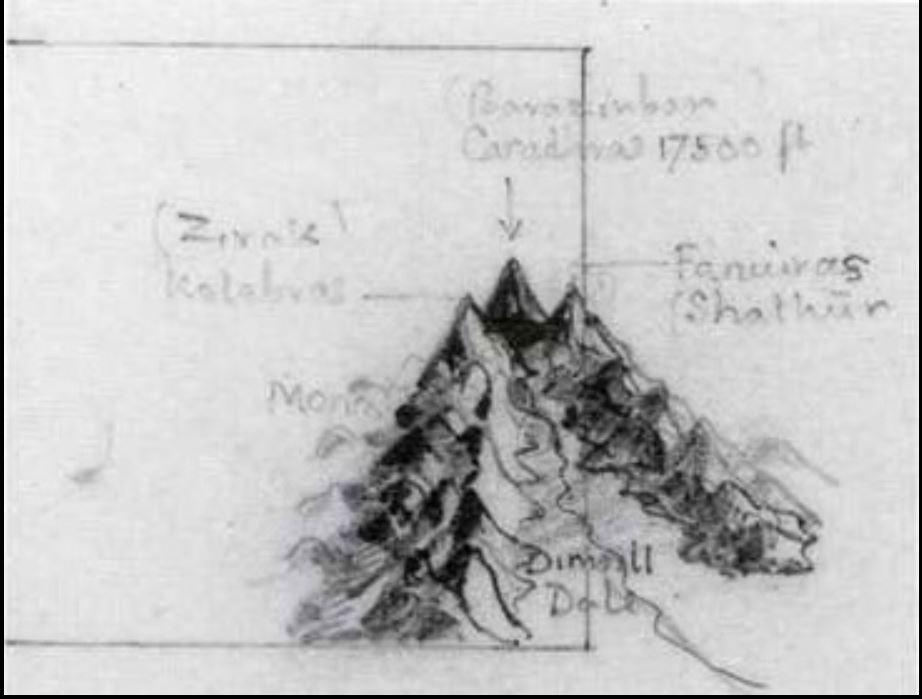
Tolkien’s sketch of the Mountains of Moria, identifying Barazinbar (Caradhras) and noting its elevation as 17,500 feet (approximately 5,330 metres).
kibil “silver”
Tolkien gives kibil as “silver,” occurring in Kibil-nâla (the Silverlode), and explicitly places it alongside his Elvish silver-words Sindarin celeb and Quenya telpë. The consonants of celeb (K-L-B) and kibil (K-B-L) are identical but for a metathesis of the final two, raising the possibility that Tolkien deliberately reshaped familiar Elvish silver-vocabulary when forming the Dwarvish word. A secondary and much weaker resonance appears in Greek kíbdēlos, “adulterated (of precious metal or coinage),” which shares the initial kib- and a metallurgical semantic field, though no Greek form of this family means “silver” outright.
Rating: B – the near-metathetic relationship to Tolkien’s own celeb “silver” is unusually close in both sound and meaning, but Tolkien does not explicitly state that one was formed from the other.
khuzd / Khazâd “Dwarf / Dwarves”
Tolkien gives khuzd as “Dwarf” and Khazâd as the plural/collective self-name, with radicals KH-Z-D. The strongest external parallel is Arabic qazam “a dwarf, short or small-bodied person” (plural aqzām), which is semantically exact but matches only part of Khazâd’s consonantal structure (Q-Z-M against KH-Z-D). Its precise meaning makes it more interesting than a generic word for “small”, but the formal fit should not be overstated. A second, purely Tolkien-internal resonance connects Khazâd with Adûnaic hazad “seven”: since the Dwarves descend from the Seven Fathers and form Seven Houses, and since hazad resembles no ordinary Semitic or Indo-European word for “seven,” the numeral may be a deliberate echo of the Dwarves’ own name rather than an independently modelled loanword.
Rating: C – Arabic qazam/aqzām is semantically exact but only partially matches the consonantal structure, while the Adûnaic hazad “seven” association is thematic and unconfirmed.
nâla “channel, course, river-course, bed”
Used in Kibil-nâla, the Silverlode. Two comparisons stand out. Indo-Aryan nālā (Hindi/Urdu “watercourse, channel, ravine,” also borrowed into English as nullah) matches nâla almost exactly in both sound and sense. Hebrew naḥal and Aramaic naḥlā, “torrent, stream, wadi, stream-bed,” match closely except for the medial guttural, absent from Khuzdul. Tolkien’s alternative name for the same river, Zigil-nâd, alongside Sanskrit nadī “river,” may point to a related Indic layer running through more than one Dwarvish name for the Silverlode. Neither source can be confirmed, and Sindarin rant “course,” Tolkien’s own gloss for the corresponding Elvish element, supports the meaning without explaining the form.
Rating: B – Indo-Aryan nālā “watercourse, channel, ravine” is exceptionally close in both form and sense, with the Semitic naḥal/naḥlā family providing independent support.
narâg / Nargûn “black / the Black One”
Tolkien associates radicals N-R-G with “black”; narâg is the adjective, and Nargûn is the Dwarvish name for Mordor. On the possible analogy of Tharkûn “Staff-man”, Nargûn may be understood as approximately “the Black One”, but Tolkien does not independently gloss the ending. The clearest external comparison is Latin niger/nigra “black”, whose consonants N-G-R correspond to N-R-G only through metathesis. The exact colour meaning is attractive, and the figurative senses “gloomy, sinister” suit Mordor, but the consonantal reordering prevents the comparison from being called probable. No comparably close Semitic source has been identified.
Rating: C – Latin niger/nigra supplies the same principal consonants and exact colour meaning, but only after metathesis; Nargûn as “the Black One” and the external influence both remain plausible rather than probable.
shathûr “cloud(s)”
Attested in Bundushathûr, “Cloudy-head.” No word meaning “cloud” outright matches shathûr closely; the more promising parallels concern covering and canopy. Semitic S-T-R, “cover, hide, veil” (Hebrew sātar, Arabic satara), and Sanskrit chattra / Persian čatr, “umbrella, canopy,” both share a loosely similar consonant shape and fit the image of cloud as a covering over a summit, but neither means “cloud” directly and the phonetic match in both cases is only approximate.
Rating: D – the proposed parallels mean “cover, veil” or “canopy” rather than “cloud” and are only approximate in form; they are useful associations but weak evidence of lexical influence.
zâram “pool, lake”
Glossed by Tolkien as “pool, lake,” occurring in Kheled-zâram (Mirrormere) and Narag-zâram. The Iranian Z-R water-family (Avestan zrayah- “sea, lake”) is especially attractive because Tolkien’s own Adûnaic azra “sea” sits beside it, suggesting an authorial Z-R association with large bodies of water reproduced across his invented languages. Hebrew zerem, “torrent, flood,” matches the full Z-R-M shape exactly, though its usual sense is moving rather than standing water; Sanskrit saras “pool, lake” gives a close semantic but looser phonetic match. Old Norse tjǫrn/English tarn, “small mountain lake,” is a weaker but contextually apt secondary echo.
Rating: C – Iranian, Hebrew and Sanskrit forms each contribute part of the formal or semantic picture, but no single comparison closely matches both zâram and “pool, lake.”
kheled “glass”
Attested in Kheled-zâram, “Glass-pool” (Mirrormere). Before assigning kheled to Khuzdul, Tolkien had already used a closely related shape, KHYEL(ES), for “glass” in his Elvish Etymologies (Noldorin hele, Quenya hyelle); Sindarin heledh was then reconceived as a loan from Khuzdul kheled. This internal continuity is the strongest evidence for the word’s origin. Externally, Old Norse gler, “glass; looking-glass, mirror,” and the wider Germanic glass-family (from *ghel- “shine, gleam”) offer an apt secondary background, particularly given the “mirror” sense appropriate to Mirrormere.
Rating: B – Tolkien’s earlier KHYEL(ES)/hele glass-vocabulary provides strong internal continuity, but the direction and mechanism of authorial reuse are not explicitly stated; the Germanic material is secondary.
ûl “streams”
Attested with the meaning “streams” in material connected with Azanulbizar. Biblical Hebrew ʾûḇāl/yûḇāl, “stream, river,” is a close semantic and reasonably close phonetic match, differing mainly in the medial b. No comparably strong parallel exists elsewhere; earlier proposals connecting ûl with Akkadian ulû/ullû are not well supported and should be set aside.
Rating: C – Hebrew ʾûḇāl/yûḇāl is a good semantic and moderate phonetic comparison, but the missing medial consonant is substantial enough to keep the proposal below probable.
-ul “of, belonging to”
A relational suffix seen in Fundinul (“of Fundin”), Khuzdul (effectively “of the Dwarves”), and Mazarbul (“of the records”). No Akkadian or Sumerian language possesses a directly corresponding genitival -ul, so earlier claims of an exact Semitic model should be rejected. Arabic W-L-Y, “be connected with, belong to, appertain,” offers only a loose semantic resonance, not a formal match. The suffix is best regarded as Tolkien’s own creation within a generally Semitic-styled morphology, and should be kept distinct from the unrelated noun ûl “streams,” despite their surface similarity in a form such as Azanulbizar.
Rating: E – no convincing external morphological source has been identified. Arabic W-L-Y offers only a broad semantic echo of affiliation and should not be treated as evidence for a corresponding suffix.
nâd “watercourse, stream, river (?)”
Used in Zigil-nâd, an early name for the Silverlode later replaced by Kibil-nâla. Sanskrit nada/nadī, “river, stream,” gives an unusually close formal and semantic match. The word’s later replacement by nâla, and the historical sense of English lode as “watercourse” (as in Silverlode), suggest that nâd denoted something in the broader field of “watercourse” rather than narrowly “river.” No comparable Semitic or other Indo-European form competes.
Rating: B – Sanskrit nada/nadī “river, stream” is unusually close in both form and meaning, and the later nâla formation supports an Indic hydrological context.
ân “river (?)”
Inferred from Gabilân, “Great River”. The form may instead be analysed as gabil plus a possible characterising ?-n, approximately “Great One”, so ân is not independently attested as a word for “river”. Swedish å “river” and its definite form ån “the river”, beside Old Norse á and the wider Germanic *ahwō family, provide a striking surface resemblance. Scandinavian river-names in -ån make the association tempting, but such a short form is exceptionally coincidence-prone and the underlying Khuzdul segmentation is uncertain.
Rating: D – Swedish ån is strikingly similar in form and context, but ân is neither independently isolated nor securely glossed as “river”; the alternative ?-n analysis and the coincidence risk of a very short form make the proposal weak.
aglâb “language”
Tolkien gives aglâb as “language” and contrasts it with iglishmêk, the Dwarves’ gesture-language, while presenting it alongside Elvish lambë. “Spoken language” is therefore a useful explanation of the contrast, not the literal gloss. Tolkien’s own Elvish root LAB, “move the tongue” (> lambë “tongue, language”), together with his ÑGAL/ÑGALAM material for vocalisation, provides the strongest internal precedent for both form and meaning. Externally, Lithuanian kalbà “speech, language” matches closely in consonants and sense, while Greek glôssa “tongue, language” and Old Church Slavonic glagolŭ “word, speech” offer looser background parallels.
Rating: C – Tolkien’s own LAB language-vocabulary and Lithuanian kalbà “speech, language” are relevant parallels, but neither establishes a clear derivation of the complete Khuzdul form.
sigin “long”
Inferred from Sigin-tarâg, “Longbeards.” The Indo-European family for “long, extended” – Proto-Celtic *sīros “long,” *sīnīti “stretch,” and Germanic *sīdaz/Old Norse síðr “long, hanging down” – fits well, the Germanic nuance being especially apt for hanging beards. A weaker secondary association may lie in Semitic Z-Q-N/Ḏ-Q-N “beard” (Akkadian ziqnu, Hebrew zāqān), which cannot explain the meaning “long” but may have influenced the S-G-N shape. The compound as a whole recalls the historical Langobards, “Longbeards,” a plausible inspiration for the ethnonym rather than for the individual word.
Rating: C – several Indo-European long/stretch forms are suggestive, but the gloss is reconstructed from Sigin-tarâg and no single external form closely matches both shape and meaning.
tarâg “beards”
Attested in the plural, in Sigin-tarâg. No single external word matches both form and meaning exactly. The strongest individual comparison is Greek thríx, genitive trikhós, “hair,” because the semantic relationship is direct and the productive TRIKH- stem lies reasonably close to T-R-G. Old Turkic tarğak “comb” and tara-/targa- “comb the hair” provide a second hair-related T-R-G-like complex, while Greek trágos “he-goat” is formally very close and has genuine beard-tuft associations (compare tragopṓgōn “goat-beard”). Persian tār “strand” is a weaker secondary echo. These parallels remain individually imperfect and should not be strengthened merely by accumulation.
Rating: D – Greek trikh- “hair” and Turkic tarğak/tara- provide real hair-related associations, but no individual source closely matches both tarâg and “beards”; accumulating several imperfect parallels does not raise the proposal above weak.
uzbad “lord”
Attested in Uzbad Khazaddûmu, “Lord of Moria”. The clearest comparison is the Middle Iranian title element -bed/-bad, “lord, master, chief, commander” (as in spāhbed “army chief”), descending from Old Iranian *pati- and ultimately Proto-Indo-European *pótis “master, ruler”. The correspondence in function and in the final portion of uzbad is close, and neighbouring Iranian/Turkic baγ/beg “lord, ruler” vocabulary reinforces the titulary environment. It does not, however, account for the initial uz-.
Rating: C – Middle Iranian -bed/-bad is excellent semantically and closely matches the final portion, but the initial uz- remains unexplained; the comparison is plausible rather than a probable source for the complete word.
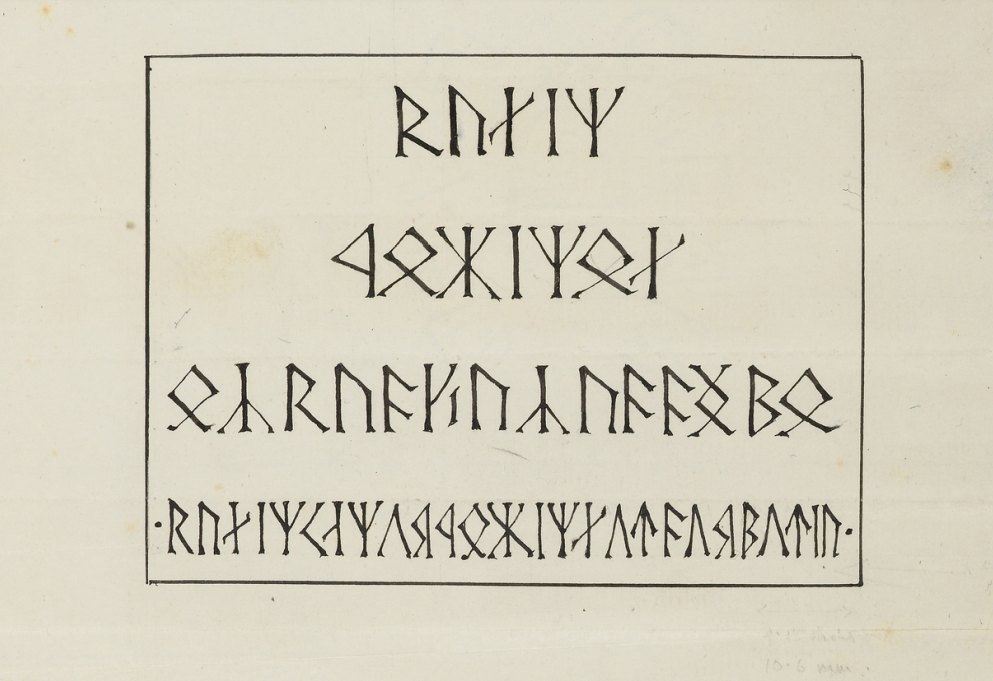
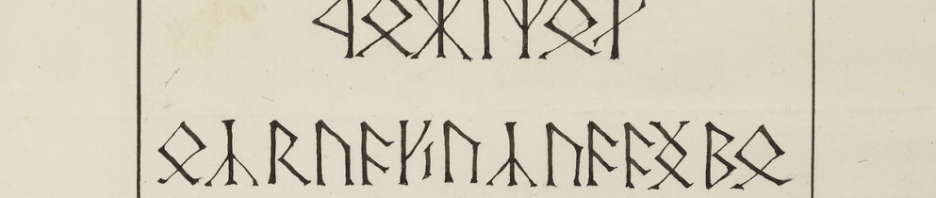
The runic inscription on Balin’s tomb in the Mines of Moria, featuring, among other Khuzdul words, uzbad. Created by Tolkien in 1953 and reproduced in The Lord of the Rings.
Rukhs / Rakhâs “Orc / Orcs”
Tolkien himself notes, in Quendi and Eldar, that the Dwarvish word appears related to the Elvish Orc-names and may derive from Avarin. Independently, Sanskrit rakṣas, “demon, evil being,” and its later Indo-Aryan descendant rākhas, “demon, monster” (via Middle Indo-Aryan rakkhasa), give an unusually close formal and semantic match to Rakhâs. This resemblance makes deliberate reinforcement of the Tolkien-internal form a strong possibility, but does not prove that Sanskrit supplied the word. The Khuzdul singular/plural alternation itself belongs to Tolkien’s Semitic-style morphology and should not be derived from Sanskrit.
Rating: B – Tolkien explicitly notes an apparent relationship with the Elvish Orc-name complex and allows possible ultimate Avarin derivation, while Indo-Aryan rakṣas/rākhas provides a striking secondary match. His cautious formulation supports a very strong relationship, but not the unequivocal source statement required for A.
Mahal (Dwarvish name of Aulë; plausibly interpreted as “Maker”)
Tolkien gives Mahal as the Dwarvish name of Aulë. Aulë is called “the Maker”, so that title supplies a plausible interpretation of the name rather than a securely attested lexical translation. The clearest external comparison is the Germanic “make” family: Old High German mahhōn “make, fashion” and its agent noun mahhāri “maker”, continued in modern German machen. The correspondence is semantically apt to Aulë’s defining role as craftsman, although the complete form Mahal is not especially close to a single Germanic agent noun. Tolkien’s Valarin māχan offers a further internal sound resemblance, but its meaning concerns authority rather than making.
Rating: C – the Germanic make-family is semantically very apt and phonetically suggestive, but the complete form Mahal is not close enough to a single external “maker” word to call the influence probable.
mazarb “records, documents”
Tolkien gives the root Z-R-B, “write, inscribe,” and mazarb, “records,” in Mazarbul, “of the records.” The Semitic root Z-B-R, “write, write down,” attested in Sabaic and continued in Arabic zabara “write, inscribe” (participle mazbūr “written, inscribed”; noun zabūr “written text, book”), matches Tolkien’s Khuzdul root through a simple metathesis of the final two consonants, and the correspondence extends through the derivational pattern as well as the root itself (ma- prefix, verb-to-noun development).
Rating: B – the Semitic Z-B-R “write” family and Arabic mazbūr/zabūr provide a systematic correspondence in root, derivational shape and meaning, though the radical order is reshaped and Tolkien never confirms the borrowing.
*thark / Tharkûn “staff (?) / Staff-man”
Tharkûn, Tolkien’s Dwarvish name for Gandalf, is explicitly glossed “Staff-man”. A standalone *thark “staff” is a reconstruction from that compound, not a separately attested word. The likeliest motivation is internal: Old Norse Gandálfr, the name Tolkien adapted as Gandalf, is traditionally analysed as containing gandr “wand, staff”, so Tharkûn re-expresses an image already present in the character’s Norse name. For reconstructed *thark, Greek thyrsos “staff, wand, sceptre” gives the best available external comparison, with Turkic/Mongolic tayak/tayag “staff, cane” as a weaker echo.
Rating: C – the internal motivation through Gandalf’s staff-bearing identity is persuasive, but the proposed Greek and Turkic/Mongolic lexical sources for thark remain only approximate.
zigil “silver colour”
Tolkien distinguishes zigil, “silver colour,” from kibil, the metal itself. The clearest source is Tolkien’s own long-established Elvish root GIL, “white/pale shine, silver glint,” preserved intact inside zi-GIL. A second and probably reinforcing influence is Old English sigel/sigil, “sun,” a word Tolkien studied in detail in his scholarly essay Sigelwara Land (1932, 1934); the near-identity of SIGIL and ZIGIL in form, combined with his documented expertise in the word, makes this considerably more than an idle coincidence.
Rating: B – Tolkien’s own GIL “silver glint, pale shine” material closely matches the distinctive meaning, and Old English sigel adds a strong authorial phonetic echo; neither relationship is explicitly identified as the source.
zirak “spike, tine”
Tolkien first associated zirak with silver or silver-grey before reassigning that sense to zigil and settling on “spike, tine,” attested in Zirak-zigil (Celebdil/Silvertine). Arabic Z-R-Q, covering both “pierce, thrust” (mizrāq, “javelin”) and, in older usage, the shine of a weapon-point, closely matches zirak’s final sense and may also explain why the same shape earlier carried a silver association. Persian zīrak, “clever, intelligent,” is a striking but likely secondary resonance for the personal name Gamil Zirak, not evidence for a separate Khuzdul sense “clever.”
Rating: C – Arabic Z-R-Q offers relevant piercing and weapon-point associations with a close consonantal frame, but no form directly means “spike, tine” and the earlier silver sense complicates the history.
zahar “bold, dwelling, habitation” (reconstructed)
Inferred from Tumunzahar, “Hollowbold.” Khuzdul’s regular adjective-then-noun compound order (as in sigin-tarâg, gabil-gathol) favours zahar as the noun, “dwelling” (Old English bold means “building, hall,” not the modern adjective). Iranian šahr, “city, town” (from Old Iranian *xšaθra- “realm, dominion”), gives a close match in both form and the broader sense of an inhabited settlement, fitting a major Dwarvish city better than a narrower word for “house.”
Rating: C – Iranian šahr “city, town” is a good formal and semantic comparison, but both the segmentation of Tumunzahar and the precise meaning of zahar are reconstructed.
aya / ai “upon”
Tolkien gives aya, “upon,” with reduced form ai, in the battle cry Khazâd ai-mênu!, “The Dwarves are upon you!” The Semitic preposition family *ʿalay- “on, upon, over” (Arabic ʿalā, Hebrew/Aramaic ʿal, Akkadian eli) matches the grammatical function closely, including the same extension toward “against” appropriate to a battle cry. Indo-European *ana “on, upon” (Greek ana, Gothic ana) and Avestan aipi “upon” offer weaker secondary parallels; short grammatical words of this kind are especially prone to accidental resemblance.
Rating: C – the Semitic *ʿalay- preposition family matches the grammatical function well, but short grammatical forms are particularly prone to coincidence and the phonetic match is not exact.
mênu “you” (accusative plural)
Attested in Khazâd ai-mênu! No single external form is a persuasive source. The ancient Indo-European second-person plural accusative paradigm (*usmé; Greek hymâs; Sanskrit yuṣmān) matches the grammatical category exactly but not the form; Dutch men, an impersonal human pronoun, matches the shape but not the specific “you” function; and Semitic plural pronoun paradigms (Akkadian attunu, Geʿez ʾantəmu) demonstrate that -u/-nu/-mu shapes are at home in ancient plural-pronoun systems generally, without matching mênu closely.
Rating: E – no external form found matches both the shape and the specific second-person plural accusative function closely enough to support a serious source hypothesis.
uzn / azan “dimness, shadow / shadows”
Tolkien’s later analysis gives uzn, “dimness, shadow,” with plural azan, “shadows,” connected with Azanulbizar; the internal vowel change (uzn → azan) mirrors the broken-plural pattern seen elsewhere in Khuzdul (khuzd → Khazâd). No convincing Semitic root meaning “dark, dim” has been found. The closest external lexical parallel is Slavic S-N “shade, shadow” (Russian сень); Indo-Iranian chāyā/sāye “shade, shadow” is a good semantic but poor formal match. The strongest evidence for Semitic influence here is morphological rather than lexical.
Rating: D – the Slavic shade comparison is only approximate and the Indo-Iranian forms are semantically but not phonetically close; the strongest external resemblance lies in general Semitic-style plural morphology rather than the lexical root.
Khîm (personal name, son of Mîm)
Tolkien gives no translation. The closest parallel is Old High German kîm/kîmo, “germ, seed, sprout; offspring, progeny” (modern German Keim), matching Khîm in both consonants and vowel length, and semantically apt for a name identified chiefly through filial relationship. A weaker secondary echo appears in Tolkien’s own Elvish root KHIM, “stick, cleave, adhere,” and in Persian khīm, “nature, disposition,” though neither carries clear relevance to the character.
Rating: C – Old High German kîm/kîmo is a striking formal match and the “offspring, sprout” sense fits the character context, but Tolkien gives no gloss and the proposed meaning is inferred from that context.
Mîm (personal name, father of Khîm and Ibun)
Tolkien gives no translation. Two threads deserve most weight. Sanskrit mímīte/mimāti, “measure, fashion, form, make”, suits Mîm’s identity as a craftsman. Independently, Old Norse Mímir, a wisdom-figure who becomes a smith in the Þiðreks saga and, through the Sigurd tradition, Wagner’s dwarf-smith Mime, parallels Mîm’s narrative role closely enough to be a plausible literary influence on the choice of name. Neither comparison establishes a lexical meaning for Mîm, and character-based resemblances must be treated cautiously to avoid retrospective pattern-finding.
Rating: C – the Sanskrit “fashion, make” root and the Germanic Mímir/Mime tradition are individually plausible, but neither establishes the meaning of Mîm; the proposal remains a lexical or literary possibility, not a probable derivation.
Ibun (personal name, son of Mîm)
Tolkien gives no translation, but the name is defined almost entirely by the relationship it encodes. Arabic ibn, “son, descendant” – part of an ancient and widespread Semitic B-N kinship family (Hebrew bēn, Ugaritic/Phoenician bn, Akkadian bīnu) – matches this relationship exactly, and the chronology fits: Ibun and Khîm were introduced only after Tolkien’s Khuzdul had acquired its mature Semitic character, unlike Mîm himself. A secondary possibility, Hebrew ʾeḇen/Akkadian abnu “stone,” is thematically apt to a Dwarf but far less specific than “son.”
Rating: B – Arabic ibn “son” gives an exceptionally close form and exactly matches Ibun’s defining relationship, though Tolkien never glosses the name and the vocalisation remains interpretive.
iglishmêk “gesture-language”
Tolkien contrasts iglishmêk, the Dwarves’ silent sign-language, directly with aglâb “language”; in context aglâb refers to spoken language. A shared element relating to language is therefore plausible, though Tolkien does not explain iglishmêk’s internal structure, and the frequently cited standalone form shimak “gesture” is not Tolkien-attested. Sanskrit saṃketa “preconcerted sign, signal, gesture” is the best available semantic comparison, with Greek sêma “sign, signal” and the Armenian/Ottoman family nšmar/işmar “sign, indication; nod, wink” offering further associations. These match the concept of subtle signals better than the complete Khuzdul form.
Rating: D – Tolkien does not explain the internal segmentation, and the proposed Sanskrit, Greek and Armenian/Ottoman parallels match the idea of signs or gestures much better than they match the complete form.
sulûn / salôn “fall, descend swiftly”
Tolkien proposed these Khuzdul forms (radicals S-L-N) late in his life as a possible source of the river-name Lhûn (the Lune), whose upper course is steep and fast. This may represent a Dwarvish reworking of Elvish material he was independently developing for the same problem, SLOUN/(S)LOW “descend; flow freely.” Externally, Latin saliō/salient- (“spring, leap; spring forth, flow down”) gives the closest combination of form and hydrological sense; Old English slīdan “slide, slip, fall” and Arabic sāla/sayalān “flow, run” provide weaker secondary support. A proposed connection to the real River Lune of north-west England is an interesting but unconfirmable speculation about why the name existed before its etymology.
Rating: B – Tolkien’s own contemporaneous SLOUN/(S)LOW material addresses the same river-name and closely related meanings, while Latin saliō and Arabic sāla provide secondary external support.
naruka (untranslated; proposed Khuzdul source of Narog)
Tolkien considered naruka as a Dwarvish form underlying Sindarin Narog, but did not independently gloss the Khuzdul word. Its extraordinary resemblance to his much earlier primitive Elvish *narāka “rushing, rapid, violent”, previously devised for the same river-name from NARAK “tear, rend”, makes deliberate authorial reuse of the older sound-shape highly plausible. This does not establish that the late Khuzdul form retained the earlier Elvish meaning. In nearby late analyses Tolkien also connected the Narog-name with Khuzdul narâg “black”, showing that he was actively reconsidering its Dwarvish etymology. Akkadian nāru “river” is an attractive secondary resemblance for the opening syllable, but is not needed to explain the authorial reuse.
Rating: B – Tolkien’s earlier *narāka for the same river-name makes reuse of his own earlier sound-shape highly probable. This rating concerns internal authorial reuse, not an independently attested Khuzdul meaning or a demonstrated external borrowing.
tumun / *tûm “hollow, empty, hollowed-out (?)”
Inferred from Tumunzahar “Hollowbold”. Khuzdul’s regular adjective-then-noun compound order favours tumun as the adjective “hollow”. A shorter *tûm is sometimes reconstructed from tumun, but is not independently attested by Tolkien. Old English tōm and Old Norse tómr “empty, vacant”, together with Middle English tome/tum/tume “empty, hollow” and the further Scots sense “to hollow out”, give an unusually close formal and semantic comparison. Hebrew ṭāman “hide, bury” and passive ṭāmūn “hidden, concealed” offer a secondary resemblance appropriate to an excavated city. Proposals identifying tumun or *tûm with the separately attested dûm “hall, mansion” rely on speculative morphology and are best kept distinct.
Rating: C – Old English tōm and Middle English/Scots tome/tum/tume are unusually close in form and meaning, but the Khuzdul gloss and segmentation are reconstructed from Tumunzahar rather than independently attested.
Buzun- “root, base, source (?)”
The first element of Buzundush, “Blackroot”; Tolkien gives no independent gloss, and even the segmentation is inferred. Middle Persian/Parthian bun, “root, stock, foundation, origin,” matches the probable sense well but not the medial z. Iranian bīz/Sanskrit bīja, “seed, germ,” and Arabic bizr/buzūr, “seed(s); offspring,” may account for that consonant, situating Buzun- within a general botanical field of root, seed, and origin, but no single attested word combines the full form and meaning.
Rating: D – the segmentation itself is uncertain and no single external form combines the visible B-Z-N-like shape with the required meaning; the proposed Iranian and Semitic material is thematic rather than demonstrative.
Sharb- “bare, barren, parched (?)”
The first element of Sharbhund, the Petty-dwarvish name of Amon Rûdh, “Bald Hill.” Hebrew and Aramaic/Syriac šārāḇ, “burning heat; parched, scorched ground,” give an exact consonantal match (SH-R-B) and a topographically apt sense, since Amon Rûdh’s “baldness” refers to bare exposed rock rather than literal hairlessness.
Rating: C – Semitic SH-R-B provides an exact consonantal frame and an apt “parched, scorched” terrain sense, but the element and its meaning are reconstructed and do not literally mean “bald.”
Azaghâl (Dwarf-lord of Belegost, slain fighting Glaurung)
Tolkien never glosses the name. The most direct internal parallel is his own Adûnaic verb azgarâ-, “to wage war” (azaggara, “was warring”), developed before Azaghâl’s appearance in the Grey Annals, which would make “warrior” a plausible sense. Hebrew ʿaz/Arabic ʿizz, “strong, mighty; power, honour,” and Old Irish gal, “valour, martial ardour” (as in the name Fergal, “man of valour”), both suit a warrior’s name and may reinforce the same general sense.
Rating: C – Adûnaic azgarâ- “wage war” and external strength/valour vocabulary create a plausible martial cluster, but no single form closely establishes a meaning such as “warrior.”
Nulu(k)- (element in Nulukkhizdîn, a Dwarvish name for Nargothrond)
Tolkien gives no gloss; the second element, khizdîn, likely relates to KH-Z-D “Dwarf”. Tolkien’s nâla “channel, course, river-course” is contextually attractive because Nargothrond stands on the Narog, and Sanskrit nāla or later Indo-Aryan nālā/nullah “watercourse, channel, ravine” offers a similar external association. The proposal nevertheless requires uncertain segmentation and substantial reshaping from Nulu(k)- to nâla/nālā.
Rating: D – the watercourse comparison is contextually attractive, but Tolkien never isolates or glosses Nulu(k)-, its radicals are uncertain, and the formal relationship requires substantial reshaping.
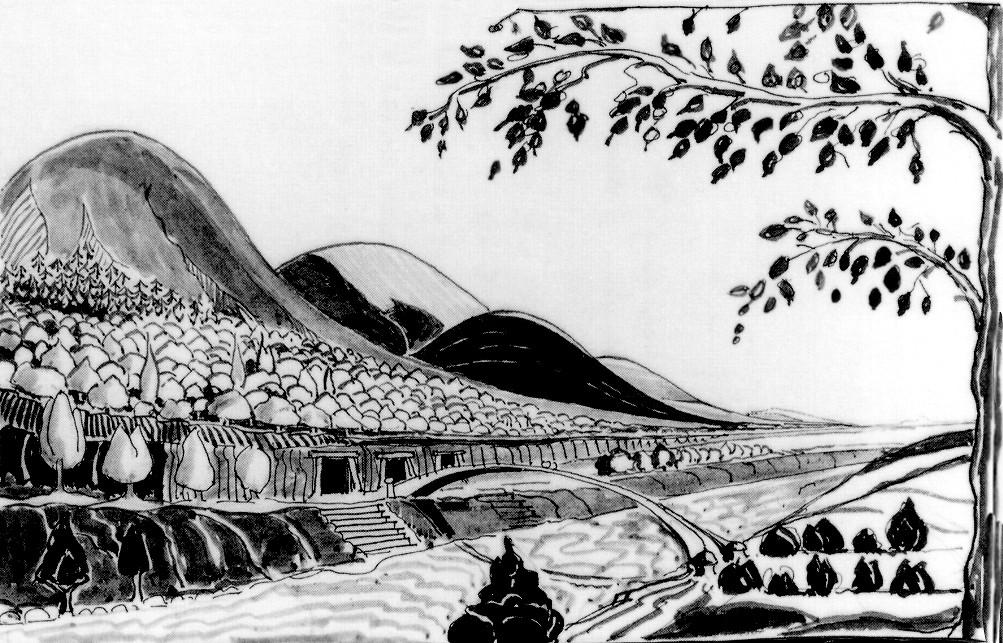
Nargothrond, drawn by J. R. R. Tolkien in July 1928, showing the fortified entrances to the underground stronghold before the construction of Túrin’s bridge. The site was known in Dwarvish as Nulukkhizdīn and later Nar(u)kuthûn.
Nar(u)kuthûn (Dwarvish name associated with Nargothrond)
Tolkien connects this name with the Dwarvish material he was considering for Narog, including naruka, but naruka itself is untranslated. The likely second element thûn resembles Old English tūn and Old Norse tún “enclosure, homestead”, and Celtic dún “fort, stronghold”, a family Tolkien had already used in his early name Tûn for the Elvish city later called Tirion. An alternative segmentation kuthûn would find a close comparison in Classical Arabic quṭūn “residence, dwelling”.
Rating: C – Tolkien’s internal connection with the Narog-name material is secure, while thûn ~ tūn/dún and alternative kuthûn ~ Arabic quṭūn are plausible settlement comparisons; naruka remains untranslated and the competing segmentations prevent a probable rating.
Uruktharbun (early Dwarvish place-name associated with Moria)
Occurs once, in the phrase “the dwarflords of Uruktharbun,” and was soon replaced by Khazad-dûm; its intended meaning is therefore very uncertain. Classical Arabic ṯarbun, “a tract of land covered with pale stones,” matches the second element closely in both form and topographic sense; Arabic ʿurūq, “roots” (with extended senses of ridges and land-forms), offers a looser possible source for the first element. No confirmation is available, and the name’s brief textual life argues for caution.
Rating: D – Arabic ṯarbun is an intriguing topographic match and ʿurūq supplies a possible first-element echo, but the name is a single abandoned early form whose segmentation and meaning are wholly uncertain.
?-n / -ûn-form “one, person characterised by (?)”
Tolkien never independently isolates or glosses a suffix -ûn or -n. Tharkûn, however, is explicitly glossed “Staff-man,” and Nargûn may show an analogous formation, approximately “the Black One.” This suggests a possible substantivising or person-forming element meaning something like “one characterised by, possessing, or associated with X,” but it remains uncertain whether the morpheme is the whole sequence -ûn or only an underlying ?-n with the vowel supplied by the derivational pattern. Ancient Greek -ōn, used in possessive or characterising formations, provides the closest functional and phonetic comparison; Persian agent-forming -un and Sanskrit -in offer weaker secondary support. Arabic -ūn is formally similar but is principally a masculine plural ending and does not match the proposed singular function.
Rating: C – Tharkûn strongly suggests some characterising or person-forming morphology, but Tolkien never isolates the morpheme, its exact shape is uncertain, and the Greek/Persian/Sanskrit parallels remain analogical rather than demonstrably sourced.
Selected References
The references below are representative working sources for Tolkien’s linguistic material and for the historical-language comparisons used throughout this review. They are not intended as a claim-by-claim critical apparatus; individual proposed etymologies remain assessments rather than documented derivations unless Tolkien explicitly says otherwise.
Tolkien primary sources
• Tolkien, J. R. R. The Lord of the Rings, especially the linguistic material in the Appendices.
• Tolkien, J. R. R. The Lost Road and Other Writings. Edited by Christopher Tolkien. The History of Middle-earth, vol. V. 1987. Includes The Etymologies.
• Tolkien, J. R. R. Sauron Defeated. Edited by Christopher Tolkien. The History of Middle-earth, vol. IX. 1992. Includes The Notion Club Papers and Adûnaic material.
• Tolkien, J. R. R. The War of the Jewels. Edited by Christopher Tolkien. The History of Middle-earth, vol. XI. 1994. Includes Quendi and Eldar.
• Tolkien, J. R. R. The Peoples of Middle-earth. Edited by Christopher Tolkien. The History of Middle-earth, vol. XII. 1996. Includes Of Dwarves and Men and later Dwarvish linguistic notes.
• Tolkien, J. R. R. “Words, Phrases and Passages in Various Tongues in The Lord of the Rings.” Parma Eldalamberon 17. Edited by Christopher Gilson. 2007.
Selected historical-language reference works
• Bartholomae, Christian. Altiranisches Wörterbuch. 1904.
• Beekes, Robert S. P. Etymological Dictionary of Greek. 2010.
• Bosworth, Joseph, and T. Northcote Toller. An Anglo-Saxon Dictionary, with Supplement. 1898–1921.
• Brown, Francis, S. R. Driver, and Charles A. Briggs. A Hebrew and English Lexicon of the Old Testament. 1906.
• Cleasby, Richard, and Gudbrand Vigfusson. An Icelandic-English Dictionary. 1874.
• de Vaan, Michiel. Etymological Dictionary of Latin and the Other Italic Languages. 2008.
• Kroonen, Guus. Etymological Dictionary of Proto-Germanic. 2013.
• Lane, Edward William. An Arabic-English Lexicon. 1863–1893.
• MacKenzie, D. N. A Concise Pahlavi Dictionary. 1971.
• Matasović, Ranko. Etymological Dictionary of Proto-Celtic. 2009.
• Monier-Williams, Monier. A Sanskrit-English Dictionary. 1899.
• The Assyrian Dictionary of the Oriental Institute of the University of Chicago (CAD). 1956–2010.
• Oxford English Dictionary, historical entries and etymologies.


