RP-ing Dwarves in LoTRO

RP-ing in LoTRO

When not working on Neo-Khuzdul translations, or reading Tolkien’s works for the gazillionth time, I often jump into Lord of the Rings Online where I Role-Play a dwarf (honestly, what else?) from the Grey Mountains.

Kandral, son of Kuinn. Dwarf character on the LoTRO Laurelin Server

Kandral, son of Kuinn.
Dwarf character on the LoTRO Laurelin Server

It’s something I greatly enjoy doing, as it allows me to slip into the mind of a dwarf and RP to my hearts delight.  Though I do enjoy questing and crafting and I’m in awe of the epic-story line the good people at Turbine have made for us, my favorite thing above all in LoTRO has to be Role-Playing.

"The Lord of the Rings Online" logo is a  registered trademark of Warner Bros. Entertainment Inc.

“The Lord of the Rings Online” logo is a registered trademark of Warner Bros. Entertainment Inc.

When you spend some time RP-ing in LoTRO you quickly notice that there are different styles of RP-ers in this wonderful world. Each RP-er has a set of skills that sets them apart from other RP-ers, some more outspoken than others. In my view a good RP-er in LoTRO is the person that is able to find a decent balance in these skills.  Here’s my view on them:

  • Lore-wise:  There are RP-ers that focus mainly on the world of Tolkien and its lore.  These are the people that know their Gabilgathol from their Tumunzahar, and have the ability to fill their RP lines with the tiniest details of Tolkien’s works.  I know a few brilliant lore-wise RP-ers; the best of them however only use this skill moderately and don’t go about spamming Middle-Earth with their book-smarts.
  • Empathy: In my view one of the most important skills of a good RP-er. The capacity to recognize emotions that are being experienced by other players, be it via their emotes or (and this is likely far more frequent) through their lines – and act on these appropriately.
  • Patience:  An underrated skill. Someone once told me that a good RP-er is like a tiger waiting for the good moment to jump its pray.  I do believe there is much truth in this saying as I honestly feel there is nothing worse than a RP-er that continuously turns the story toward their own character before the situation calls for it.   This is all about timing and respect for the evolving story.
  • Acting-skill:  After RP-ing a character for a while your character often slowly get’s many traits of yourself, only natural off course.  Distancing your real life self from your character, or rather, distancing your character from your real life self is often not as easy as it looks at first.  Think of it as if you are an actor and have been cast a role (it is “role play” after all).  To play your character you must study who he/she is, what makes them tick, their history, their style, their personal experiences that have shaped them.  These items can be inspired by your RL self off course, but ultimately must see to fit in the world of Middle-Earth and your character.   Those RP-ers that often have impressed me the most in LoTRO are those that have made their characters “real”, by acting as their character and not necessarily as themselves.  Giving their characters (at least) as many flaws and weaknesses as they would have qualities and strengths. It often isn’t easy to “expose” your character and make them weaker, however it makes them a lot more interesting and “real” to others around you, as opposed to being the one-millionth hero out for revenge.

    The Art of Acting

    The Art of Acting

  • Tolerance:  Every RP-er in LoTRO will one day find him or herself in a situation where another RP-er launches a line into the ongoing RP-session that either doesn’t fit or breaks the momentum of the RP-session completely.   When such moments happen…. you leave the Prancing Pony. I kid, I kid… when such moments happen you have a choice as a RP-er, you a) continue the RP-session as if nothing happened b) try to fit in the line as best as you can c) end the RP-session.   Unless this is the x time that this kind of thing happens I would always suggest you go for a) or b), depending on the topic at hand.  Reason for this is that I believe a good RP-session sometimes just happens when you least expect it, and by throwing in the towel at the first bump in the road you often miss out on some excellent RP further down that road.
  • Preparation:   Before you jump into RP, make your character 3-dimensional by developing the basics.  This doesn’t need to be a 20 page biography, but do try to think of “where am I from?”, “how old am I?”, “what are my strengths and qualities?”, “what are my weaknesses and flaws?”, “what have I witnessed?” etc.. ..   I find that the more in depth you make your character, the easier you will find it to RP with them.   With some players a lot of these questions are answered at the character-creation screen.  Others write down the basics and improvise the rest as they go along.   Both are fine, just beware you don’t jump into RP as a blank page, as in those cases you might often revert back completely to the person behind the keyboard, or the cliché “dorf”, instead of the complex and interesting character waiting to be RP-ed.

RP-ing Dwarves

It would be easy to dictate how dwarves should be played, based on characters such as Thorin or Gimli.  But I’m not going to do that.  Main reason behind this is that not every dwarf in Middle-Earth is like Thorin and Gimli.  In addition, and equally important, YOU are the one doing the RP. And I’m convinced everyone has a great RP-er within them (even if he/he might be hidden very thoroughly), you just need some tips and tricks to find him/her.

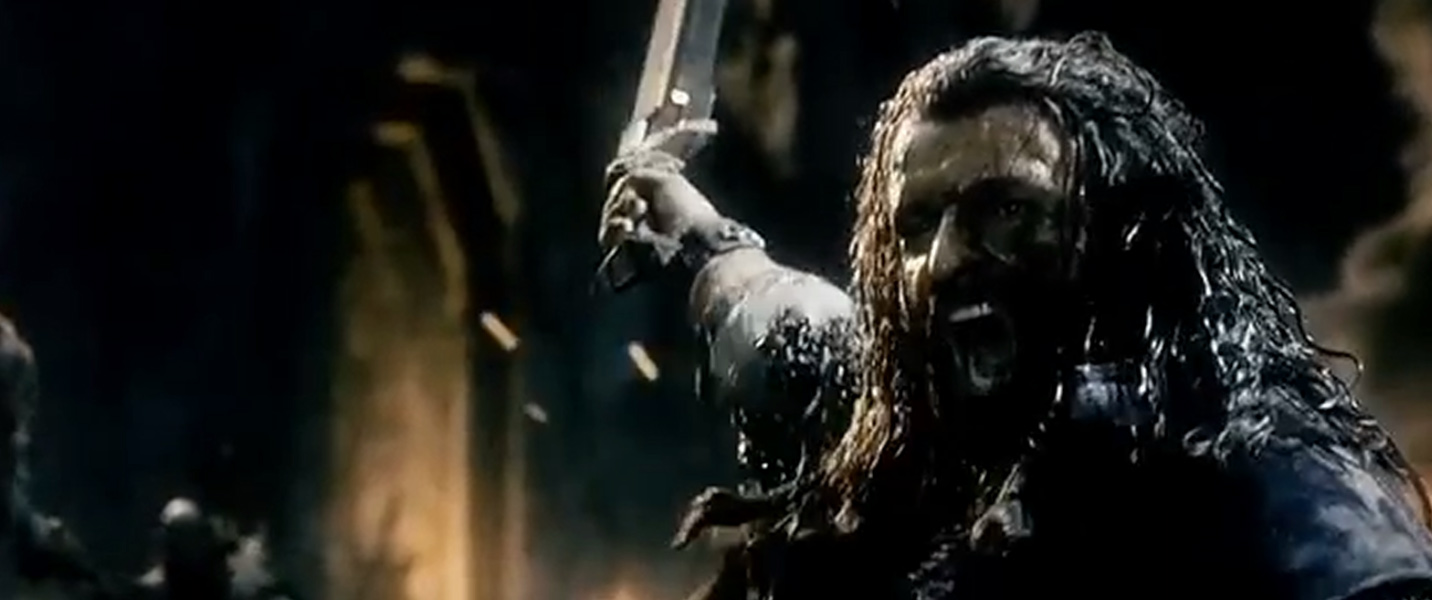
Thorin at the Battle of Azanulbizar ® & ™ 2012 Warner Bros, Entertainment Inc. All Rights Reserved.

Thorin at the Battle of Azanulbizar
® & ™ 2012 Warner Bros, Entertainment Inc. All Rights Reserved.

There are specific traits however that make a dwarf a dwarf though, separating them from the Elves, Hobbits and Men of this fantasy world.  I believe if we try to focus on these traits in a bit more detail by asking ourselves some key-questions, it will reveal (by magic) that inner RP-er, giving you a blue-print of how your character could be played.

1- What Hall does your dwarf hail from?

The first thing that strikes you when you review the options in LoTRO is that Turbine limits the options to different Mountain ranges where dwarves would have dwelt, instead of using the names of the seven clans of the dwarves.

I believe this wasn’t done lightly.  This choice has some pro’s but also some con’s.

I don’t know the actual reason behind this choice (anyone from Turbine reading this is welcome to comment of course), but it would seem logical NOT to have players select one of the seven clans, for several reasons.  Firstly, by the end of the Third Age, there would have been far fewer Firebeards and Broadbeams around than most other clans.  Secondly, the vast majority of the dwarven characters in Tolkien’s works are Longbeards.  And lastly, four out of seven of these clans (Stiffbeards, Ironfists, Blacklocks and Stonefoots) live far in the East and would have rarely been seen in the lands shown by LoTRO.

Though, granted, these Eastern dwarves would have been seen more in the late third age than at any other time in History: “But now Frodo often met strange dwarves of far countries, seeking refuge in the West. They were troubled, and some spoke in whispers of the Enemy and of the Land of Mordor.” (FoTR, The Shadow of the Past).   Seeing that Turbine uses Mountain ranges in this option, this quote from FoTR would have allowed them to use “The Red Mountains” (where many of the dwarves of the East would have come from), as one of the options.  Unfortunately “The Red Mountains” is not an option in the game, we do have 5 other options, let’s review them in a bit more detail….

  • Of the Blue Mountains – “Your home is in Ered Luin, the Blue Mountains, where there had once been two great dwarf-kingdoms and where the kinsmen of Thráin and his son Thorin Oakenshield lived in exile after Smaug drove them from the Lonely Mountain.” – If you want to play a Firebeard or Broadbeam dwarf, this is likely the logical choice for you.  “Where there had once been two great dwarf-kingdoms” refers to Gabilgathol (Belegost) and Tumunzahar (Nogrod), homes of the Broadbeam and Firebeard dwarves.   We know these clans, though ravished by several events lived on in fewer numbers, many moving to Khazad-dûm.  When the Balrog drove out the dwarves of Moria these clans would have likely either followed the Longbeards or resettled Halls of their own in their native Blue Mountains.  It seems the folks at Turbine went along with that idea as when you roam through the region of Ered Luin you will be able to spot far away Halls in the West which you can’t get to (Gabilgathol or Tumunzahar of old rebuild ?)  You could off course also be a Longbeard who chose to remain in the Blue Mountains after Erebor was reclaimed.   Going for a Firebeard or Broadbeam character is bold choice, though an extremely interesting one.  These clans excelled in smith-craft (even more so then other clans), so when you love crafting, you might want to give this choice a go and make your character a Firebeard or Broadbeam.  Going for a Longbeard of the Blue Mountains is just as interesting though, as it sets you apart from other Longbeards, as your family (or perhaps you individually) did not heed the call of King Dáin to return to Erebor, perhaps unwilling to leave behind what you had build up, or content with life… Whatever the reason is, you would have been the rare exception to the rule, so give a careful thought as to “why” you didn’t follow the rest of your clan-brothers and sisters.

    Blue Mountains in LoTRO

  • Blue Mountains in LoTRO

    Of the Lonely Mountain – “You hail from Erebor, the Lonely Mountain, where Smaug the Golden made his Lair until Thorin Oakenshield reclaimed it for his people. There does Dáin Ironfoot now rule as King under the Mountain. “- The safe option in a way, as the majority of the dwarves would have dwelt here by the end of the third age. On the other hand, you need to ask yourself the question “what is a dwarf of Erebor doing in places like Ered Luin, Bree and the Shire?”  Is he a trader? Perhaps and adventurer or trying to settle in these parts?

  • Of the Iron Hills “You come from the Iron Hills, settled by dwarves as a refuge from the Cold-drakes, and whence came Dáin Ironfoot, King under the Mountain, kinsman of the great Thorin Oakenshield.” – Though the Iron Hills had been a colony of the Longbeard Dwarves since the early years of Khazad-dûm, around the year 2500 of the Third Age Grór son of Dáin I founded an independent kingdom here.  At the time of the events of LoTRO however these halls would have been a shadow of their former self, as most of the Dwaves would have gone with King Dáin to live in Erebor. So again, choosing for a dwarf of the Iron Hills is setting you apart from the main stream. Ask yourself why this is ? The answers should give your character some “meat” and him/her more detailed.
  • Of the Grey Mountains – “You are from Ered Mithrin, the Grey Mountains, the chief of which is Mount Gundabad, from whence came Durin the Deathless, first Father of the Dwarves. Your kindred returned to the Mountains after the Dragons perished. “- Most of the dwarves would have left these mountains by the time of the events in LoTRO, settling in the Iron Hills first and later on at Erebor when it was reclaimed.  Picking this option adds two distinct features to your character 1) You have experience with Dragons 2) Your hatred of Orcs and Dragons is likely unrivaled – as the Holy site of Mount Gundabad now defiled by Orcs is ever in sight.  – These would have been hardened dwarves, and you would have had a good reason for staying, being….  In T.A 2210 King Thorin I, learning that most of his people were gathering in the Grey Mountains, left the Lonely Mountain to join the Dwarves to the north, for those mountains were rich and little explored. ”  …  “riches”.   It would not be an easy life to remain in these drake and orc infested lands, but a profitable one it likely would have been, if you don’t mind a bit of risk.
  • Of the White Mountains – “You are from the southwestern halls of Ered Nimrais, the White Mountains in the south bordering the lands of Andrast. Though your kingdom lies far from the central mountains where Men once dwelt, the rumor of the Oathbreakers has given your realm an ill name.” – This is a strange choice I always found.  As it wasn’t until Gimli returned to the White Mountains at the start of the 4th Age that these mountains would have been settled by Dwarves.  Also the Turbine description of this choice refers more to the men that dwelt there, than to the actual dwarven population.  Now, of course, we can’t always follow lore, otherwise it wouldn’t be much of a game.  So Turbine has added their own hall, “Zigil-jabâl”, in the White Mountains.  If you follow the epic line, you will run into one or two dwarves that mention this hall.  No need to look for it in Tolkien’s works, as you won’t find it.   Now, we can assume that some dwarves took refuge in these mountains after the fall of Khazad-dûm.   So, this option gives you a bit of carte blanche really, allowing you to fill in much of the blanks the way you see fit.  Personally I believe it might have been better to change this to the Red Mountains, giving folks a chance to pick an Eastern kindred dwarf, but I understand their choice however, so I’m not complaining here.
  • So I can’t play an Eastern Dwarf?  Of course you can!  Who’s stopping you?  Just pick one of these above options and tell folks that ask you were raised there but born in the East… there are a zillion options here.  Just have fun with it.


2- What age is your Dwarf?

The introduction quest of LoTRO tells us that we would have been around at the time Thorin left on the quest for Erebor.

This took place in T.A 2941, so that would make us at least 78. However, we know newborns don’t travel, in fact any dwarf under the age of 65 would have to stay put and not go out on adventures (hence why Gimli didn’t come with his father Glóin on their quest to reclaim Erebor).  So that would make us at least 143.   Seeing that dwarves die round the age of 250, this “limitation” would kind of have written much of your life story already, perhaps limiting the RP we had in mind.

Example Character Creation Screen

Example Character Creation Screen

So, what if you want to play a younger dwarf… one that might still want to raise a family (for those around the age of 90).  Just ignore the introduction quest, is my advice on that one.   I know this all starts a finely laid out path by the good folks at Turbine, but if it honestly does not serve your fantasy as RP-er, ignore it.  In the end YOU make your character what it is, not Turbine… and yes, not even lore.  While I hear rocks being gathered by the lore-buffs for a good stoning of the Dwarrow Scholar, let me explain why I feel lore should not hinder your character in LoTRO.

Firstly, the world of Middle-Earth of Tolkien’s books is not what we see in LoTRO.  If it were we wouldn’t see Hobbits east of Bree (with the exception of those of the fellowship themselves), nor any dwarves in Lothlorien for that matter, nor a thriving dwarven colony in Moria, nor dwarves riding horses by the hundreds, etc… .  If we are to RP in the world of LoTRO I believe we must first respect the world created for us by Turbine.  A world in which things differ from lore, so you can enjoy a tremendously fun game.  Should we throw everything over board and have flying horses and dwarf-elven mixed marriages? No, we should not.  Merely using your common sense and trying to stay as close to lore as you can, yet giving yourself some space to play with your own fantasy in the world of LoTRO.

Some examples I can think of:   A good friend of mine loves playing a dwarven female, and it must be said, she does a tremendous job at it too.  If we were to strictly follow lore, we couldn’t have dwarven females running about in Middle Earth, they would have been fiercely protected and shielded within the halls of her husband or father.  Hence Turbine not even allowing this option in the character creation screen. Yet, my friend here (yes, talking about you Fryjpora) has made such a wonderful RP story that justifies her being out there in Middle-Earth, as opposed to being locked up in a Hall.  Who are any of us to strike that down?  In fact it should be applauded, as it brings an amazing flavor to the game.  In short, try to respect the writings of Tolkien as much as you can, but don’t shy away from adding to them, as Turbine has also done themselves on occasion.

Fryjpora "The True"

Fryjpora “The True”

3 – Are there any tips I can take into account when playing a dwarf?

  • Hating Elves: Yes, most dwarves aren’t fond of Elves, not really a secret.  Yet, that doesn’t mean every single dwarf would swing his axe in the air at the very sight of one.  If you look at Tolkien’s writings dwarves are respectful toward elves, even if they aren’t their cup of tea.  If you must play the elf-hating dwarf, which is your good right, try making it personal.  Maybe there was an elf that treated you badly in the past and you never got over it.  Try to avoid the old “an elf killed my family and I’m out for revenge”-story, as it does get a bit old (nor would it make much sense).  Be inventive; think out of the Hall 🙂
  • Talking like your average Glaswegian:  Yes, you can say “lad” or “lass”, people won’t drop like flies if you do.  Some claim it isn’t lore and dwarves don’t use the word “lad”.  Well, that’s incorrect, they do (though rarely).  There are in fact two occurrences of the word “lad” spoken by dwarves (both in the Hobbit).  Thorin refers to himself as “a fine adventurous lad” (in chapter 1. An Unexpected Party), and Balin refers to the company as “lads”(in chapter 8. Flies and Spiders). So using the word “lad” while RP-ing a dwarf isn’t a crime, there’s absolutely nothing wrong with it.  The issue is that you sound like your average Glaswegian and half those around you have no clue what you are on about. So, as long as you ensure folks can actually understand what you are saying, I don’t have much of a problem with Glaswegian-style-words myself. If we were to follow the typical Tolkien dwarf, like Thorin and Gimli, we would not go binge drinking with our characters, nor would we speak in clearly defined Scottish accents. In fact we would be rather long-winded most of the time, with a tremendous love for strong adjectives and never ending speeches.  All I can add here is that it’s your call, but if you go for the “dorf”, then don’t go overboard either, as you’ll quickly fall in a caricature of a dwarf and perhaps might not be as interesting for yourself and others in the long run.
  • Animals:  Dwarves aren’t fond of any type of beast and see them more as a tool than a being with proper feelings.  A dwarf wouldn’t willingly mount a horse.  So what are we to do with all these ponies and goats thrown at us?  My advice is, embrace Turbine’s fantasy and use them as you see fit, yet keep in mind that dwarves don’t love the animals either, so a grunt every now and then at your pony might be just the trick.  When I RP, I’m anything but gentle with my steeds. Calling them “beasts” and loathing the very thought of having to ride them.
  • Homesteads:  Dwarves live in their Halls underground, no news there.  Yet Turbine offers us the deluxe choice of living in the Shire, or even in an Elven neighborhood.  The choice is yours off course, but if you want to RP that your house is amongst elves, you might want to come up with a good reason for it (as I’m having a hard time thinking of one).  The Shire might not be that difficult as dwarves traded with Hobbits and lived amongst them at times.  A dwarf-trader wouldn’t have had many issues explaining he lived amongst Hobbits.

    Homesteads at Thorin's Hall in LoTRO

    Homesteads at Thorin’s Hall in LoTRO

  • Outfits:  Turbine gives us loads of dwarven-style outfits, try them out, play with them a bit, and try to find a dwarven-style outfit that is just you.  Though I don’t mind personally if folks dress around in elven-armour, it’s kind of a hard thing to sell in RP.
  • Language:  Khuzdul is the language of the dwarves, a secret language even.  Meaning, you really shouldn’t be talking khuzdul to anyone who isn’t a dwarf (with the exception of some place names).  Yes, Tolkien wrote extremely little Khuzdul (compared to Elvish), so if you want to go all out and RP in khuzdul with other dwarves (which is a challenge, I’ll grant you) you might want to have a look the following articles.  Shameless plug I know… ah well, sue me 😉
  • Spend some time on the character creation screen.  Think long and hard about your character. It will be worth it in the long run.
  • Practice makes perfect:  By far the most important tip I can give anyone. Seek out some fun RP-events on your server (Laurelin and Landroval have loads) and try out your character.  It’s like making pies, you might have a burned crust at first, but eventually you’ll get it right… oh wait, that’s a Hobbit saying.

And don’t forget to have fun RP-ing 🙂

Updated: 13/04/2015 – pictures re-added

Posted in LoTRO | 10 Comments

Counting Dwarves

Some weeks ago I asked everyone to throw some interesting Dwarven questions my way while my PC was in the shop… and to my absolute delight I received quite a few.  The following outstanding question came via email from Samir:

“How many dwarves would there have been around at the end of the third age?”

Thank you Samir. I have often wondered the very same, so I decided to dig into to this without delay. Truth be told I was already busy looking in to this very question some months earlier, while working on demographic models for the various Dwarven halls of Middle Earth (another related project I was working on).

Unfortunately we can’t hold a census, nor are their any written records on their exact numbers either. The easy answer here would be: “We have no idea, nor is there anyway to know”.

Those of you that have read a few of my articles here know I’m not too fond of easy answers; hence I did what any good dwarf would do… I started digging.

Now if we want to answer this question there are various factors we must consider, as these can impact the outcome to our question tremendously.

Factors such as:

* How many dwarves did Aulë actually create?

* How many children do dwarves have, how many dwarves choose to have children and at what age do dwarves have children?

* What impact do war and times of troubles have on their numbers?

* What impact does the availability of food have on their numbers?

* What interaction was there between the various halls of the dwarves?

Granted, some of these question might seem odd to ask when trying to answer our question at hand, but bear with me on this, as I believe that when we answer the above questions, or more accurately “try to make a somewhat educated guess on these questions”, we should see patterns appearing giving us a clearer picture on the number of Dwarves by the end of the third age.

* How many Dwarves did Aulë actually create?

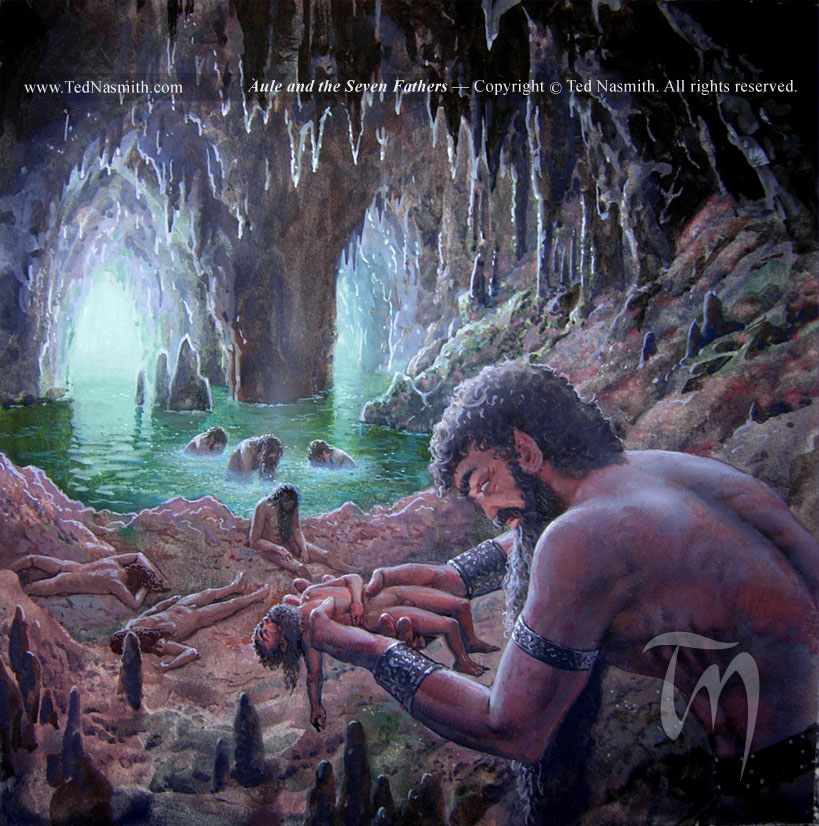
This is one of the only questions we can answer without any doubt.  The Silmarillion tells us that Aulë (who the Dwarves call Mahal) created the seven fathers of the Dwarves and their six spouses before the awakening of the Elves.   Though The History of Middle Earth talks about the fact that Tolkien had plans to rewrite this piece quite drastically (adding many more Dwarves) he in the end never did.  So we can be sure that all Dwarves that roamed Middle Earth were in fact descendants of this first generation of 13 Dwarves.

Ted Nasmith's  Aulë and the Seven Fathers

Ted Nasmith’s
Aulë and the Seven Fathers

* How many children do Dwarves have, how many Dwarves choose to have children and at what age do Dwarves have children?

From the start, we can see something odd about the Dwarven population… it has more males then females.   This odd feature is apparently still in place well in the third age, in fact – using Gimli as our source – the gap between the sexes has become even worse: “It was said by Gimli that there are few dwarf-women, probably no more than a third of the whole people.” (From the Appendices in The Lord of the Rings).

I believe we must be extremely careful with this statement, as if we draw the wrong conclusions here; based on this quote, our end result could be way off.

Though this is the opinion of one dwarf, we have no reason to doubt our good friend Gimli here.  In fact he is one of the rare direct sources we have related to the customs of the Dwarves of the late third age.  So let us assume indeed that only 1 out of 3 is female.

Unfortunately fewer still will ever give birth, as less than one-third of all males ever choose to marry….

“For Dwarves take only one wife or husband each in their lives, and are jealous, as in all matters of their rights. The number of dwarf-men that marry is actually less than one-third.”

Now, it could be argued here that Dwarven women would not need to marry to have children.

On that topic I would like to refer to the article on marriage customs.  Where the link between sexual relations and marriage is explained in more detail.    In short, if we follow Judaic customs and Tolkien’s own writings, having sexual relations would mean you are in fact engaged to be married, meaning that a pregnant dwarf is a married (or soon to be married) dwarf.

Now, if the above (less than 1 out of 3 dwarf women would give birth) would be a fixed rule we would have a major issue from the start, as that would mean that out of our 7 clans only 2 would have survived past the first generation.  We know from Tolkien’s own writings that this is not so. As he writes that in the Second Age 7 rings were given to 7 Dwarven kings.  Clearly indicating that all the seven clans survived well beyond the first generation and at the same time also indicating that this rule “less than 1 out of 3 dwarf women would give birth” is not a rule that applies to all ages and is likely to have been valid more for the Dwarves of the late third age then those of earlier ages.

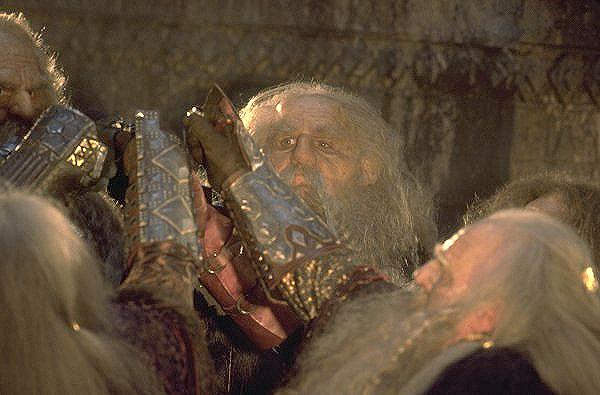
Some of the Seven Kings of the Dwarves

Some of the Seven Kings of the Dwarves

Given the fact that Tolkien stated that the Dwarven population was on the decline by the end of the third age, we can be sure that at some point in the past it was in fact on the rise (otherwise there would likely not have been any population at all past the first 3 generations).

Tolkien gives us a very decent hint on one actual Dwarven population, be it extremely indirectly…

In the Silmarillion Tolkien mentions that the Dwarves of Belegost went to war along side the Elves and Men during the Battle of Unnumbered Tears.  Though no direct number is mentioned as to the size of the Dwarven host, there are ways we can make a founded estimate – (Mythlore, Number 51, Volume 14, No.1, ‘The Kindreds, Houses and Population of the Elves During the First Age’, 1987; Mythlore ISSN:0146-9339, a detailed study of the numbers of Elves). From this 1987 article and from more recently published volumes of The History of Middle-earth (e.g.: Vol. XI, pp. 380-381, pp. 420–423; Vol. XII, p. 307, “two thousand full grown men”). relatively sound estimates can be drawn of the numbers of Elves, Men AND Dwarves.    

If we additionally consider that Tolkien stated that Dwarven females were fiercely guarded, it would be very unlikely that there were many Dwarven women in the army of King Azaghâl (as the risk too lose the valuable women folk would be far too high).  This study gives us a minimal number of male Dwarves of Belegost (this just being one of the seven clans), being 6.000.   With this number in mind and what we know about female Dwarven numbers, the total Dwarves of Belegost would have at least been 9.000.

Seeing that at that point in time no other major battles would have happened that impacted the dwarven clans, we are looking at (at least) 63.000 dwarves of all Seven Clans by the year 468 of the First Age.

From the time the second generation of Dwarves was born, till the time of this battle, over 4000 years would have passed. Now to achieve these population numbers in this period of time all Dwarven females that had chosen to marry (and had the chance to have children) would have had on average 6 children.  Taking into account also that most Dwarves would rarely get married before the age of 90.

* What impact do war and times of troubles have on their numbers?

In short… a devastating impact.

The history of the Dwarves is filled with battle after battle; the vast majority of those battles would have greatly impacted their numbers.

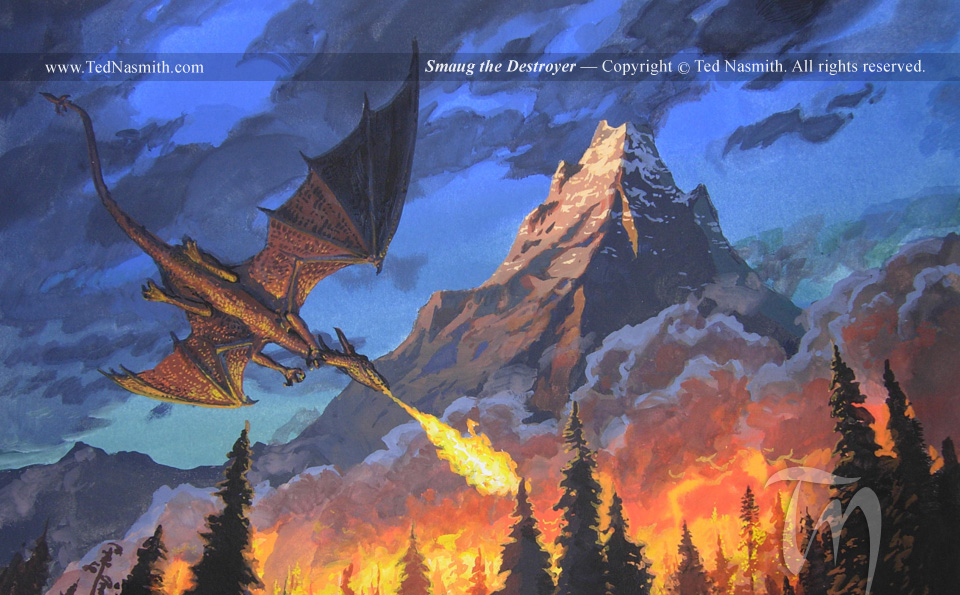
For example, the biggest battle of all Dwarven history, The Battle of Azanulbizar, wiped out half of all Dwarves alive at the time.   The battle of Sarn Athrad for instance almost killed all the Dwarves of Nogrod.  Tolkien often gives us a very clear overview of battles the Dwarves were in, and the impact some of those battles had.  In addition, dramatic events such as the arrival of Smaug at the Lonely Mountain, further desecrated Dwarven numbers (especially those of the Longbeards).

Ted Nasmith's Smaug the Destroyer

Ted Nasmith’s
Smaug the Destroyer

Taking the above into account and the previously mentioned slow population growth, we have a clear opportunity of estimating the Dwarven population in the third age.

We however have two problems with this… 1) Tolkien mentions next to nothing about the 4 clans in the East (Blacklocks, Stonefoots, Ironfists and Stiffbeards).  2) He also focuses almost exclusively on the battles and events where the Longbeards were involved in.

So when we ask ourselves “how many Dwarves were around by the late third age”, we can only base us on the Longbeard clan.  Seeing that this clan had a tremendous amount of devastating wars and battles in their history, we can assume that their numbers would likely be one of the smallest clans (with the exception of the Firebeards and Broadbeams perhaps – who saw their ancient halls of Tumunzahar and Gabilgathol ruined at the end of the First Age).

* What impact does the availability of food have on their numbers?

Little to none.   Unlike men Dwarves could suffer great hardships and still come out on top.  The best example of this is Khazad-dûm being closed off after the Sack of Eregion in 1697 S.A and being opened once again some 1700 years later.   No trade of food went into Khazad-dûm, so they were solely reliant on their own food supplies and whatever they could grow under the mountain.  They might not have flourished during this time, but at least they did more than just survive.  As the first thing they did when opening the gates of Khazad-dûm again, was go to war (The Last Alliance).

* What interaction was there between the various halls of the Dwarves?

Now this might seem an odd question at first when trying to calculate Dwarven population numbers.  However, the reasoning behind this question can have a tremendous impact on our outcome.  Let us, for the sake of an example, say that there was only one clan and all Dwarves lived in one Hall.  This would mean that the females that wished to marry would have more potential male mates outside of their own family.  This would result in potentially more births.  While if Dwarves would live in very small groups far away from other Dwarves, their potential mates could perhaps be limited. This could result in fewer births.  Now if the interaction between the various halls of the Dwarves would be high, this problem could be avoided, not impacting the maximum potential births.

Tolkien tells us that the females rarely traveled from their Halls and at the same time also tells us that Dwarven traders were a frequent occurrence in Middle Earth, meaning that (most likely the male) Dwarves traveled freely within the Western regions.   I say “Western regions”, as it can be believed that the Eastern clans rarely traveled west, due to great distances.  Another reason I believe the Dwarves of Eastern clans would rarely come to west can be found here: “But now Frodo often met strange dwarves of far countries, seeking refuge in the West. They were troubled, and some spoke in whispers of the Enemy and of the Land of Mordor.” (FoTR, The Shadow of the Past).

These “strange dwarves of far countries”, could not have been Longbeards, as these were frequently seen on the trade routes that passed through the Shire.  Hence must have been dwarves of the Eastern clans, and indeed these rarely traveled to the West.

Throughout Dwarven history the population numbers of the Longbeards would have been great enough to not be impacted by a limitation of potential partners.  This I believe changed drastically in 1981 T.A, when Khazad-dûm was lost and Durin’s Bane drove out the remnant of the Longbeards into exile.   From that moment on their history is one of woe and war, further impacting their already dwindling numbers.  Smaug dealt a further blow to their number and the Battle of Azanulbizar almost finished off their clan (in addition impacted all clans tremendously).  Directly after the Battle of Azanulbizar the amount of males would have likely been equal to the females, if not less.  Seeing that Dwarven females – who likely survived hidden away in their halls during the battle – only marry that one dwarf they have their heart set on, changes are quite big there were less births in the generations that followed these dramatic events.

Thorin at the Battle of Azanulbizar ® & ™ 2012 Warner Bros, Entertainment Inc. All Rights Reserved.

Thorin at the Battle of Azanulbizar
® & ™ 2012 Warner Bros, Entertainment Inc. All Rights Reserved.

* Adding up what we know

Taking into account all the various factors mentioned above we can make a calculation on what the numbers of the Dwarves would have been like at the end of the Third Age – at least what Durin’s Folk is concerned.

This tells us that there were likely around 10.000 Longbeards at the end of the Third Age, the vast majority of which would have lived in the Lonely Mountain.  This number is in sharp contrast to the number that would have lived in Khazad-dûm in the mid third age, prior to the awakening of the Balrog, were we likely would have seen close to 100.000 Longbeards.

So, our calculation model seems to be very in line with Tolkien’s writings, where he says dwarven numbers were dwindling.

It is more difficult to say how many Eastern clan dwarves would have been around, however we do know that their Halls were often the target of dragons as well, in addition to all of them having suffered the same fate at Azanulbizar.  This leads me to believe their numbers were very close to that of the Longbeards, if not less.

The Firebeards and Broadbeams, who lived in the West alongside the Longbeards would likely have had fewer numbers that the Longbeards, between 1.000 and 3.000.  Unlike the Longbeards their halls were ruined at the end of the First Age.  The Dwarves of Nogrod (most likely the Firebeards) were likely the smallest of all clans due to the battle of Sarn Athrad in the First Age.

So if we add up our estimates of all 7 dwarven clans, there would have been between 50.000 and 60.000 dwarves in all of Middle Earth at the end of the Third Age.

Posted in Life & Death | 4 Comments

The Resurrection of Durin

As my regular PC is in the shop, the neo-khuzdul translations I was working on grinded to a sudden halt.  Though I had made a backup of most of the documents I was working on, some of the files are just too enormous to run on my little old backup-PC.

Hence the idea of writing another article for the blog in the meanwhile slowly took form.  Asking around for suggestions I quickly received some superb ideas concerning things people always wanted to know about the dwarves, but never had seen answered.   I believe I have received enough excellent suggestions to create many new articles in the months to come.  So thank you all for that.

There were many ideas I wanted to start researching straight away, one of them jumped out just a bit more than the others, which is the topic I want to talk about now.

Mike. wrote: “I never understood how the whole resurrection of Durin worked.  Was Durin II son of Durin the Deathless? If he was, how could Durin the Deathless have been “reborn” in Durin II, if they at one point were both alive?  Also, Tolkien says that Durin the Deathless died at the end of the First Age, living longer than any other dwarf. Yet at the same time says that Durin’s line never failed, from father to son.  Surely Durin must have seen his children die and grandchildren die, perhaps even many generations.  How did he hold his line in check from not claiming the thrown during his reign?  Looking forward to your view on my questions DS”

Thank you so much for your excellent question Mike.

Let me start with your first question: “I never understood how the whole resurrection of Durin worked.  Was Durin II son of Durin the Deathless? If he was, how could Durin the Deathless have been “reborn” in Durin II, if they at one point were both alive?

For those that don’t know exactly what you are talking about, this refers to appendix A in the appendixes of Rotk

There he lived so long that he was known far and wide as Durin the Deathless. Yet, in the end he died before the Elder Days had passed, and his tomb was in Khazad-Dûm: but his line never failed and five times an heir was born in his House so like to his Forefather that he received the name of Durin. He was indeed held by the Dwarves to be the Deathless that returned, for they have many strange tales and beliefs concerning themselves and their fate in the world.

In this quote I believe we already find the answer to your first question. In my opinion Durin II could not have been the son of Durin the Deathless.   Apart from writing “Forefather”, Tolkien writes: “the Deathless that returned”.  If both were alive at the same time he could not have “returned” at the time of the birth of Durin II, as he was still alive.  Some have suggested the possibility that the soul of Durin the Deathless would have transferred to Durin II on the night of his death, but I cannot agree with that as I find it to be contradicting to the quote above.   Now, according to me this does give us a hint when Durin II would have been born.   “…an heir was born in his House so like to his Forefather that he received the name of Durin. He was indeed held by the Dwarves to be the Deathless that returned …” This means it is very likely that the dwarves would have known the previous Durin when the heir was born, to be able to judge this likeness.  It is possible off course that statues of the previous Durin existed.  Meaning that Durin II was likely born at the start of the Second Age, as we know Durin the Deathless died at the end of the First Age, so keeping their lifetimes within one generation of each other.

Tolkien strengthens the idea that Durin II was no son of Durin the Deathless in this quote from Last Writings (HoMe XII):

“For the Dwarves asserted that the spirits of the Seven Fathers of their races were from time to time reborn in their kindreds. This was notably the case in the race of the Longbeards whose ultimate forefather was called Durin, a name which was taken at intervals by one of his descendants, but by no others but those in a direct line of descent from Durin I… Of these Durin’s the Dwarves reported that they retained memory of their former lives as Kings, as real, and yet naturally as incomplete, as if they had been consecutive years of life in one person.
How this came to pass the Elves do not know; nor would the Dwarves tell them much more of the matter. But the Elves of Valinor knew of a strange tale of Dwarvish origins, which the Noldor brought to Middle-earth, and asserted that they had learned it from Aulë himself… The Dwarves add that at that time Aulë gained them also this privilege that distinguished them from Elves and Men: that the spirit of each of the Fathers should, at the end of the long span of life allotted to Dwarves, fall asleep, but then lie in a tomb of his own body, at rest, and their its weariness and any hurts that had befallen it should be amended. Then after long years he should arise and take up his kingship again.”

For some the last line “Then after long years he should arise and take up his kinship again.” Was seen as a sign that every Durin was in fact the very same dwarf.   I don’t entirely agree with that assumption.  As the “he” in “he should arise” refers to the spirit of the Father (in this case Durin).  Tolkien states clearly that he rests in a tomb of his own body.  So the body of Durin the Deathless did not arise to walk Arda again, yet his spirit did and found a new home in the body of his own offspring.   So not a resurrection, but a  reincarnation in fact.

It is interesting to notes that this isn’t something exclusive for the Longbeards, but this gift was given to all the seven fathers.

This does make me wonder one important thing though, how did the dwarves know without a doubt that the son of the current King was indeed the spirit Durin the Deathless reborn ?

“…an heir was born in his House so like to his Forefather that he received the name of Durin.”

“Of these Durins the Dwarves reported that they retained memory of their former lives as Kings, as real, and yet naturally as incomplete, as if they had been consecutive years of life in one person.”

This would indicate that the dwarves did not give their children* an outer name at birth (*or at least those of direct Royal line).  The likeness here could have be physical, but would obviously have been spiritual.  Tolkien stated that dwarves were born with beards, perhaps the beard of the new-born was like that of Durin the Deathless – though I doubt a new-born dwarf would have had a beard alike to that of an elder dwarf (yet, perhaps that was the likeness that gave it away).  But as it was the spirit that found a new home in the young dwarf, it would be logical that the dwarves would wait for some sign of the little one to indicate it was indeed Durin the Deathless reborn.

As the dwarves have both an outer and inner name (see previous articles on this), there would have been no pressure for the father of the young dwarf-prince to give his heir an outer name, as the child already had a name used by his family (his secret inner name).  In addition to the fact dwarven children are hidden from the outside world, as their parents are highly protective of them, the inner name would suffice for years.  Until the young heir was old enough to venture out of the Halls of his father would an outer name really be of any use.   Meaning that there was plenty of time for young dwarf prince to prove that Durin the Deathless had returned within him.  As the memories of Durin the Deathless would have been as real to the young dwarf as his own, this should not have proven too much difficulty to convince the dwarves that Durin was reborn.


Turning to the second part of Mike’s question:

Also, Tolkien says that Durin the Deathless died at the end of the First Age, living longer than any other dwarf. Yet at the same time says that Durin’s line never failed, from father to son.  Surely Durin must have seen his children die and grandchildren die, perhaps even many generations.  How did he hold his line in check from not claiming the thrown during his reign?”

Most would think that Durin the Deathless would have seen many of his children and grandchildren die.

I don’t agree with that myself.  Though Tolkien mentions that no other dwarf lived longer than Durin the Deathless and that this gift of long life became less with every generation, being stronger though with those that were named Durin.  We must not forget a very important detail in this story, and that is that the Fathers (and their spouses) were laid to sleep for a very long time. During this time they obviously had no children, hence their first children were born long after they themselves were created.   So, did Durin see any of his offspring die before he himself passed away?

Well, we know that by the third age life-expectancy of the dwarves had been reduced to around 250.  Which is indeed true for the majority of the Kings mentioned in Tolkien’s overview of Durin’s Folk.  Durin the Deathless was created by Mahal many years before the awakening of the Elves.  So let’s say he was created in the year 900 of the Years of Trees.  And died at the end of the First Age, for the sake of our example here, let’s say in 567 F.A. This would fit with all of the known lore.  This would make Durin the Deathless 6316 Years old at his time of death (multiplying Valian years with 9,582).

Knowing that the children of the first generation were born after 1090 YoT (after the dwarves awake) and gently reducing the age expectancy with 3 to 9% every generation until we reach the end of the First age (when Durin the Deathless died) we notice that the next in line to be King would have been Durin’s eldest son, who himself would have likely reached the fine age of 5000 (deducted by the notion that age expectancy gradually reduced over time).   This means that Durin the Deathless would not have seen any of his children or grandchildren die.  Though his offspring was not as long lived as him, the fact that he slept for a very long time before he had children allowed him to see many generations be born and none of them die.

The children of Durin the Deathless would not have been that lucky unfortunately, as they would have seen many generations of their offspring die (as their offspring died earlier each generation).

It could be argued off course that as they were long-lived they likely had children at still an older age than dwarves in the 3rd age.  I don’t believe this would have been the case.  For three reasons:

* Tolkien mentions that the army of King Azaghâl in the Battle of Unnumbered Tears numbered 6.000 dwarves. Assuming that the majority of the male Broadbeam dwarves entered this battle, this gives us a clear view on dwarven population numbers of this period.   If it was the custom of the Kings of old to have children at an age far greater than one-hundred (which is about the dwarven custom), it would simply have been impossible to reach this number of 6.000.   To reach this number the dwarves of elder days would also have fathered many more children than was the custom by the third age. But more on that topic in a future article.

* In HoME XII a similar question is raised (How many Kings were there between Durin I and Durin IV?) and it seems Tolkien changed his mind a few times on the topic.  On a piece of paper he had first written “5”, which he later replace by “12”, and later still by “many”.  This is speculation, but perhaps it can be suggested that Tolkien also did the math and noticed that it would have taken many dozens of generations to given them the numbers he had in mind.

* When Mahal created the seven fathers they were already adult dwarves, ready to have children of their own. They slept for about 200 years of the Trees (about 1800 years in our reckoning), so for them to wait any longer still to have had children would not make any sense, nor would it make possible the dwarven numbers that are mentioned in later stories.

You also asked: “How did he hold his line in check from not claiming the thrown during his reign?”

Well, I don’t believe this would have been a problem that Durin the Deathless faced himself.  He was Mahal’s first dwarf and his son would have become the next King after all.  This problem would have arisen with his grandchildren and those that followed.  As they became old and eventually died, while the son of Durin was still alive.  After a few generations you might expect that sooner or later an heir was born that did not agree with the fact that he was not going to be King, due to the fact that his great-great-grand-daddy, the King, was still around.

I personally doubt that however, as the important thing here is that we should not compare the behaviors and succession customs of men with those of dwarves.   The succession of the Numenorean Kings saw such problems, as a result of their extended age they chose to have children at a later age (some having children still when they had passed the age of one-hundred).  This ensured they did not have too many living generations in their line, making their rule a more solid one as there were less contenders for the crown.  With the dwarves I cannot see this happen so easily as we must not forget that Mahal made the fathers (rulers of each house) and their line was practically a sacred institute. The Kings of men did not necessarily come in a straight line from the very first man that roamed the East, hence the line of the Kings of men could have been contested more easily as well.   With dwarves, challenging that “sacred institute”, would have been “not done”, as in a way it would have challenged the wisdom of Mahal himself.

I hope that answers your great question Mike, and it proves interesting reading for all.

Posted in Characters, History, Life & Death | Leave a comment

LoTRO: Grand Travelling Dwarrow Fayre (Laurelin)

The combined Kinships of Durin’s Folk and Khuzd Belkul are hosting a Grand Travelling Dwarrow Fayre!

Starting in Frerin’s Court at 8pm (BST) on Wednesday 24 April, the Fayre will travel to Needlehole on 25th, Bywater on 1st May and finish in Bree on May 2nd. All dwarrow traders are invited to contact Hanfur to secure a stall. Entertainers of all races are also invited to perform.

Date: April 24th, 2013 – May 2nd, 2013
Time: 15.00-19.00 (ST)
Location: Frerin’s Court, Needlehole, Bywater and Bree

Event details:

The first Travelling Dwarrow Fayre is about to begin! Join the brothers and sisters of Durin’s Folk and Khuzd Belkul in their caravans as they traverse Ered Luin, The Shire and Breelands to bring the finest Dwarrow goods to the people of Middle Earth. All dwarrow traders are welcome to register with Hanfur, fayre organiser, to sell their wares.

Ale and vittles will be avaiable with the finest entertainment in Eriador. Do not miss this unique event! Stalls, Games, Music and dancing. Even if you’re not buying come along and enjoy true dwarrow hospitality.

Dates:
Wednesday 24 April at Frerin’s Court, begins 3PM (ST)
Thursday 25 April at Needlehole Trading post, begins 3PM (ST)
Wednesday 1 May at Bywater (Green Dragon), begins 3PM (ST)
Thursday 2 May at Bree (Stone quarter market place), begins 3PM (ST)

OOC details:

Anyone wishing to sell (dwarves only) or entertain (all races) contact Hanfur in game or at hanfur@me.com. Rogue traders will meet an untimely end.

Posted in Durin's Folk Kinship, Events, LoTRO | Leave a comment

“Who’s the Bride ?” – Dwarven Marriage

Updated: August 4th 2015 (Added DS Neo-Khuzdul translations)

My thanks to Merrydew that gave me the idea to look into this topic almost a year ago.

—–

As we know Tolkien provides very little information with regard to the customs of the dwarves, compared to that of the elves it’s almost nonexistent. So when we want to delve into something like the topic of marriage, the procedures of a marriage, the methods of finding a spouse, the form of the wedding ceremony, and the nature of the marital relationship we are forced to think in terms of conjecture.  In other words, what do we think could be true (without breaking any of Tolkien’s lore).

So what do we know from Tolkien related to the marriage customs/relations of dwarves… our “core facts on the topic” are:

* Only 1 in 3 dwarves are female, and not all females choose to marry.

* Few dwarves wish to marry (some are more interested in their crafts than a spouse)

* When dwarves marry they marry for life, choosing only one partner in their life.

* Female dwarves are never forced against their will to marry.

* Dwarves marry late, seldom before they are ninety or more.

* When dwarven women marry they join their husband’s family.

* If female dwarves could not marry the dwarf of their choice they would have none.

With the above in mind, how do we proceed to expand what we already know ?  My way of working has been to look at Jewish customs (as Tolkien often used the Jewish people as a base for his dwarves).

It has been quite a study, of which the details can be found in this article.  For those of you who however wish to know the basics of the dwarven marriage, here is an extremely brief chronological summary:

  • The female dwarf would select her husband to be
  • The male dwarf would have the right to accept or deny
  • If he denies she will not marry any other for the rest of her life, If he accepts he will do so by offering her his “acquirement sum, which can be a contract (“zarb”), sum of money or sexual relations (or a combination of these).  The groom will usually visit the halls of the bride and give the acquirement sum to her, after which they will together make the zarb.
  • An acceptance by the bride means the couple enter the stage of betrothal, or “azlâf” (“sleep”).
  • During this period the male is required to make a home where the couple will live (an extension of his Halls).  While the female dwarf will make the clothing she will wear for the wedding.
  • Shortly before the father of the groom approves the new house of his son he will inform family and friends that the Halls of this son near completion, meaning that the guests should make their way to the halls of his son as the wedding is near.
  • When the father of the groom approves of the house his son has made he will allow this son to inform his bride that the betrothal will end soon and the marriage, or “abkân” (“awakening”) will take place (usually the week after).  A friend of the groom will blow a horn in the Halls of the bride informing all of the wedding and the wedding date.
  • The week before the wedding the groom enjoys a bachelor party (be it in a different form) and the bride receives gifts from her guests.
  • The family of the groom will prepare the Halls of the groom for the ceremony and the festivities. The family of the bride will prepare to leave their halls in safety to travels to the Halls of the groom.
  • On the day of abkân the family of the bride travels to the halls of the groom (a well-armed force to protect the bride on her first voyage)
  • When arriving at the halls of the groom they are met with great celebrations
  • The ceremony proceeds (explained in detail below)
  • There is a feast for seven days
  • The newlyweds go to their new home and have sex
  • The couple will start to save for the acquirement sum of their own offspring.

For those brave amongst you… or those that wish to know more about the above summary, read on and enjoy 🙂

Delving Deep, a prepared study.

The first thing I did however was not related to the Jewish community at all…  I tried to look at other cultures around the world (both present and historically) where the men outnumber the woman greatly, looking at the impact on marital relations and seeing if there is something that we could learn that would fit the dwarves.

Seeing that this article is already very long as it is, I have decided to spare you the study of skewed man/woman gender radios of China and Qatar, as frankly they did not provide any new insight.

Which leads us to our best possible source for more on the dwarven culture, one that Tolkien openly used… the Jewish culture.

The method of finding a spouse, the form of the wedding ceremony, and the nature of the marital relationship are all explained in the Talmud.

Obviously copy/pasting what we find here won’t do.  We need to find aspects of these customs that fit our core Tolkien facts established at the start of this article.

Reading all what I could find related to Jewish marriage customs in the Talmud has proven to be an education on its own, one I would recommend to all regardless of your own faith.   Though it must be said, I’m sure I only scratched the surface as it would take a life time to truly read all on the topic.

Now there are some things within the Judaic marriage customs that strongly oppose our established dwarven facts, these off course have not be included in our theory of the dwarven marriage customs.  Some examples of that would be polygyny (though never common in Judaism it was permitted), remaining unmarried (refraining from marriage is considered to be unnatural in Judaism) or divorce (allowed in Judaism).


DEVINE DESTINY

I long doubted about using something like the concept of “bashert”.  Those not familiar with the concept of “bashert”, according to the Talmud, Rav Yehuda taught that 40 days before a male child is conceived, a voice from heaven announces whose daughter he is going to marry (talk about a match made in heaven!) In Yiddish, this perfect match is called “bashert,” a word meaning fate or destiny, but it is usually used to refer to one’s soul mate. Seeing that most dwarves do not bother with marriage at all, “bashert” could not apply to them. As that would mean that for every dwarf male that would be born Mahal would assign a dwarf female that would later become his wife.  There would simply not be enough women to go around. Nor do I believe Tolkien meant for Aulë, “the great smith” to become “the great matchmaker”.

On the other hand Aulë did create 6 spouses for the dwarves, talk about a matchmaker… he not only coupled the dwarves, he literally created their wives for them.   So where would a concept like “bashert” fit in with the dwarves ?   Seeing that dwarven women would not marry against their will and their choice would be one for life, one could argue that their choice would be a divine one, similar to the one Mahal himself made when he made a wife for 6 of the dwarven fathers. Although “bashert” in its original meaning would not be applicable for the dwarves, it surely would seem logical that the dwarves would relate their marriages to the first ones made by Mahal himself, hence seeing the commitment as a divine choice.

How would the dwarf woman know she has indeed found her “divine choice”?  When in doubt she should perhaps hold off on marrying someone for fear that the person she would want to marry might not be her “bashert”, and there might be a better match out there for her ?

Well, this simply would not apply to the dwarven women to begin with. Tolkien tells us that when dwarven women make their choice and they could for whatever reason not marry that dwarf, they would not have another.  So, waiting for another is something that would not cross their mind.  They would be 100% sure of their choice. So, from the moment she believes she has found her dwarf, that would be it, that would be her “bashert”.


Acquiring a Spouse

Firstly, in all cases, the Talmud specifies that a woman can be acquired (i.e to be a wife) only with her consent, and not without it. Kiddushin 2a-b.   I believe Tolkien clearly got his inspiration from this when he said the dwarven women could not be forced to marry.

Mishnah Kiddushin 1:1 specifies that a woman is acquired (i.e., to be a wife) in three ways: through money, a contract, and sexual intercourse. Ordinarily, all three of these conditions are satisfied, although only one is necessary to effect a binding marriage.

Now how would this translate to the dwarves?  It is important to remember that “acquiring” a wife does not mean that you buy the woman, who would become a piece of property.  In fact, as we have established, the woman is in fact the one that decides if she will take a man, the man can only accept or deny – when he denies he in fact “condemns” the woman into a state of unaccepted love for the rest of her life (as she will not have another).   So, “acquiring” a wife is in fact a symbolic demonstration of the husband who accepts his future wife.

Which can be done through money, sexual intercourse or a contract (or a combination of these).

Knowing the love of dwarves for gold and a good contract (referring to Bilbo’s burglar contract). It would seem very logical that the acquiring would solely be done through an extensive contract and a decent sum of money, gold or gems. Some might believe that, considering Tolkien’s catholic belief that sex is the product of a healthy marriage, it would seem unlikely that Tolkien would have thought of sexual intercourse as being a fulfillment to enter into marriage.   Well, nothing could be further from the truth, in Morgoth’s Ring by Tolkien (Laws and Customs of the Eldar) we see that for the Elves sex is marriage (more on this on: http://www.realelvish.net/an_elven_wedding.php).   Similar to the Elves, when two dwarves would have sex, it would mean the dwarf male would have acquired his wife for marriage and by doing so would enter into an automatic state of betrothal (more on that later).   Unlike the Elves though they would not be married yet.

In case the wife is acquired by a sum of money, why would it need to be a “decent” sum of money, and not a mere copper coin ? In Judaism the amount of money involved is nominal (according to the Mishnah, a perutah, a copper coin of the lowest denomination, was sufficient). So why state a large sum of money would be appropriate ? Well, because these are dwarves, and they value gold and other treasures from the earth above most things in life.  Which means that the acquirement by one copper coin would be seen by the dwarven woman as an insult. As the sum of the acquirement would be an indication of how the husband views his future wife.

Seeing that a dwarven father would not wish to have his family shamed when his son would marry (in case the acquirement sum would be viewed by the bride as an insult), it would be a custom for dwarven families to set aside gold, gems and coins for the marriage of their son, often from the moment that the newlyweds move into their new home before any child is born.  Seeing however that only 1 in 4 male dwarves marry, a family would usually set aside one of these acquirement sums.

Tolkien writes that dwarven women were fiercely protected by the male dwarves and seldom left their halls.  Which means that their fathers would have protected them within his halls as long as they were unmarried.  When a male dwarf would offer the acquirement some, this would be accepted by the female dwarf, who at that time would still live in the halls of her father. Her property would in effect than also belong to her father.  Meaning that the acquirement sum would in fact be a payment made by the daughter to her father for shielding her during her youth. She would off course not be “obliged”, in the strict sense of the word, to offer the entire acquirement sum to her father, but on the other hand, whatever sum she would take with her to the halls of her husband would be a public insult to her own father.

To satisfy the requirements of acquisition by wealth, the sum of acquisition must belong to the groom. It cannot be borrowed, although it can be a gift from a relative (in most cases the parents of the groom). It must be given to the wife irrevocably. In addition, the value must be known to the wife, so that there can be no claim that the husband deceived her into marrying by misleading her as to its value.

The wife keeps (from the moment it has been signed by both parties) the marriage contract, in Khuzdul the “zarb” (from roots ZRB – as in mazarbul – “that which is written” / in Judaic custom the “Ketubah”, meaning “writing”). The “zarb” spells out the husband’s obligations to the wife during marriage, conditions of inheritance upon his death, and obligations regarding the support of children of the marriage. There are standard conditions; however, additional conditions can be included by mutual agreement. Marriage agreements of this sort were commonplace in the ancient Semitic world and considering the fondness of dwarves for a good contract, I can imagine these would have been at least as extensive as Bilbo’s contract.

Although the zarb has much in common with prenuptial agreements, it should not be compared to it. As prenuptial agreements automatically suggest the events in case of divorce.  The zarb has nothing to do with divorce as it is a concept unfamiliar to dwarves.  Its purpose is to declare to the Halls of both bride and groom in what manner the couple will care for each other till death (a more symbolic part of the contract) and ensure their offspring will gain the riches which they are entitled too (in effect an insurance of wealth).

The zarb would have been written in Khuzdul, the language taught to the dwarves by Mahal.  Seeing that khuzdul is considered a secretive language of the dwarves it would not be framed or displayed in the home (unlike the Judaic custom) but would be guarded as a treasure and heirloom of the family until the conditions of the zarb were fulfilled (in most cases after the settling of the child(ren)’s inheritance after the death of the both parents), which meant the “zarb” would be a well-guarded contract of tremendous worth for usually over 160 years.

The Process of Marriage 

Bethrohal (sleep – azlâf)

In Judaism, the process of marriage occurs in two distinct stages: kiddushin (commonly translated as betrothal) and nisuin (full-fledged marriage). Kiddushin occurs when the woman accepts the money, contract or sexual relations offered by the prospective husband. The word “kiddushin” means “sanctified”, it reflects the sanctity of the marital relation, however also connotes something that has been set aside for a sacred purpose.  In short, the woman has been set aside to be the wife of the particular man and no other.

This stage of betrothal is far more binding than any engagement as we understand the term in modern English; in fact, Rambam speaks of a period of engagement before the kiddushin. Once kiddushin is complete, the woman is legally the wife of the man. The relationship created by kiddushin can only be dissolved by death or divorce. However, the spouses do not live together at the time of the kiddushin, and the mutual obligations created by the marital relationship do not take effect until the nisuin is complete.

Translating this to the dwarves would seem rather straightforward, without breaking any of our core facts.  The two stages would be the “azlâf” (the sleep – referring to the betrothal) and the “abkân” (the awakening – referring to the full-fledged marriage). These terms refer to the times where the fathers of the dwarves slept together with their spouses (safe Durin) and awaited the moment of awakening so they could live the remainder of their lives together.

In Judaism the second stage is the “nisuin” (meaning “elevation”) which completes the process of marriage. The husband brings the wife into his home and they begin their married life together. In ancient times these two ceremonies would routinely occur as much as a year apart (today however these are performed together). Between these two ceremonies the husband would prepare a home for the family.

When translating this to the world of the dwarves, this however might not be as straight forward as it looks.  We should not forget that the dwarven women were considered to be true treasures of the Halls and they were guarded fiercely.  This meant that the father would not let his daughter from his sight when moving beyond his own halls until the time that “abkân” was completed, and his daughter would be entrusted in the keeping of her new husband.  In practice this would mean that when “azlâf” was accepted by the groom he would bring his bride her acquiring sum, in the halls of her father.  This would be a solemn (and very public) moment as the dwarves of the Halls of her father would judge the sum carefully. The groom would then return to his own halls and prepare them for his wife to be. In the meanwhile, while azlâf continued, the bride would guard her acquiring sum, while her father would guard her. During “azlâf”, the bride would naturally remain in the halls of her father.

The Marriage (“awakening” – “abkân”)

Dwarves have a betrothal, that usually lasts about a year, followed by a wedding. The actual wedding ceremony would only take place when the father of the groom believes his son has done the required preparations for the new home of the couple. Meaning that when the father of the groom would give the “go” and with that approves the home he has prepared for his bride, the groom would see to announce the marriage in the halls of the bride (similar to ancient Hebrew customs).

This means that dwarves can never know in advance the exact date of the wedding, in fact the bride would not even know. When the new home is as-good-as-finished however the father of the groom would send out letters to both his own family and that of the bride.  The letter would serve as an early warning that the wedding would happen soon, stating: “The Halls of my son near completion”, basically meaning: “start your travel to the halls of the groom* as the wedding is about to happen soon”.  When the father of the groom finally approves the home his son has delved for his wife, he would call his son to him and give his blessing.  The groom would than appoint a herald (usually a close friend of his) to travel to the halls of the bride carrying a horn.  Once arrived at the halls of the bride the herald would sound the horn and announce “The groom of …. cometh”. Which for the bride would be like winning the lottery after having waited for a year or so. In all fairness this time would have been used by the bride to fashion her own wedding clothing.  The herald would also announce the date of the actual wedding.  Unless the bride and groom would live more than a week of walking away from each other this would usually be the next week.

*Note that the closest relations of the bride will in fact leave with her and her father from their halls.

The period between the proclaiming of the marriage date and the actual wedding ceremony the couple do not see each other (this refers to the same period in Judaism).  In this period the family of the groom would welcome the arriving guests.  During this period the bride and groom are treated as Queen and King and are to refrain from any laborious activity.  For the groom this usually means a lengthy feast (from dawn till dusk). While for the bride this means she receives gifts from all who visit her.

When the day of “abkân” finally came the father of the bride would lead a hoste of dwarves from his halls.  The larger the hoste the better, as this would ensure greater safety for the bride (who in most cases would venture out her halls for the first time).  We must consider that at this time the acquiring sum also would normally remain in the Halls of the father of the bride. At the same time, in the Halls of the groom, a large hoste of the groom’s kin would make prepare “the welcoming”.  “Admâ” in khuzdul, is a welcoming feast that calls in the end of the “azlâf” and the start of the “abkân”.  When the hoste of the bride and her father would arrive in the halls of the groom the “zarb” would first be read aloud.  This would normally be done by the father of the bride, as the “zarb” is kept with the bride during the “azlâf” (reason for this is that in case the bride would die during azlâf the father of the bride would burn the zarb and dissolve the marriage, while in case the groom would die the bride would burn the zarb herself and live the rest of her life unmarried).

Though the dwarves honour Mahal as their creator and Eru as the father of all and giver of life they do not worship either in what could be called an organized religion, hence there are no religious officials of any kind involved in the marriage.  The name of Mahal and Eru are spoken in the ceremony, reminding all of the beginnings of the dwarves, their first marriages and the seed of their life (referring to the offspring that will grow from the marriage).

Which brings us to the next part…

A Typical Wedding Ceremony

Before the hoste of the father of the bride leaves his halls on the day of abkân, as part of a well-armed (merely to ensure the protection of the bride) family, the entire party is outfitted with masked helms and simple robes (above their wedding attire), so no distinction can be made between the bride and the rest of the party.  The belief here is that in case the party is attacked the bride would not be singled out and would stand a better chance of surviving.   Even when the abkân takes place within the same mountain Halls, the tradition stands.  It is not uncommon that dwarves with small families would pay a large company of dwarves to guard the party of the father of the bride, after all the protection of the bride when on route to her groom is the prime importance.

Dwarven weddings must take place within a mountain or hill, symbolic of their new dwelling together and the husband’s bringing the wife into his new home. (This obviously refers to the Judaic custom of the “chuppah”).

When the party of the father arrives at the Halls of the groom, there are exuberant celebrations and the family of the groom offer gifts to the members of the fathers party.  This is in gratitude for safely delivering the bride to what will be her new home. It is common that the amount and type of gifts would have been decided in the zarb, at the start of azlâf, 1 year prior to the day of abkân.

When the entire party of the father has safely entered the Halls of the groom the mask-helms and simple robes are removed.  This reveals to all for the first time the attire of the bride and her party. The wedding attire of both bride and groom are a symbol of the history and wealth of their halls, a showcase of power of both families. It is custom for both bride and groom to decorate their beards with jewels and gold, in addition to wearing robes of gold and silver color, again to emphasize the wealth of the families.  As marriages are few and far between it is not uncommon for the bride to wear the robe of her mother (the time of azlâf can be used to either make a new wedding-robe or enrich the one of her mother).  Note, that dwarves do not wear a wedding dress, but a formal robe (referring to Tolkien’s statement that dwarven females dress as males), which is often encrusted with a variety of jewels.  Though the wedding robe of the groom can be tailor-made, that of the bride cannot, as she must use the time of “azlâf” to fashion her own attire.  It is not unheard of that other members of the family of the bride assist her in this.

When the bride reveals her robe, her father will start the actual ceremony by holding up a hammer in the air. At this sign the two families will form a large circle around the bride and groom.  This symbolizes the staying of Mahal’s hammer by the grace of Eru and signifies that both families will shield the couple from harm. When the circle is formed the father of the bride lowers the hammer and enters the circle, after which he reads aloud the zarb.  The reading of the zarb can take a tremendous amount of time, as dwarven contract can be quite extensive. Though none of the guests would utter any sound while the father of the bride reads the zarb aloud, as this would be a sign of disrespect, protesting to what both groom and bride have agreed to.

After the reading of the zarb, the bride and groom – who have been on opposite sides of the circle approach each other, followed by the groom that circles the bride (indicating he will guard her in his halls).  The circling of the bride is a joyous event, met with cheers from both families.

When the cheers fade (which can take several minutes, as one family does not wish to appear less overjoyed than the other) the father of the bride will ask the groom if he accepts his daughter in his halls.  The groom would than kneel to the father of the bride as a sign of acceptance, respect and appreciation of the protection the father has given his bride.

The final part of the ceremony then proceeds.  The bride and groom will stand facing each and hold each other’s hands and will recite seven blessings (again another Judaic reference, this time to “sheva brakhos”).  The Seven Dwarven blessings are (note, I’ll see to update this article soon with the Khuzdul translation of these):

  • Mamahdûn Mahal ku’ muha sullu khama akrâzu Sulladad. ((Blessed are you Mahal who has created everything for the glory of Eru.))
  • Mamahdûn Mahal ku’ muha kâmin, abbad ra hanâd. ((Blessed are you Mahal who fashioned the earth, the mountains and the hills.))
  • Mamahdûn Mahal ku’ muha îbin ra ritîh ni kurdû id-abad. ((Blessed are you Mahal who fashioned the gems and metals in the heart of the mountain.))
  • Mamahdûn Mahal ku’ muha khazâd ra barraf haded. ((Blessed are you Mahal who fashioned the dwarves and the seven houses.))
  • Mamahdûn Mahal ku’ gashara khazâd atrâb d’amzur îbin ra ritîh ni kurdû id-abad. ((Blessed are you Mahal who taught the dwarves the skill to work the gems and metals in the heart of the mountain.))
  • Mamahdûn Mahal ku’ mahgayada dûmmâ tur naddanhu. ((Blessed are you Mahal who gladdens our Halls through his children.))
  • Mamahdûn Mahal ku’ mahgayada mayasthûn ra mayasthûna. ((Blessed are you Mahal who gladdens groom and bride.))

These blessings are said by both bride and groom.  The groom would start and the bride would repeat.

The ceremony continues by the groom reciting his vow to the bride:

Ni dûmê zasamkhihiya zahar, ni kurduzi zâmkhihi azhâr. ((In my Halls you will find a house, in your heart I will find a home.))

The bride than replies:

Ni dûmzu zâmkhihi zahar, ni kurdumê zasamkhihi azhâr. ((In your Halls I will find a house, in my heart you will find a home.))

With this vow the groom proclaims to all that the bride is now his wife and she belongs to his clan. Though it is not stated as a question he in fact asks her to be part of his house and love him.  By the fact that the bride replies in this manner she accepts his proclaiming and vows to love him.  This does not mean the groom does not proclaim his own love, in fact the delving of their new home is considered  the proof of the love of the groom for his bride.

This would follow with the giving of the rings.  The groom would hand the bride a golden ring which had markings of his clan on it, while the bride would hand the groom a plain golden ring.  This symbolizes again that the bride is now part of the clan of her husband.

The father of the groom would now hand both the bride and groom the “marriage-ale”, a frothy pint of malt.  Once it has been drunk it concludes the ceremonial part of the marriage, met with great cheers and well wishes.

As is to be expected it, a marriage is followed by a festive meal.  The festive meal is followed by a repetition of the Seven Blessings.  After this the festivities are not over, on the contrary, the dwarves rejoice with seven full days of food, music, dance and celebration – (Referring to the ancient Judaic custom in Jn. 14:10-12).

After the festivities of seven days the husband brings his bride to their new home to live together as husband and wife. At this point it is expected for the newlyweds to have sex which completed the marriage.  As most dwarves marry late (usually after the age of 90) this explains why we notice why the first children of dwarves are usually born when their parents are close to 100 (see Fili and his mother Dís who was 99).

Would there be any music during the ceremony ?  Though exuberant music and dancing would traditionally accompany the welcoming before the ceremony and the festive meal after the ceremony, the actual ceremony would have no music at all. As this would be very disrespectful and could be seen as an actual sign of protest.


Prohibited Marriages  

Only dwarves considered to be adult would be able to marry, which in most cases would make the minimum age for marriage for Dwarves 65, for both males and females.  However the azlâf can take place before that.  Most dwarves (if they would indeed marry, which is the minority still) would wait well past the age of 65. Usually beyond the age of ninety (“Dwarves marry late, seldom before they are ninety or more”).

As mentioned earlier, divorce between Dwarves is not an option. Even when one of the partners dies the marriage is still considered very much alive. Meaning that divorce or marrying a second time is simply not considered. Only until both dwarves would have died and the terms of the zarb would have been fulfilled would the marriage be considered ended, though some would argue that this would only end the marriage on Arda as even then the couple would be in the Halls of Waiting together as husband and wife.

Dwarves cannot marry those who:

  • Are not dwarves
  • Are not of adult age
  • Are a married dwarf
  • Are a widowed dwarf (as they are still considered married even though their partner has died).
  • Are relatives (marriages within the same clan are allowed though are prohibited within four degrees of consanguinity)

Dwarves MUST marry those who:

  • They have sexual relations with.  As noted earlier, having sex would in fact mean they entered “azlâf” (betrothal) which cannot be undone (unless one of the partners would die before the “abkân” (actual marriage ceremony) would take place.


Matchmakers

As dwarven women stay within the Halls of their father before they get married it obviously might not be ideal for them to find the partner of their dreams.  Hence the dwarven female that had a wish to indeed marry would hire a marriage broker or matchmaker (referring to the Judaic custom – “the shadkhan”) that would for her travel to other halls and make arrangements for her to meet other dwarves who she could potentially marry. These meetings would take place within the Halls of her father. Note however that custom would be rarely used.
Posted in Life & Death, Marriage, Women | Tagged , | 52 Comments

The Dwarrow Slacker ?

I’ve been getting a few emails lately by friendly folks asking if I’ve fallen asleep, or worse yet, perhaps had given up on the project to update all neo-khuzdul documents.

Firstly, my thanks to all that have taken their time to send me emails and requests, I much appreciate it.

To answer the question though.  Work and family life have kept me busy of late, though that’s no excuse.  In fact there isn’t anything to excuse for, as I’ve used every spare bit of my time to update and create documentation I hope all will be able to enjoy.

The main culprit has been my completely mad idea to not only redo most of the documentation (and on quite a few parts start anew) but to add to the current documentation AND my recent decision to redo all the neo-khuzdul videos (I just couldn’t leave these as was while the rest was updated).

So, in short… no Dwarrow Slacker here 🙂

I must admit though that I have been close to giving up at times (as the task is massive), but the kind comments of so many people have kept me going.  Thank you again for that all!

So when will this project be finished you say ?

As soon as I’m done and satisfied with the result you can be sure to find the material in your mailboxes.  Might take another month, but hope to get it done sooner.

Thanks for the patience.


Posted in Language | Leave a comment

Salo shares more insight on his Khuzdul.

Greetings friends,

I wanted to give a heads-up to all that I’m nearly done with the updating of the neo-khuzdul documents (and should send them as soon as I can).  I’m merely waiting for some confirmation from David Salo (Linguist who made the neo-khuzdul for The Hobbit movies) on some questions I still had related to his work.

It must be said that I’ve been plaguing David Salo for months now, asking question after question, trying to get the neo-khuzdul on this blog in line with the ideas he had invented, even before the release of The Hobbit movie.  My apologies David 😉

This morning David informed me of a blog he has created where he will be posting more information for all to view… some extracts from the email:

….. I wanted to let you know that your questions (among others) got me to start a blog where I can talk about my version of Khuzdul and similar issues. I’m inviting you to follow it. It’s called Midgardsmal, and it’s located at the URL midgardsmal.com.  It’ll probably start a little slowly, and generally, because I’m addressing a lot of people who don’t have your background or special interests — but it will eventually get into core details about the language…..

So, exciting news…  what are you waiting for friends, have a look!  www.midgardsmal.com

Posted in Language | Tagged , , , | 6 Comments

Traditional Dwarven Map of Middle-Earth

This has been a work in progress for some time now… in between other items whenever I had a moment to spare.

This might be a bit odd to look at, at first, but as is traditional among the Dwarves, the map is drawn with East at the top.

Meaning that the mountains, trees and rivers have been hand-drawn by myself, so apologies for that, as I’m anything but an artist.

Enjoy.

MiddleEarthDwarfMapv2


Posted in Maps | Tagged , , , , | 8 Comments

Zai dashunizu! (At your service!) – 2013 Updates

For those that might think I have forgotten about the affairs of the dwarves, fear not!

In fact, you could not be further from the truth! 🙂

As in the last weeks and months I’ve been tremendously busy updating all the neo-khuzdul documents (with brand new “The Hobbit: An Unexpected Journey” material).

In addition The Hobbit movie has really kept me busy as I’ve received a ton of emails from friendly and eager enthusiast wanting to pick up the language of our dwarrow friends.

To all of you that have sent me emails… thank you so much.  And yes, I’ll soon publish all the new documents and you’ll get them in your mailbox in a neat little package – a grand thanks to David Salo (linguist on “The Hobbit: An Unexpected Journey”), consider it a late Christmas gift 😉

® & ™ 2012 Warner Bros, Entertainment Inc. All Rights Reserved.

® & ™ 2012 Warner Bros, Entertainment Inc. All Rights Reserved.

– for those Khuzdul enthusiasts that haven’t yet “signed up”, no worries… just drop a reply on this post and I’ll add you to the list.

Finally, there is more from The Dwarrow Scholar still to come in the weeks and months ahead… including a massive project that will surely please all dwarven fanatics! (stay tuned!)

Now, for those that have a hard time waiting for all of this juicy content, I would like to point you in the direction of the monthly Khuzdul lessons I provide via LotRO (Laurelin Server), for dwarves only (obviously 😉  )

This week’s Khuzdul lesson will provide a new twist on our monthly lessons.

For the first time, we are going beyond our class room and will see to use Khuzdul while exploring the world around us.

It goes without saying that we must only use the ancient tongue of the seven fathers when dwarves are around, hence our exploration will focus on the dwarrow lands of Ered Luin.

Not only will we practice our Khuzdul, in addition we will learn new words, numbers and verbs by playing games while we explore the grand lands of the Blue Mountains.

All dwarves, of all kinships, are welcomed at the Gates of Thorin’s Hall, at 3 past the noon ((3PM LotRO Server time – 8PM UK Time – 9PM Central European Time)) on Friday 11th of January.

Those not on Laurelin, merely create yourself a dwarven character on the server and you’ll be most welcome.  In game questions can be directed to “Kandral”  –  See you there!

May your beard continue to grow longer!

Posted in Durin's Folk Kinship, General Updates | Tagged , , , , , , | 101 Comments

Dwarven Astronomy

With Durin’s day recently, I had the idea to make an article on astronomy from a dwarven viewpoint, hence this post… .

It turned out to take quite a bit longer to research that I had though initially, which is always good news I find as it proves some or most of my ideas on the matter were in need of some finetuning.

Firstly, what did I set out to do ? To gather all mentions of constellations, stars, planets related to the dwarves and provide a happy-meal-sized post for all to (hopefully) easily digest.

So, what do we know about dwarven astronomy ?

We know that Durin’s Day, like the rest of the dwarven calendar was based on the moon cycle.  More can be found on that in previous articles on the matter on this blog.

Now, as for stars, there is “Durin’s Crown” , the constellation Durin saw when he was first at Kheled-zâram (Mirrormere).  As written in “Song of Durin”:  “He stooped and looked in Mirrormere, and saw a crown of stars appear”.   It also formed the symbol of Durin, as seen on the doors of Khazad-dûm. Many believe that the seven stars that make up the Big Dipper (Sickle of the Valar) are those stars.

Seven Stars

The Sickle of the Valar in LotRO

So did I at first… but I believe I’ll have to disagree on that now.  First reason for that is that if we look at the 7 stars on the symbol of Durin’s crown, they are arragened in a specific order, 1 high in the middle, 3  on each side slightly lower.

Some believe “Durin’s Crown” is what is known as “The Netted Stars” in middle earth. A tiny group of seven stars, that in our modern age are known as Pleiades, which in fact is a part of Taurus.

I can’t agree with that myself, merely because these would have been too tiny to make up any crown, in addition to the fact that they do no look like a crown.

After looking at all the constellations and star groupings I could only find one constellation that comes close to a crown… which is the Northern Crown.

Northern Crown (Corona Borealis)

Not only does it look like a crown, the name itself says it, which Tolkien would have known without a doubt.  If you look at the symbol on the doors of Moria, you can see a closer resemblance than the Big Dipper, which in my view is no crown at all.

In the Northern hemisphere, the Northern Crown can only be seen in summer time, which makes sense if you listen the “Song of Durin” where it says: “he drank from yet untasted wells”, which perhaps might prove difficult in winter time when wells can freeze over.

This is also the reason that we won’t find the Northern Crown in LotRO, as the stars in LotRO resemble those of the fall/winter skies, when Sam and Frodo departed on their quest.

Normally, the Northern Crown would appear upside down in the summer sky, however as a reflection in the water, it would “fit like a crown”.  Hence my vote goes to the Northern Crown.

Apart from Durin’s Crown and the Moon phases (calendar) no other stars or bodies are mentioned in direct relation to the dwarves.  Likely related to the fact that few of them saw many stars in the mines of the deep. Though obviously dwarven scholars must have used lunar tablets to calculate the passing of the months and years. Unlike with the elves or men it is likely that few other stars were of great importance to the dwarves however. The morning and evening star (Venus- Star of Eärendil) for instance, important to many middle earth cultures, has little meaning to the Dwarves.


Posted in Calendar & Festivals | Tagged | 7 Comments