All about the Petty Dwarves

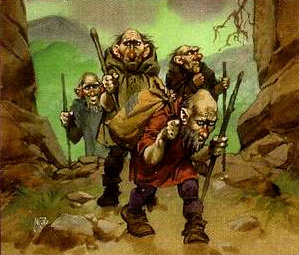
Those not familiar with Petty dwarves.. these were dwarves very much differed from normal Dwarves in various ways: they were smaller, far more unsociable, and they freely gave away their names; other Dwarves kept their Khuzdûl names and language a secret. This may have been one of the reasons the Petty-dwarves were exiled, but more on that later.

They were the first to arrive in Ered Luin in the First Age, and established strongholds in Beleriand before the building of Nogrod and Belegost in the Blue Mountains, and before the Elves arrived.

Petty dwarves had a different dialect, some might even go so far as to claim they had a different language. Though petty dwarves have long gone extinct by the Third age. The only remnant of their different dialect is the dialect used by the dwarves currently living in the Blue Mountains. Although not as strong a variant, it has been noted that the Ered Luin dwarves have a different dialect then dwarves from other regions, who speak a standard unchanged Khuzdul. It is unclear however what the accent changes are.

It is said that the writing “Nulukkizdîn” was an older version Tolkien devised, in later version it was replaced by its current form.

“…before the proud ones came from over the sea, dwarvesdelved the halls of Nulukkizdîn.”
Words of Mîm  –from Quenta Silmarillion 22 —Of the Ruin of Doriath

From its first conception, the name Nargothrond means “Underground fortress on the river Narog”. Its Petty-dwarvish name was Nulukkhizdîn (erronously spelled Nulukkizdîn in some published works).

However, in his later life, Tolkien devised the Dwarvish name Nar(u)kathan instead, to which the Elves suffixed -rond, “vaulted dome”.

Looking at the Petty dwarf name in neo-khuzdul first.
It consist of three seperate words, Nuluk – khiz – dîn

Nuluk : could be an older (or petty dwarvish way) of writing Nûlukh (which means moon).

Khiz : is derived from Khuzd, meaning “dwarf”

dîn: is a shortened from of zdîn, meaning “land”.

So litteraly this would mean: “the land of the Moon-Dwarves”.

Let’s look at the later dwarvish name of Narukathan.
Again consisting of 3 words: “Nar – u – kathan”

* Nar: a referrence to the river (or the name of the river: “Narog”)

* u: indicates “of”

* kathan: could be derived from “khathuzad”, meaning “elves”

Full meaning would be: “Elves of the River (Narog)”
This translation would make perfect sense, as Nargothrond was mainly populated by Noldorin elves.

Taking into account that the area of the Narog river was populated with petty-dwarves long before the elves ever set foot there, it would possible that Petty-dwarves referred to themselves as “moon-dwarves”. It seems logical that the Petty-dwarves would not refer to themselves as “petty”, so why “moon dwarves” ?

The elves that arrived later at the Narog river couldn’t have given them the name either, as they hunted the petty dwarves to extinsion, not knowing they were related to dwarves at the time.

Well, I believe I might have another idea…

After the Darkening of Valinor and the destruction of the Two Trees, Telperion, the White Tree, bore one last Flower of Silver before its end (which was the moon). According to the lore of the Elder Days, Mahal (Aulë) and the dwarves made a vessel to carry to the silver flower aloft, and Tilion, one of the hunters of Oromë; was granted the task of steering the new Moon through the sky.
So, without Mahal and the dwarves, the moon wouldn’t be in the nightsky.
Now, what does this have to do with the Petty-dwarves ?

Well, firstly we need to look at when this happened… and we find a remarkable piece of information, which is that it coïncides with the existance (and exile) of the petty-dwarves.

It is written that the petty dwarves were banished for “various reasons”, although not clear for which reasons exactly. One theory is that the Petty-dwarves were banished because they spoke Khuzdul freely and gave away the secrets of their language and names, which could indeed have been the case (but only accounts for one reason). However, taking into account the above I believe there is another reason…

My theory is this…
I believe that some dwarves actually took credit for the creation of the moon, not just assisting Mahal by putting it at the nightsky, but claiming it’s actual creation.
For this Mahal punished them by making them physically smaller and giving them bodily deformities. These dwarves abandoned Mahal and his laws and started speaking Khuzdul openenly, giving their inner names away to all. As a result Mahal (or the other dwarves themselves) banished this group of dwarves.

This would account for being banished for “various reasons”. It also explains why these dwarves did not follow Mahal’s rules of Khuzdul secrecy (as they were holding a grudge due to being made smaller and deformed). Also, the name of “petty-dwarves”, I believe “petty” doesn’t just mean small, but means “of little importance” (like in 16-century english). Which generally would be the case for people that have been banished, they would be labled “of little importance” – as you would normally not speak of those that have been banished out of respect for the ruler that banished them. Hence, I believe we’ve found a reason why these dwarves were referred to as “petty”.

Now, if we hold this theory to be true and we consider the position of the Petty-dwarves from their point of view, I believe it would make perfect sense they would refer to themselves as “moon-dwarves”. Think of it, you’ve been made smaller, deformed, banished… all because you didn’t agree with your creator. So chances are pretty high you would still be holding a grudge and wouldn’t simply give up your claim of moon creation… on the contrary (knowing how headstrong dwarves can be), you’ll likely hold your head high, denounce Mahal alltogether and call yourself “moon-dwarf”.

That’s my theory … just a theory off course. And as petty-dwarves are extinct (and the man that invented them no longer lives) I guess it will remain a theory.

Posted in History | 3 Comments

Cirth

Firstly, the initial C in Cirth is pronounced as a K, never as an S.

With that out of the way, let’s move on…

There are 3 common types of Cirth, one that was used by elves long ago, “Certhas Daeron”, which was the basis for the Cirth used by Dwarves. During the First Age, Elvish craftsmen in Beleriand began developing an informal alphabet for use with their Sindarin language. This alphabet became known as the Cirth (meaning: “runes”). The Cirth letters were almost entirely made from straight lines that could be easily engraved onto hard surfaces. The Elves used the Cirth exclusively for carved inscriptions.

Dwarves use two types of Cirth, the first is likely the most widely used, known as “Angerthas Moria” (which is the Elvish name, in Khuzdul it would be: Kirth Khazâddûmu). During the beginning of the Second Age in Eregion, Dwarves first came to know the Elvish runes of the Noldor. They modified the runes to suit the specific needs of their language, Khuzdul. The Dwarves spread their revised alphabet to Moria, where it came to be known as Angerthas Moria (meaning: “The Long Rune-rows of Moria”) . The Dwarves used the runes extensively, and developed both carved and pen-written forms. They spread their alphabet whereever they went through out Middle-earth. Variations of Angerthas Moria were also used by other races for their languages, such as the Mannish tongue Westron.

The second system of writing, called “Angerthas Erebor” (Kirth Zesulu) is much more recent. At the beginning of the Third Age, the Dwarves were driven out of Moria. Some migrated to the Grey Mountains, some to the Iron Hills, and some came to Lonely Mountain (or Erebor). The Dwarves in Erebor modified the Cirth even more. Several letters reverted back to the original Angerthas Daeron phonetic value. They also added a number of extra characters.

Both Dwarrow writing systems are in use today. You will find the Moria Cirth style more common still in Middle-Earth and considered the standard style. The Erebor Cirth style still has many users in the North-Eastern mountain ranges, though fewer in the West (Ered Luin) and almost none in Khazâd-dûm.

Strangely enough in the LoTR movies both Erebor and Moria style are used on Balin’s tomb. For our Khuzdul lessons I’ve researched about a dozen different documents on Cirth that can be found on the web, and they all have differences between them. So I reverted to the source and read the “The History of Middle-earth” edited by Christopher Tolkien – Volume VII, “The Treason of Isengard”, Appendix on Runes, amongst other original works. On the internet there is one source that comes very close to being exactly correct, which is: HERE. Again note, that there are two minor mistakes in the Moria style cirth table listed (HERE). It is very close to being accurate however. I have put all my findings in the tools that accompany the lessons –  which allow the user to type the word in latin characters and get it converted into both dwarven Cirth versions.

Posted in Writings | 4 Comments

Death

A good topic, left untouched for the most part by Tolkien.

We can however, when we dig deeper into some Tolkien lines and appendices get a bit of a clearer picture.

What is known about Dwarven beliefs of death and the afterlife:

1) Join Mahal in the Halls of Mandos

The Dwarves believe that Mahal will gather their spirits, if it is not to be reborn, to the Halls of Mandos with the other Children of Ilúvatar. It was to the Halls of Mandos that the spirits of Elves and Men were gathered to await their different fates, and so Mandos was given its common name of the Halls of Waiting. No dwarf knows the fate which awaits them there.

2) Spirits are reborn

The dwarrows believe that the spirits of the Seven Fathers of the Dwarves–the seven Dwarves that were originally created (not including their spouses)–are at times ‘reborn.’

Mahal gave us dwarves also this privilege that distinguished them from Elves and Men: that the spirit of each of the Fathers (such as Durin) should, at the end of the long span of life allotted to Dwarves, fall asleep, but then lie in a tomb of his own body, at rest, and there its weariness and any hurts that had befallen it should be amended. Then after long years he should arise and take up his kingship again. (Tolkien, The Peoples of Middle-earth 383)

Meaning that dwarves cannot be burned* (cremated) after death and should always be buried… as their spirit sleeps in their own body.

*Note however, that Tolkien says, that after the battle of Azanulbizar that there were far too many dwarves fallen for them to be buried in the usual fashion. So “they stripped all their dead, so that Orcs should not come and win there a store of weapons and mail.”, then “they built many pyres and burned all the bodies of their kin.” Tolkien adds, as a footnote “Such dealings with their dead seemed grievous to the Dwarves …. But those who fell in Azanulbizar were honoured in memory, and to this day a Dwarf will say proudly of one of his sires ‘He was a burned dwarf’, and that is enough’

Note though that this dwarrow resurection is a rare exception, only seen with few dwarrows, most notably those of Durin’s line. Little else, or perhaps even nothing, is said of what happens to other Dwarves at death (if indeed Tolkien himself even knew), so apart from the above one can conclude nothing for certain on the matter.

3) Their inner name is not written on their tomb.

Dwarrow title or rank (uzbad) and outer name (Balin) is written on their tombs, not even their inner name.

4) Tearing of the Beard.

As a sign of grief dwarves tear there beards.  An example of this can be found when Nar brought back the tale of Thrór to Thrain: “… and when he had wept and torn his beard he fell silent”. (This again clearly shows the link between the dwarves and the jews – as it is a judaic custom to tear clothes to express the mourner’s grief.)

What is likely to be true, logical or assumed about dwarven death rituals and beliefs

1) Their weapons or greatest treasures are buried with them

If we look at the burial of Thorin Oakenshield, both the Arkenstone and Orcrist were placed on his chest when he was buried deep under the Lonely Mountain. We cannot be sure this is the case for all dwarrows, but it seems very logical as dwarrows are so over protective of their treasures, that they would take them into their graves.

2) Inner name is revealed at their funeral.

The name they hide all their life, given to them by their father or mother, is likely reveaveled at their funeral, though only when the gathering is only made up of dwarves. – As non-dwarves should not hear the inner name of a dwarf.

Beliefs and Customs related to death and burial

Dwarves do not consider death to be a tragedy, even when it occurs early in life (before a dwarf turns 240) or through unfortunate circumstances. This is mainly due to the firm believe dwarves have in an afterlife where they will be at the side of their creator Mahal.

Mourning

Mourning practices of dwarves are extensive, but they are not an expression of fear or distaste for death. Dwarrow practices relating to death and mourning have two purposes: to show respect for the dead and to comfort the living dwarves, who will miss the deceased.

Care for the Dead
After a dwarf dies, the eyes are closed, the body is laid on the floor and covered.
Respect for the dead body is a matter of paramount importance. For example, those in the presence of the dead may not eat, drink or smoke. To do so would be considered mocking the dead dwarf, because he/she can no longer do these things.

Most dwarrow kinships have one or more “amradshomak” (Guard of the Dead), a dwarf that not only guards the dead dwarrow till his/her funeral but cares for the dead. Dwarrows that are amradshomak are volunteers. Their work is considered extremely meritorious, because they are performing a service for someone who can never repay them.

As the dwarrows believe their body is a vessel for their spirit it must not be harmed in any way. Hence cremations are not done and autopsies in general are discouraged as desecration of the body. Meaning that the body of the dwarf is not embalmed, and no organs or fluids may be removed.

In preparation for the burial, the body is thoroughly cleaned. The dead dwarf is then clothes in his/her finest robes, as a token of their riches. It is not unheard of, and even seen as a gesture of kindness, for a dwarf lord to donate gold for the burial of a poor dwarf, so fine robes can be bought to bury the dwarrow in. It is generally done though when the dwarf had no other family or lived in poverty, as otherwise the donation would be considered an insult to the mourning family. Once the deceased is clothed in fine attire, jewels and/or weapons can be placed on the chest of the dead by the amradshomak. The amradshomak then continues his/her guard and care for the body till the burial.

Coffins are not required to bury a dwarf, but if they are used, they must have a hole drilled in them, close to the head, so the spirit can escape and join Mahal when he calls. For this reason dwarven tombs also have a small hole in them.

The body is never displayed at funerals; exposing a dwarven body is considered disrespectful, because it allows not only friends, but also enemies to view the dead, mocking their helpless state.

Mourning Practices

Dwarrow mourning practices can be broken into several periods of decreasing intensity. These mourning periods allow the full expression of grief, while discouraging excesses of grief and allowing the mourner to gradually return to a normal life.

When a close relative (parent, sibling, spouse or child) first hears of the death of a relative, the mourner is expected to ask Mahal to let his/her spirit sleep until he/she is buried – when Mahal can call upon his/her spirit.

From the time of death to the burial, the mourner’s sole responsibility preparing for the burial. During this time, the mourners are exempt from all orders that take time away from the preparation of the burial, because the preparations take first priority. This period usually lasts a day or two; dwarrow believes require prompt burial – in case Mahal would call for them and their body is not yet buried.

During this period – called “atkât” (“silence”), the family should be left alone and allowed the full expression of grief. Condolence calls or visits should not be made during this time.

After the burial, a close relative, near neighbor or friend prepares the first meal for the mourners. This meal traditionally consists of eggs (a symbol of life) and bread. The meal is for the family only, not for visitors. After this time, condolence calls are permitted.

The next period of mourning is known as hadud (seven, because it lasts seven days). Hadud is observed by parents, children, spouses and siblings of the deceased. Hadud begins on the day of burial and continues until the morning of the seventh day after burial. During hadud mourners are expected to stay within their halls and honor the deceased and not do anything for comfort or pleasure.

If a festival occurs during the mourning period, the mourning is terminated, but if the burial occurs during a festival, the mourning is delayed until after the festival.

The next and final period of mourning is known as trem (thirty, because it lasts until the 30th day after burial). During that period, the mourners are allowed to leave their halls but do not attend parties or celebrations, nor listen to music.

Tombstones / Tombes

A buried dwarrow must have a tombstone or placed within a tomb, so that the deceased will not be forgotten and the grave will not be desecrated. It is customary to keep the tombstone/tomb veiled, or to delay in putting it up, until the end of the last mourning period. The idea underlying this custom is that the dead will not be forgotten when he/she is being mourned every day. There is generally a formal unveiling ceremony when the tombstone is revealed.
It is preferred that dwarrow tombstones or tombes are placed beneath the mountain in the halls, not on flat land. As it is believed to allow the spirit to reach Mahal easier through the mountain.

Dwarrow Mourning Prayer

During the different mourning periods, adrûthigulûb (Words of Mourning – a dwarrow mourning prayer) is recited again and again by the mourners, at least once each day.

Adrûthigulûb:

Bless those who mourn, creator, shield them from the pain with your hammer and guide them to a new day.

Umhûdizu tadaizd ku’ adrûthîzd, Mahal , murukhîzd udu charach bakhuzizu ra udnîn izd ana ghiluz nur.

Death in Battle

It is considered an honor to die in battle amongst dwarves. Only in this case is it allowed that the body is buried with other dwarves and a common tombstone be placed. The reason behind this is that time should not be wasted as the spirits await Mahal. Once buried the mourning rituals preceed as normal.

EDIT NOTES:  – Tearing of the Beard added – Used all I could find on dwarven death, burial (such as death and burial of Thorin Oakenshield, tomb of Balin, Gimli’s words at the tomb, etc..) and colored it in with Jewish traditions (due to Tolkien stating the Jewish influence on his dwarven characters).
Posted in Life & Death | 1 Comment

Dwarven Festivals

Expansion on the post “Dwarrow Calendar”


Details on the more well known festivals:

Muhudtuzakhmerag (“Blessed Green Fest” or “Spring Fest”), a dwarrow spring-festival traditionally held from the 1st till the 20th on the 6th Month of the Dwarrow calendar –
the month of “‘âfmuhudtuzakh” (“Blessed Green Month”). The first day of the festival marks the cutting of the springbarley.
Barley which had been sown during the first day of the harvest festival, 6 or 7 months earlier.
It is noted that in the North, the spring festival is usualy held 2, sometimes even 3 weeks later, due to the fact that the springbarley is not ready to be cut in the colder climate.

A tradition of Muhudtuzakhmerag is to carry a fresh straw of spring barley with you. Dwarrow woman are known to wear it in their hair while dwarrow males often carry it in their pockets.
“The carrying of the straw”, is a dwarven tradition which, according to legend, dates back to the first Dwarrow Spring Festival, held at the beginning of the Second Age.
During this first festival, which the dwarves held in honor of Yavanna (the wife of their creator Mahal), Yavanna gave the fathers of the dwarves each a straw of spring barley.
This served to remind them of their dependance of nature.
Many years later during the war of the last alliance at The Battle of Dagorlad (3434 Second Age), the dwarves lead by dwarven general Barin were carrying straws of spring barley in their pockets,
which they had been offered during the start of the spring festival some time earlier.
Though a vast amount of soldiers died, not a single one of the generals regiment perished.
Since then it is considered good luck by most dwarves to carry a straw of spring barley in your pocket during the time of the spring festival.

The last day of Muhutuzakhmerag notes the annual pony race between Thorin’s Halls and Needlehole in the Westfarthing, known by many dwarves and hobbits as “The Broken Bone Race”.
The pony race, first held in the year 2903 TA, starts traditionally at foredawn.
Though originally a race held by dwarves only, in recent years hobbits have been known to enter.
The race is well known for its difficult conditions, the majority of the riders never reaching Needlehole.
The winner of the race is allowed to carry the title of “Race Champion of The West” untill the next spring-festival.
The most notable winner has been lord Dwalin (who won the first race – commemorating the Founding of Thorin’s Halls the year before)

Unlike the hobbit spring festivals, the dwarrow spring festival does not hold any sporting events (as those are reserved for the Harnkegger Festival some months later).

More information on some of the more obscure above mentioned holidays:

Ghiluzkhebabmerag (Forge Day Fest) – 19th of ‘âfnudkhazâd (This year on February 9th 2012)
As its name suggests, sacred to Smiths. Each Dwarven smith is required to forge a large, exquisite item in honor of this day. Some of the greatest Dwarven weapons (most notably the Durin’s Axe) were reportedly forged on this day. The meal for this feast day is quite heavy- dark bread, mutton, and mushrooms. Likewise the Dwarven spirits on this day are thick, black ales.

ghuregbuzramerag (” Deep Ale Fest” / Harnkegger Fest) – 9th till 19th of ‘âfghuregablug
(This year from May 29th till 17th of June 2012)
This holiday reflects the love of hard work the Dwarves have, followed by equally hard play. The holiday is named after the ceremonial position of the Harnkegger, which is given to a Dwarf who works conspicuously hard between spring festival and this holiday. The Harnkegger dons the traditional heavy boots and red garterbelt and gets the honor of tapping and sampling the first barrel of summer ale. Thus begins a 10 day festival of drinking ale, eating enormous amounts of food, gaming contests, and general merriment. On the last day, votes are taken and awards given for the best ale. The Dwarves work without cease from muhudtuzakhmerag till ghuregbuzramerag , so they can take full advantage of this holiday. Though this was originally a Dwarf feast of Ered Luin, many other Dwarrow nations have adopted it.

Lomil Zatamaradu (Night of the Kill) – evening of the last day of ‘âfizhu
(This year on September 14th 2012)
Lomil Zatamaradu starts on the last evening of ‘âfizhu and ends at Foredawn the next day. The Night traditionaly starts with a fellowship of Dwarves heading out early in the evening, set out to hunt and kill a deer or boar. The meat and hides are donated, later that night, to dwarves that are less fortunate. In comparison to other dwarven feasts no heavy ales nor feast meals are to be had, instead most dwarves drink a simple Mead and eat meager rashions on this eve. When the fellowship returns it is noted to pay homage to those dwarves that have gone to join Mahal.

Yuleblot (aka Mahalmerag or Yule Fest) starts 20th of ‘âfnarag – ends 18th of âfgalab (this year from December 13th 2011 till January 10th 2012).
Although Yuleblot is celebrated throughout its 29 days, the core of the festivities start on the 6th day of Yuleblot (this year on December 19th), when the traditional “zariragholt” (Sónargǫltr or sacrificial boar) is sacrificied. After the sacrifice, “Strengdir” (also known as Hietstrenja or The Yule Fest vows), would take place. The lord of the dwarrow kin or eldest dwarrow, would stand and first place his foot upon a stone or bench, then would lay his hands on the bristles of the sonargoltr and say: “I mount on the block and solemnly swear by Mahal… ”
Each adult dwarrow male, in order of rank or age is then to follow the Lord and also perform Strengdir. Each vow is solemn and there are punishments for breaking them. On the 10th day of Yuleblot (this year – 2011 – on 23rd of December), the “Yulebocken” (or Yule Goat) is killed and sacrificed to Mahal. The richer the dwarrow clan or kin is the fatter the goats are, sometimes 2 or even 3 goats are slaughtered as a symbol of the riches of the kin. A tradition which is followed by chants. On the 12th day of Yuleblot, (this year – 2011 – on 25th of December), a mass is held in honor of Mahal. The days after Mahal’s mass are known as Yulenkagr (“Fat or Rich Yule”), as they herald the start of the drinking and eating – till the last – 29th day of Yuleblot. Yuleblot is traditionally closed by chants on the last eve (this year – 2012 – on January 10th). *Note: apart from “zariragholt”, most names related to Yule are directly derived from Dale and have no seperate khuzdul word.

Posted in Calendar & Festivals | 2 Comments

The Dwarrow Calendar

Why this post ?

Well, it was my understanding that there was no such thing as a Dwarven calendar, apart from “Durin’s Day”. Tolkien wrote in great length about calendars of Elves, Hobbits and Men.. but nothing about the Dwarven calendar.

You might think.. who cares about a calendar?
Well, I do, as a calendar means holidays… and holidays are always a fine occasion to have some Ales and Pies (as if we needed an excuse). So I did some searching… it is a long read, but could be well worth it, enjoy!

Some of you that are familiar with Dwarrow history, as written in Tolkien’s writings, might know that a vast amount of what we believe to be Dwarven (or of Dwarrow origin) takes its inspiration from the rich Jewish culture, traditions and language. The best example of that is clearly “Khuzdul” (the Dwarven language), down to the pronunciation and sentence structure is a near copy of Hebrew. Even the way Dwarves are described in The Hobbit, indicates (according to scholars) the perception of many Anglo-Saxon Christians about Jews round the time the book was written (1937) – “There it is: dwarves are not heroes, but calculating folk with a great idea of the value of money; some are tricky and treacherous and pretty bad lots; some are not, but are decent people like Thorin and Company, if you don’t expect too much.”
According to The History of the Hobbit, Tolkien was now influenced by his own selective reading of medieval texts regarding the Jewish people and their history. Tolkien himself said, and I quote: “The dwarves of course are quite obviously, wouldn’t you say that in many ways they remind you of the Jews? Their words are Semitic, obviously, constructed to be Semitic.” – so don’t take my word for it.

If you look closely at the relationship between the Tolkien Dwarven culture and the Jewish culture, you will find many similarities. To name a few… Medieval views of Jews also saw them as having a propensity for making well-crafted and beautiful things, a trait shared with Norse dwarves. The dwarves’ characteristics of being bearded, dispossessed of their homeland (the Lonely Mountain, their ancestral home, is the goal the exiled Dwarves seek to reclaim), and living among other groups whilst retaining their own culture are all derived from the medieval image of Jews, whilst their warlike nature stem from accounts in the Hebrew Bible.

Another of those examples is the Dwarven Calendar. Now, Tolkien has written in great detail about the calendars used by Men, Elves and Hobbits, but many believe he has not given us any details on the Dwarven calendar, that isn’t completely accurate however. We know from the Hobbit that the Dwarven Calendar is lunar based (like the Hebrew one). Unlike the Hebrew calendar, the Dwarven New Year starts on Durin’s Day, which is the day that begins the last cycle of the Moon. When on this day both the Sun and Moon may be seen in the sky together. That places Durin’s Day, anytime between about Oct. 7 and Nov. 6, on the last day before the astronomical new moon as the moon sets just before the sun. As the base of Tolkien’s Dwarven culture is believed to be a mix between of Old Norse and Hebrew cultures, I took up the challenge to find a bit more information about the Dwarrow Calendar. So we would at least have an excuse to celebrate more than one holiday a year 🙂

Working with the information we have from Tolkien’s writings about the Dwarven calendar – a Dwarven year must have either 12 or 13 months . The reason for having a 13th month is to ensure the lunar calendar realigns with the solar years, simply because a lunar month is shorter than a solar month. A lunar year (twelve lunar months) is only 354 days long: eleven days short of a solar year. For every solar year that passes, the calendar will ‘slip’ back by more than a week. This is much more than a technical inconvenience, because the passage of seasons follows the solar year, not the lunar. Any given date will ‘shift’ by six months every seventeen years or so – midsummer becomes midwinter in less than a generation.

The Dwarves seem to have taken a direct approach to this problem – they reset their calendar every single year. When Thorin says that their year starts on ‘the first day of the last moon of Autumn’, what he means is that the Dwarves find a point where the lunar and solar (seasonal) calendars coincide, and restart their calendar from that point.

So, with all this information (setting my base in the cultures, festivities and tradition of Old Norse, Hebrew and Tolkien Dwarrow history), this is what I came up with…..

Note: the full calendar for the next years is found in the Khuzdul tools, see “free khuzdul lessons”

A brief overview of the months, their times and holidays:
According to the Dwarrow Calendar we are in the year 11361.

Month 1 “‘âfdohyar” starts on: 26/10/2011 ends on: 23/11/2011 Holidays: 1) Ghiluz Durin (Durin’s Day) – 1st of ‘âfdohyar —- 2) gwivashazdînmerag (Treasures of the Land Fest / Harvest Fest) – ends on 16th of ‘âfdohyar

Month 2 “‘âfnarag” starts on: 24/11/2011 ends on: 23/12/2011 Holidays: Yuleblot (aka Mahalmerag or Yule Fest) – starts 20th of ‘âfnarag

Month 3 “‘âfgalab” 24/12/2011-21/01/2012 Holidays: Yuleblot (aka Mahalmerag or Yule Fest) – ends 18th of âfgalab

Month 4 “‘âfnudkhazâd” 22/01/2012-20/02/2012 Holidays: Ghiluzkhebabmerag (Forge Day Fest) – 19th of ‘âfnudkhazâd

Month 5 “‘âfanak” 21/02/2012-21/03/2012

Month 6 “‘âfmuhudtuzakh” 22/03/2012-19/04/2012 Holidays :muhudtuzakhmerag (Blessed Green Fest / Spring Fest) – 1st till 20th of ‘âfmuhudtuzakh

Month 7 “âfvalasirkha” 20/04/2012-19/05/2012

Month 8 “âfghuregablug” 20/05/2012-17/06/2012 Holidays: ghuregbuzramerag (” Deep Ale Fest” / Harnkegger Fest) – 9th till 19th of ‘âfghuregablug

Month 9 “âfghelekvust” 18/06/2012-17/07/2012 Holidays: ghelekvustmerag (Feast of Good Health / Summer Fest) – 3rd till 23rd of ‘âfghelekvust

Month 10 “âfkidhuzabad” 18/07/2012-15/08/2012

Month 11 “âfizhu” 16/08/2012-14/09/2012 Holidays: Lomil Zatamaradu (Night of the Kill) – evening of the last day of ‘âfizhu

Month 12 “âfhumryanj” 15/09/2012-14/10/2012 Holidays: gwivashazdînmerag (Treasures of the Land Fest / Harvest Fest) – starts on the last day of ‘âfhumryanj

Month 13 “âfthùrag” The 13th month is marked 7 times each 19 years (about every 3 years) – Next time this will take place is in 2014: from 25/09/2014 till 22/10/2014. In years where âfthùrag is held gwivashazdînmerag (Treasures of the Land Fest / Harvest Fest) – ends on 16th of ‘âfthùrag – (only if ‘âfhumryanj is followed by ‘âfthùrag -otherwise 16th of ‘âfdombar)

Meaning of the Month Names:

âfdohyar “Anvil Moon” Referring to Aulë and the creation of the Dwarves

âfnarag “Dark(ness) Moon” Referring to the time the Dwarves Fathers had to sleep before being awoken

âfgalab “Speaking Moon” Referring to the time the Dwarven Fathers were awoken.

âfnudkhazâd “Two Dwarves” Referring to the 2 surviving Dwarves after the death of Thingol in 502 of the 1st Age (Wars of Beleriand)

âfanak “The Arrival” Referring to the arrival of the Dwarves in Ered Luin in 1250 of the 2nd Age

âfmuhudtuzakh “Blessed Green” Referring to the first days of new life each year – “the first green on the fields”

âfvalasirkha “Moon of Valacirca” Referring to an important constellation of seven stars set in the sky by Varda as an enduring warning to Melkor and his servants. Also formed the symbol of Durin, seen on the doors of Moria.

âfghuregablug “Moon of Food and Ale” Referring to the first wheat harvests and the start of the Ale periode.

âfghelekvust “Moon of Good Health / Moon of Drunkeness” Referring to the period of plenty (of both food and ales) – lead up to the summer feast

âfkidhuz’abad “Moon of the Gold Mountain” Referring to the vast amounts of riches found at Khazad-dûm during the rule of Durin the Deathless

âfizhu “Moon of Few” Referring to the period of few – a period for remembrance and sparse living

âfhumryanj “Double Praise” Referring to the thanks to Mahal – lead up to Durin’s Day Feast and Harvest Feast

– Again, pointing out that we’ve used Tolkiens writings as a base – this is by no means lore, however can provide a more deeper understanding on the topic, allowing you to use it in your RP (for those dwarven Lotro RP-ers).

Posted in Calendar & Festivals | 12 Comments

About dwarven women and children

Yes, we know, dwarven women have beards… but let’s take the next step and dig a bit deeper.

Without a doubt this topic is draped in mistery… still, here at the Dwarrow Scholar we’ll let you in on our thoughts.

If we look at age difference from known dwarven brothers (and or brother-sister pairs) in Tolkiens works most of these differ 9 or even 10 years in age. The exeptions to the rule are the sons of Thráin II, Thorin II Oakenshield born in 2746 and his younger brother Frerin born in 2751 – meaning these brothers were born “only” 5 years apart. The other exeption to this 9-10 year age gap between brothers are Fíli and Kíli, born “only” 6 years apart. All other brothers are born with a 9 or 10 year age difference, examples: Frerin and Dís (female), Dwalin and Balin, Fundin and Groin, Oin and Gloin, Fror and Gror, Thror and Fror. Not one case are any of these brothers (or brother-sister pairs) born more then 10 years apart.

Now this doesn’t tell us anything about a gestation period directly, but gives us a fair idea that it was common to wait several years before giving birth to your second or third born.

Considering the following facts and founded assumptions:

1) Dwarves usually take only one spouse in their lives (unless their spouse died) having two sons of different mothers would be extremely rare, in the case of Fíli and Kíli we can be sure they had the same mother simply considering the age difference.

2) It apperently is considered perfectly normal by the other dwarven companions that Fíli and Kíli differ “only” 6 years, as no mention is made otherwise in The Hobbit or other works. Which leads to believe the difference could have been even less (like Thorin and Frerin).

3) Tolkien wrote that dwarven women were fiercly guarded by the males and rarely seen in the outside world, one reason for this could have been due to them having an extended gestation period, which made them vulnerable. The risk of losing an unborn child in a multi-year-pregnancy would be to great a risk to take, hence the men guarded their women inside their halls, away from danger.

4) Dís, the only dwarven female ever named by Tolkien gave birth to her first son Fíli at the age of 99. So like dwarven males who come of age at 40, adult hood is reached at the age of 65-75. So like the male they have children between the age of 75 and 120, as the example of Dís proves.

5) Tolkien often used Jewish custom and traits when writing about dwarves, if we follow this rule too for dwarven pregrancy and customs surrounding it, it would be possible that dwarven women also held a period of purity after giving birth (or even after having their monthly cycle). In Judaism this is only 14 or 7 days after birth (depending on the gender of the new born), with dwarves this could have been considerably longer, due to the fact that they age slower then men and due to the fact that they do not have the same reproduction drive as men. In old judaic custom it was considered proper to wait for longer then 9 months to be pregnant again (could still be the case even not sure about that). So if we copy this to dwarves, we would be looking at a period of non-pregnancy of 5 years and pregnancy of 4 years – giving us the 9 year gap between most siblings.

So with all of the above in mind, my thoughts on the matter are this:
* Most dwarven women have children between the age of 75 and 120
* They consider a period of at least 2 months as a period of purity after each birth – in which they cleanse themselves and do not have relations with their husband.
* A dwarven gestation is 48 months – or 4 years.
* The minimum age difference between two dwarven siblings would be 50 months (just over 4 years).
* Most dwarves are born 9 or 10 years apart from any of their siblings. Meaning most female dwarves respected a period of 5 years in which they were not pregnant, before being pregnant of their next child.
* dwarven twins are almost none existant (none were ever written in Tolkiens words, so we can assume they were as rare or perhaps rarer then with the race of men).
* only 1 out of 3 dwarves would have children and they feel no pressure to have more than 1 child. As we can see from Tolkiens writings that less then half of those that had children, had more then one (Thrain II and Dáin I were rare exceptions with 3 children). Though it must be said that this is likely something typical of the third age, or the Royal House of Durin, as otherwise the dwarves as a race could not have possibly existed passed the first age.  The early Dwarves would have had 6 children on average (to account for the numbers we see in later stories).
* like the women, any son under the battle ready age of 40 was fiercly guarded by their father and family. Merely to protect them from an early death. Daughters we fiercly guarded regardless of their age, untill they married at the adult age of 75-120, at which time they become part of the family of their husband and fell under his protection.

The above is mainly theory offcourse, be it based on all the Tolkien sources available. But from my point of view the above would fit nicely and break none of Tolkiens writings.

Posted in Women | 23 Comments

The Age of Dwarves

One of the first things I noticed when looking into this topic is that there seem to be 5 important “age-marks” in a dwarven life.


BATTLE READY (30)

The first at the age of 30, when dwarves are considered to be “battle ready”.
Note that, “battle ready” doesn’t equal adult… . (Compare it to 14-year old soldiers giving their lives in WWI fields). The idea behind this seems to be clear, when you are tall enough to carry armour and strong enough to hold a heavy double handed axe or hammer, you are “battle ready”. Dwarves remained young – e.g. regarded as too tender for really hard work or for fighting – until they were 30 or nearly that (Dain II was very young in 2799 (32) and his slaying of Azog was a great feat). There are a few remarkable exceptions though, such as Gloín, who fought in the war of Dwarves and Orcs – in the Battle of Azanulbizar at the very tender dwarven age of 19, so Gloín must have been very tall and strong for his age.

Battle of Azanulbizar as depicted in the The Hobbit movies - All Rights Reserved

Battle of Azanulbizar as depicted in the The Hobbit movies – All Rights Reserved


COMING OF AGE (40)

The second age-mark is at the age of 40, by which time dwarves haven take on the appearance of age (by human standards). This metamorphoses takes place somewhere between the age of 30 and 40, and happens very quickly (in a few years). By forty all Dwarves looked much alike in age, until they reached what they regarded as old age, about 240. Note however, that a dwarf at the age of 40 is still not considered an adult.


ADULT HOOD (65-75)

This takes place at the third age-mark, between the age of 65 and 75. The age at which dwarves take on the role of adult. Meaning that they move from their fathers home into that of their own (or their own halls if they are regal or heavy with gold). This age allows them to adventure completely on their own, under their own name (meaning they can earn riches in expeditions without having to give these to their father). This explains why Gimli could not join into the expedition of Erebor (as he was only 62 at the time), but Kili could (who was 77 at the time). It is also the age some dwarves (that have an interest in doing so) start to think about taking a wife (no earlier than when they are 90 in most cases). Most dwarves however do not marry and from what we see, most that do have no more then 4 children, in most cases one or two. The rare cases dwarves have 4 children is because the first born were girls, so the couple continues to have children until a male heir is born. Dwarves can have children until their old age, but most no longer do however after the age of 120 or so. If a son is seen to be 110 or so years younger than his father, this usually indicates an elder daughter.

Kili as shown in -The Hobbit: The Desolation of Smaug - All Rights Reserved

Kili as shown in -The Hobbit: The Desolation of Smaug – All Rights Reserved


OLD AGE (240)

The 4th age mark is that of old age, which happened at the age of 240 for most dwarves. They then underwent a new transformation and began to age greatly and wrinkle and go white quickly (baldness being unknown among them), unless they were going to be long-lived, in which case the process was delayed. So unlike with men, physically dwarves of 40 and dwarves of 240 can look almost identical. Otherwise ‘old age’ lasted not much more than ten years, and from say 40 or a little before to near 240 the capacity for toil (and for fighting) of most Dwarves was equally great.


DEATH

The last age mark is that of death. Dwarves of different ‘breeds’ vary in their longevity. Durin’s race were originally long-lived (especially those named Durin),
but like most other peoples they had become less so during the Third Age. Their average age (unless they met a violent death) was about 250 years, which they seldom fell far short of, but could occasionally far exceed (up to 300). A Dwarf of 300 was about as rare and aged as a Man of 100. Dwalin lived to be 340, a extremely rare age, even for a dwarf. Dwarves either died in combat, of old age, or (in times of riches) due to corpulence. Corpulence being the only physical disorder they suffered from (they were singularly immune from diseases such as affected Men, and Halflings). In times or great riches many grew very fat, and could not do much (save eat) afterwards.

Dwarf Tomb

Dwarf Tomb as seen in Lord of the Rings Online


Sources:

* The History of Middle Earth, The Making of Appendix A (IV Durin’s Folk) /p 284.

* Unfinished Tales – The Quest of Erebor

Posted in Life & Death | 15 Comments

Naming Conventions

“Thorin son of Thrain son of Thror King under the Mountain!” said the dwarf in a loud voice, and he looked it, in spite of his torn clothes and draggled hood.” – The Hobbit Chapter 10 A Warm Welcome.

It is clear from the above example that Dwarves and especially those of regal line don’t just have one name they use when introducing themselves. In fact, using our example above, Thorin could have even added the name “Oakenshield”, or “of the Longbeards” to this already long personal introduction.

J.R.R. Tolkien said that names such as “Thorin”, “Thrain” and “Thor”, are what is known as “outer names”. Names dwarves use when talking to non-dwarves (and even among themselves), hiding their “real” names from most. Tolkien said the language of Dale was used for the outer names of dwarves, as he took most of the dwarvish names in his work, from Old Norse poems (Poetic Edda). This he later explained by the translation fiction: since Westron was translated with English, the language of Dale, used by Dwarves for their “outer” names, was translated with Old Norse. So for Tolkien it was a convenient device to allow him to use Old Norse names for the dwarves.

thorin

Thorin and his grandfather King Thrór as seen in The Hobbit movies.


This explanation (of using “Dalish” for the outer names of dwarves) however leads to a major problem.  Seeing that if dwarves got their outer names from the men of Dale, Durin the Deathless could not possibly have been called Durin, seeing he was created by Aulë hundreds of years before any man (let alone one of Dale) even existed.  One could assume that the name “Durin” was a name the dwarves gave sometime during the third age to the eldest of their kind and he was known by another name before. But that wouldn’t make sense either, seeing that the records of the elves use the name of Durin as well.

In other words, it doesn’t make sense for the dwarves to have taken their outer names from men, as they didn’t exist yet. So, how do we explain this? Well, the other way around seems much more logical.  What I mean is, it would not be illogical for the men of Dale to “adopt” the outer names of dwarves; outer names the dwarves invented themselves.  The men of Dale lived in close proximity to the dwarves, so it is not unthinkable that they would have used taken such names for their sons. And perhaps in later days, the names the men used (which likely took on a “Dalish” flavour) were in turn used by the dwarves themselves for their sons.  This would explain the enigma of the name “Durin”. Dalish was however not the only other language used for outer names, as the First Age dwarf King of Nogrod “Naugladur“, clearly uses an early-elvish name for his outer name (though it could be argued the elves gave him this name – as it is only mentioned in their histories – it’s likely meaning is “King of Dwarves” in Goldogrin (early-elvish).

Now, as we’ve covered, the outer name could be given freely, but the inner name was a matter of top secrecy, like the language Khuzdul itself. Dwarves do not even record their true (inner) names on their tombstones. A prime example of this is notable by the runes written on Balin’s tomb in Moria, which have the names Balin and Fundin on them, both “outer names”.

150px-Balin

Dwarves in fact have 4 different names, their outer name (in a manner these could be seen as “first names”). Then there is their inner name, which is revealed to no-one. Apparently given to them at birth and revealed to other dwarves only on very rare occasions, likely at important dwarvish ceremonies.

The third is their descriptive name, or epithet. Such epithets, like their outer names would not be secretive. Examples of epithets can be found in the names we see of the First Age Dwarves of the Ered Luin, Azaghâl, Telchar, and Gamil Zirak, are believed to be descriptive names either directly in Khuzdul (Gamil Zirak, Azaghâl) or derived from Khuzdul (Telchar). Such descriptive names they tell us something about the dwarf or his deeds.  The usage of Khuzdul for such names confirms that not all Khuzdul was held secret (like place names). Dwarves even gave such names to non-dwarves. “Felakgundu”, the name given to the elf Finrod, is a clear example of such an epithet.

Another example of an epithet is “Oakenshield” or “Ironfoot”. In these two examples the Khuzdul descriptive name has been translated to the common tongue. Unlike Azaghâl, Telchar or Gamil Zirak these dwarves lived in a period where Westron was the common tongue and Khuzdul had become a language of lore, hence it would be logical for such dwarves of great renown to translate their epithets in Westron. Note that such epithets are  NOT handed down, unlike the last names of men; such names are in fact earned.

The 4th name dwarves commonly use in their personal introduction is their patronymic name, indicating their lineage; “Balin Fundinul” – “Fundinul” being a fine example of patronymic name – meaning “son of Fundin”. In other words, it merely indicates the outer name of the father of the dwarf. On tombstones this would have been written in Khuzdul (“Fundinul”), yet spoken in Westron when one would introduce oneself, considering the secrecy of the Khuzdul language.

Only important dwarves or those of regal line would use a double patronymic name, as we see in our example at the start of this article (Thorin, son of Thrain, son of Thror). Those dwarves that have no regal blood, or have no great renown, would likely only indicate their fathers outername. Note that not all regal lines used this convention of double patronymic names, it is even considered rare – for instance Balin (although of regal line) only used a single patronymic name.

Lastly, a dwarf can indicate their clan lineage, although not considered a name itself, noting “of the Longbeards” in place (or in addition too) a title is perfectly acceptable. These names cannot be invented; there are 7 clans, no more – no less (not counting the extinct exiled petty dwarves who could be considered the 8 clan).

When would a dwarf use which name?

Dwarves would never ever use their secret “inner name” for introductions. The only other “rule” I have noticed in the Tolkien writings, is… the more official, prestigious or formal an introduction is, the more names are used (apart from the inner name obviously). To make matters utmost official one could place their title at the end of it, example: Thorin Oakenshield, son of Thráin, son of Thrór, King Under the Mountain.  In the Third age all of this would be said in the common tongue, and perhaps in ceremonies among dwarves in Khuzdul.  Revealing Khuzdul for names (place names, outer names, descriptive names or titles – not inner names) would likely not be considered an offence against the secrecy of the language. Seeing we can find several examples of this happening in Tolkiens writings (Azaghâl, Felakgundu, etc…)

What happens to dwarves that hand out their inner names freely?  

Exile would be the likely answer. Petty-dwarves freely gave away their names and this may very well have been one of the reasons why they were exiled.

Angus_McBride_-_Petty_dwarves

The Petty-dwarves by Angus McBride

An example of a Full Dwarvish name (using my LotRO dwarf character as an example):

Kandral Belkultarg Rayad Kuinnul Zêzabad Thikilgundu Zaharul Sigintarâgul

— Meaning: Kandral Strongbeard, heir and son of Kuinn – First Lord of Thakalgund, (son) of the house of the Long-beards.

This above example would only be used when meeting the King under the Mountain himself, otherwise it would be considered far to elaborate an introduction.

Note that in this example all names are listed, except off-course the inner (true) name of Kandral.

Updated: 31/05/2016

Posted in Names | 9 Comments

Welcome to the Dwarrow Scholar

Welcome to the Dwarrow Scholar !

This site is designed for a variety of people, that wish to learn more about the dwarves as written in the books of J.R.R. Tolkien.

Whether you are a Lotro RP-er with a dwarven-character trying to find fresh ideas that will enhance your RP or you are merely trying to find information about the bearded dwellers knowns as dwarves… you have surely come to the right address.

At this stage the site is under construction, but do return shortly as we will be adding loads of articles, videos and photos in the upcoming weeks.

Cheers,

Kandral Strongbeard, son of Kuinn

Posted in Uncategorized | 3 Comments