On the Governance of the Dwarven Clans

A study of Dwarven political structures in Tolkien’s legendarium

General Note: While this study refers to the Seven Clans as a whole, the available material is overwhelmingly drawn from the history of Durin’s Folk. The Longbeards are by far the most documented of the Dwarven peoples, and as such, they provide the primary basis for any structural analysis. Where broader conclusions are drawn, they should be understood as cautious extensions from this better-attested example.

Note on platforms: I will be publishing a number of longer, previously unreleased articles here in the coming period. This blog (thedwarrowscholar.com) will host extended pieces, while the main site remains focused on general information and the Tumblr continues to serve for questions and shorter responses.

Note on terminology: Strictly speaking, “dwarvish” would be the more appropriate adjectival form, in line with Tolkien’s own usage. I have chosen to use “dwarven” nearly throughout, as it reads more naturally in this context.


I. One Clan, One King

At the highest level, the structure is simple. Each of the Seven Clans possesses one King, and one only. This kingship is lineage-based, descending from one of the Seven Fathers, and it persists through exile, migration, and loss. It is also exclusive, allowing no parallel royal authority within the same Clan.

For the Longbeards, this is the Line of Durin. No matter how many halls rise or fall, there remains only one true King of the Longbeards.


II. Succession and the Preservation of the Royal Line

If Dwarven kingship is defined by lineage, then the question of succession becomes central. Yet Tolkien provides no explicit description of Dwarven inheritance law. What can be observed instead must be drawn from the behaviour of the royal line itself.

The events surrounding the death of Thorin Oakenshield provide one of the clearest insights. Upon the deaths of Thorin, Fíli, and Kíli, the throne does not pass to Thorin’s sister Dís, who was both a direct descendant of Thráin II and older than Dáin Ironfoot. Instead, it passes to Dáin, a more distant male relative within the broader line of Durin.

It indicates that Dwarven succession does not follow a system in which the closest relative, regardless of gender, inherits. Nor does it reflect the commonly known form of male-preference succession found in many human kingdoms. If that were the case, Dís would have been the natural heir.

Instead, what emerges is a system that prioritises the male line of descent, even when this requires moving laterally across branches of the family. The throne passes not simply to the nearest kin, but to the nearest male heir within the wider lineage.

At the same time, this process is not without limits. The royal line is preserved with remarkable continuity, and there is a clear tendency to remain as close as possible to the direct line of descent from the founding ancestor. In the case of the Longbeards, this is the line of Durin himself, a lineage so central to their identity that it is remembered, preserved, and reaffirmed across generations.

This suggests a system comparable to what is known in human terms as agnatic or semi-agnatic succession, in which inheritance follows the male line, but may extend across branches when the direct line fails. Such a system ensures both continuity and stability, preventing fragmentation of kingship while maintaining its grounding in ancestry.

It also explains why, despite the existence of multiple realms and centres of power, there is never more than one true King within a Clan. Kingship cannot be divided, because it is not tied to territory, but to a single, continuous line and title.


III. Multiple Realms Within One Clan

The political structure of the Dwarves becomes clearer when examining how their realms develop over time. The history of Erebor, when placed in its proper context, provides a key example.

Tolkien makes clear that the Lonely Mountain was not an ancient or continuous Dwarven political centre, but a location that rose in importance over time. Thráin I, a fugitive from Moria, is said to have come upon Erebor and established a realm there “for a while.” This marks the first clear attestation of Erebor as a royal seat, rather than its first possible use by the Dwarves.

It is not unreasonable to assume that the mountain may have been known, and perhaps even used on a smaller scale, in earlier ages. Erebor lies along the natural route between Khazad-dûm and the Iron Hills, and would have been a prominent landmark, visible from afar. Its position, combined with the presence of fresh water and access to nearby peoples for trade, would have made it a logical point of passage, provisioning, or temporary occupation.

Such use, however, should not be confused with the establishment of a realm. The account of Thráin I describes not a return to an existing centre, but the elevation of Erebor into one. That early settlement was not permanent, and the Longbeards later abandoned the mountain, moving further north before returning after the defeat in the War of Dwarves and Dragons.

In T.A. 2590, under Thrór, Erebor was re-established and elevated into the primary royal seat of the Longbeards. The account of Thráin I “discovering” the Lonely Mountain (as stated in the History of Middle Earth) should, in my opinion, not be understood in the absolute sense of first encounter. Given Erebor’s position along the route between Khazad-dûm and the Iron Hills, and its prominence as a landmark visible from afar, it is highly unlikely that the Dwarves were previously unaware of its existence. It would have been passed, observed, and likely used in some limited capacity for generations.

Rather, the term “discovered” is better understood as marking the moment at which Erebor was first recognised and established as a centre of settlement and rule. It signifies not the finding of the mountain itself, but the decision to make it a dwelling place and, for a time, a seat of power.

Erebor stands as the primary royal seat, yet it does not exist in isolation. At the same time, the Iron Hills function as a major Dwarven realm, inhabited, developed, and capable of fielding substantial forces of their own.

These are not rival kingdoms. Instead, Tolkien’s terminology reveals a clear hierarchy. The ruler of Erebor is styled King under the Mountain, while the ruler of the Iron Hills is styled Lord of the Iron Hills. Even where both are described geographically as “kingdoms,” this distinction in title is consistent and meaningful. It indicates that the King of Erebor stands above the Lord of the Iron Hills.

What emerges is not a system of competing sovereignties, but one in which multiple centres of power coexist within a single lineage. Erebor functions as the central authority of the Longbeards, while other realms operate beneath it, retaining their own leadership, but not independent kingship.

A brief linguistic note reinforces this distinction. In Neo-Khuzdul, both “Lord” and “King” are rendered by the same term, uzbad, meaning “one who rules.” The distinction between them, therefore, is not carried by the word itself, but by the position that ruler holds within the wider structure. With this in mind, referring to the territories of both as “kingdoms” is understandable, though the term should not be taken to imply equality between them.


IV. Persistence of Lesser Centres

This layered structure is not limited to the major realms. Other Dwarven centres persist alongside the primary seat. Thorin’s Halls in the Blue Mountains likely continue to exist after the reclamation of Erebor, albeit in diminished form, and Aglarond, founded by Gimli, becomes a recognised Dwarven domain.

Yet in all such cases, the ruler is styled Lord, not King. This produces a consistent pattern. New halls may be founded, old halls may decline but endure, but none generate new kingships.

At this point, a distinction must be made. Not all subordinate centres are equal in scale or function. Realms such as the Iron Hills, with their population, resources, and military strength, may be described as “kingdoms” in a geographical or practical sense, even while remaining subordinate to the King of the Clan. Lesser halls, by contrast, do not carry the same weight, and remain more clearly defined as lordships.

All, however, remain tied to the same structure. Whether great or small, they do not form independent lines of kingship, but remain subordinate to the single royal line of the Clan.


V. Local and Legal Authority: Lines, Representation, and Judgement

Beyond kingship and the hierarchy of realms, the internal structure of Dwarven society must be understood at a lower level, within the Clan itself.

Though Tolkien speaks primarily of Clans, it is evident that each Clan would have been composed of numerous lines or families, varying greatly in size and influence. Some would consist of only a handful of Dwarves, others of many dozens or more, with certain lines rising to prominence through craft, wealth, or reputation, while others remained humble and labour-bound.

Yet all shared a common foundation. Among the Longbeards, every Longbeard Dwarf was held to descend from Durin himself, a belief deeply embedded in their history and identity. This creates a structural condition unlike that of most human societies. However great the disparity in wealth or influence, each line participates in the same ancestral framework and cannot be wholly disregarded. This does not create equality, but it prevents disregard.

In such a society, local authority is unlikely to have rested solely in the hands of appointed lords. Rather, it would have been exercised through the recognised leaders of these lines, whether defined by age, mastery of craft, or established reputation. Authority, in this sense, is not granted from above, but acknowledged from within.

A useful structural parallel may be found in the Old Norse assemblies, where leading figures spoke on behalf of their households and kin. A similar mechanism is highly plausible among the Dwarves. Matters of law, dispute, and judgement would not be imposed unilaterally, but deliberated collectively, with the heads of lines representing their people. Such gatherings, comparable to the Old Norse ting (assembly), had as their function to settle disputes, determine compensation, and uphold the shared traditions of the Clan.

Within this framework, even where a King grants a Dwarf the right to found a hall or govern a domain, thereby raising him to the position of Lord, that authority does not extend to absolute legal control. The Lord governs and leads, but does not solely determine law.

Legal authority remains distributed. It is grounded in tradition, in inherited custom, in oath, and in obligation, and it is sustained through the collective judgement of those recognised within the Clan.

Thus, while the King stands at the head of the Clan, and Lords govern its various realms, the administration of justice and local governance is likely rooted in the lines themselves, expressed through forms of assembly and shared deliberation.

It is worth noting that this structural idea has, perhaps unsurprisingly, found its way into modern interpretations of Dwarven society. Within roleplaying communities of The Lord of the Rings Online, gatherings known as a “Dwarrow Ting” have been organised, explicitly inspired by the concept of an ancient assembly. In these meetings, all Dwarves present are given the opportunity to speak and offer counsel, regardless of status.

While such practices are not themselves evidence for Tolkien’s intent, they reflect a natural reading of the material: Dwarves do not decide matters by rank alone.


VI. Military Authority: Training, Structure, and Command

The military structure of the Dwarves is not an isolated institution, but an extension of their society, shaped by lineage, obligation, and long-standing tradition. It is therefore best understood not as a professional army in the mannish sense, but as a system in which the capacity for war is embedded within the people themselves.

It is reasonable to assume that military training formed a structured and deliberate part of Dwarven life. In halls of sufficient size, dedicated training environments, whether described as schools or academies, would likely have existed to prepare younger Dwarves for eventual participation in war. This conclusion finds strong support in Tolkien’s own chronology.

At the Battle of Azanulbizar in T.A. 2799, Dáin Ironfoot slew Azog before the East-gate of Moria, an act recognised as extraordinary not only for its significance, but for his age. Dwarves are not considered physically mature until around the age of forty, yet Dáin was only thirty-two at the time. Even allowing for the natural strength of his kind, such a feat strongly implies prior training and preparation.

The presence of Glóin at the same battle reinforces this conclusion. At only sixteen years of age, he would still have been far from physical maturity, and likely still in training. That he was present at all suggests that, in times of great need, even those not yet fully battle-ready could be called upon. This, in turn, indicates that martial training must have begun well before full adulthood, likely as soon as a Dwarf was no longer considered a child.

It is important here to avoid direct comparison with Men. A Dwarven youth of sixteen or even thirty-two does not correspond to a mannish equivalent, but remains within a prolonged period of development. A training span roughly between the mid-teens and the approach of maturity fits both Tolkien’s descriptions and the historical cultures that informed his work.

When war arises, the Dwarves do not draw upon a narrow warrior class, but upon a broadly prepared population. Those who labour in peace take up arms in war, and the distinction between craftsman and soldier becomes secondary. This creates a force that is not only numerous, but cohesive, as those who fight together are often already bound by work, kinship, or shared training.

The organisation of such forces further suggests a structured hierarchy beneath the King. At the Battle of Five Armies, Dáin Ironfoot is said to have led five hundred Dwarves, a number that corresponds closely to common military divisions in many historical cultures.

Within a Dwarven context, such a force would likely be divided into smaller companies, each led by experienced figures, and composed of groups that retain internal cohesion (more on this topic here). Given the cultural importance of the number seven among the Dwarves, even these smaller formations may have reflected such structuring principles.

From this emerges a layered military hierarchy, with the King, or uzbad, at its head, supported by recognised leaders at each level. Alongside fighting units, the Dwarven host would also include those responsible for provisioning, engineering, and support, reflecting the broader organisational strengths of their culture.


VII. Lineage Over Land: A Structural Comparison

At a glance, the local and regional structures may resemble feudal Europe, with a king presiding over subordinate lords and multiple territories. However, the resemblance is superficial. Feudal systems are land-based and contractual, defined through grants and obligations tied to territory. The Dwarven structure is different. It is lineage-based, inherent rather than granted, and persistent regardless of territorial change.

A closer parallel can be found in the ancient Israelite model, where kingship is tied to lineage and identity, and authority exists over a people rather than merely land. The King of the Longbeards functions in this sense as the head of a people composed of multiple internal realms.

This reading is further supported by the movement of the Broadbeams and Firebeards after the destruction of their Blue Mountain halls at the end of the First Age. Many are said to have settled in Khazad-dûm, yet the story of the Seven Rings centuries later indicates that they retained their own kings. This suggests that they did not merge into the Longbeards, but continued as distinct clans within the same physical space.

Khazad-dûm may therefore, for a time (perhaps even millennia), have housed multiple kings, each ruling his own people, yet likely not as complete equals (more on that here). The Longbeard king, as lord of Khazad-dûm itself, would have held senior authority, while the others remained kings in their own right, but in a subordinate position within that shared realm.

Such an arrangement would likely have made matters of rule and law more complex. With multiple kings governing their own clans within a single domain, authority could not have been exercised in purely territorial terms, but would instead have required coordination, negotiation, and recognition between the ruling lines.

Yet it appears to have functioned. Nowhere does Tolkien suggest that the Broadbeams and Firebeards withdrew from Khazad-dûm, and later evidence points to continued mingling of the clans. Among the Company of Thorin Oakenshield, several members, such as Bofur, Bombur, and Bifur, are said to be of Moria, yet not of Durin’s royal line. This indicates that Dwarves of other origins lived alongside the Longbeards for generations, retaining their identity without dissolving into it.

What emerges is a model in which kingship remains tied to lineage, not land. Even when multiple clans occupy the same space, their identities and lines of rule persist, while hierarchy between them is maintained.


VIII. Obligation, Tribute, and Material Flow

A further point of comparison with the ancient Israelite model discussed earlier lies in the question of obligation between central and subordinate authorities. In Israelite practice, subordinate rulers paid tribute, supplied goods and resources, and acknowledged the authority of the king through both material and symbolic means.

A similar mechanism is not explicitly described by Tolkien for the Dwarves. However, the internal logic of their society strongly suggests its presence. The Longbeards are (for the most part) depicted as highly organised, economically specialised, and deeply concerned with ownership, craft, and material wealth.

At the same time, we know that the Iron Hills were a principal source of iron, while Khazad-dûm and later Erebor functioned as central hubs of wealth, craft, and authority. Multiple Dwarven centres coexisted within a single lineage structure, and within such a system, it is difficult to imagine complete economic independence between them.

The great halls of the King, likely housing the bulk of the population, would by necessity have required a steady flow of resources. This alone implies regular movement of goods from regions such as the Iron Hills toward Khazad-dûm and later Erebor. Beyond these practical requirements, it is reasonable to assume that such transfers were not viewed as mere supply, but carried the character of obligation. What in other systems might be described as taxation or tribute would, among the Dwarves, more likely have been understood as the natural due of the royal seat, recognised and upheld by those who held lands and resources under it.


IX. Authority Is Not Absolute

Despite this hierarchy, Dwarven kingship is not unchecked. The encounter between Dáin Ironfoot and Thráin II provides a clear example. Dáin openly contradicts the king, prevents him from entering Khazad-dûm, and suffers no loss of status or loyalty.

This cannot be reconciled with a feudal model of strict command and obedience. It aligns more closely with systems where authority is bounded.

Among the Dwarves, however, this opposition is not expressed through separate institutions, nor through a class set apart to judge the king. It is grounded instead in knowledge, experience, and responsibility toward the people. Kingship remains central, rooted in lineage that traces back to the first of the Seven Fathers, and carries a weight that is as much traditional as it is authoritative. Yet even so, it is not beyond challenge when such challenge is justified.


X. Norse Parallels and Internal Conflict

The Norse influence on Tolkien’s Dwarves is most visible in their outer names, but also their behaviour. In the Viking Age, power was often fragmented among chieftains, rivalries and conflicts were common, and authority depended on loyalty and strength.

Tolkien explicitly describes the Dwarves as a warlike race, capable of fierce conflict and not exempt from fighting among themselves. We also know that the eastern Dwarven Clans often warred among themselves, and that feuds and long memories of injury are central to their culture.

This suggests that even within a structure of one king per clan, subordinate rulers are not prevented from conflict.


XI. Structural Character

Bringing these elements together, the political structure of the Dwarves can be understood as a system in which one king per clan, defined by lineage, stands at the centre of multiple co-existing realms. These realms are governed by subordinate rulers, typically styled as lords, forming a hierarchy that is not strictly territorial in the feudal sense.

Authority operates simultaneously on multiple levels. It is royal through lineage, territorial through lords and realms, and local and legal through the lines and their recognised leaders. It is supported by shared obligation, reinforced through economic interdependence, and expressed in both cooperation and conflict.


Conclusion

The political structure of the Seven Clans is neither feudal nor purely tribal. It is a lineage-centred system with layered authority, in which kingship provides unity, realms provide structure, and authority is recognised without being unchallengeable.

The discovery and later re-establishment of Erebor, the coexistence of the Iron Hills, and the actions of figures such as Dáin Ironfoot all point to the same conclusion: Dwarven power is not tied to a single place, but to a single line, expressed through multiple centres.
Posted in History, Life & Death | Tagged , , , , , , | 1 Comment

Slow to Be Born, On Dwarven Reproduction

A Reconsideration of Dwarven Gestation Length

It has been a long while since I last posted on this blog, as I have mainly been writing through Tumblr in recent years, often in the form of replies to questions rather than long-form articles.

This post returns directly to one of the earlier subjects of this site.

An older article explored the question of dwarven women, children, and reproduction, drawing on Tolkien’s remarks and cautious biological extrapolation. Over time, that argument has benefited from further thought, reading, and discussion. Some parts have held up well. Others required refinement.

What follows is a revised and more defensible version of that earlier reasoning. It remains speculative, as it must, but aims to do greater justice to both Tolkien’s text and biological plausibility.

As this article is intentionally long and detailed, it is not particularly suited to Tumblr’s format. A shorter version will be prepared for that platform at a later date, with a reference back to this post for readers who wish to explore the full argument.

So, in this earlier article (posted over a decade ago here) I proposed that Dwarves likely experienced a significantly longer pregnancy than Men, potentially extending far beyond a single year. That argument was grounded primarily in Tolkien’s depiction of dwarven rarity, slow population growth, and the overall biological conservatism of the race. Dwarves are repeatedly described as enduring, slow to change, and resistant to rapid reproduction.

Upon revisiting the question with greater attention to biological plausibility and internal consistency, the central idea remains sound, but its scale requires refinement. The most extreme gestation estimates are neither necessary nor particularly well supported. A more moderate conclusion proves stronger, both textually and biologically.

This article therefore serves as a clarification rather than a reversal. Dwarven pregnancy was likely longer than that of Men, but not to the degree previously suggested.

Before going further, a brief note of context.

Dwarves are a fantasy race, and Tolkien provided only limited explicit biological detail. Any attempt to discuss their reproduction therefore involves extrapolation. The aim here is not speculation for its own sake, but to build a model that remains faithful to Middle-earth lore while making careful use of relevant real-world biological knowledge.

I should also stress that I am not a biologist. The ideas presented here grew out of many years of thought, conversations with some that have a much greater expertise in this field than I do, and a great deal of reading. This is by no means a scientific work, but rather a reasoned and informed exploration.

Gestation is not determined by size alone

A common assumption in speculative biology is that gestation length scales neatly with body size. In mammals this is demonstrably false. Animals of comparable mass can differ dramatically in pregnancy duration, depending on developmental strategy, endocrine balance, and how much growth occurs before birth versus after.

Some mammals give birth to highly altricial young, completing development externally. Others produce offspring that are relatively mature and robust at birth. Gestation length reflects this allocation of development across time, not mere physical dimensions.

Tolkien’s Dwarves are consistently portrayed as slow growing, slow maturing, and slow reproducing. They value lineage intensely, marry rarely, and recover demographically only over long periods. Any reproductive model that produces frequent or rapid births conflicts with this portrayal.

A longer gestation therefore fits the narrative pattern, but only if it can be justified without invoking pathological or exotic biology.

Endocrine balance as a plausible mechanism

A more productive explanatory avenue lies in endocrine balance, specifically androgen tolerance.

In humans, elevated maternal testosterone levels are associated with restricted fetal growth and increased pregnancy loss. However, this association reflects human specific hormonal sensitivities. It does not represent a universal mammalian rule.

What matters biologically is not the presence of testosterone itself, but how pregnancy is hormonally supported in its presence. In humans, pregnancy relies heavily on estrogen dominant and progesterone mediated systems that are sensitive to androgen interference. In other mammals, alternative mechanisms exist.

Some species maintain stable pregnancies in androgen rich internal environments through different progestogenic pathways, demonstrating that high androgen levels are not inherently incompatible with reproduction.

This distinction is crucial when considering Dwarves, who are described as physically robust, hormonally masculine by human standards, and sexually monomorphic to outside observers.

DHP and androgen tolerant pregnancy

One particularly instructive example comes from the rock hyrax. Female rock hyraxes exhibit androgen levels that are unusually high relative to males, a condition that would be pathological in humans. Despite this, they do not suffer from reduced fertility or widespread pregnancy failure.

Research indicates that pregnancy in female hyraxes is supported primarily by 5α-dihydroprogesterone, or DHP, acting directly on uterine progesterone receptors. This allows pregnancy to be maintained without reliance on estrogen amplification.

The significance of this mechanism is twofold.

First, it demonstrates that pregnancy can be hormonally sustained in an androgen rich environment without compensatory estrogen dominance. Second, because DHP does not drive the same degree of estrogen mediated secondary sex characteristic development, it allows reproductive success without enforcing strong sexual dimorphism.

This model maps remarkably well onto Tolkien’s Dwarves.

Implications for dwarven sexual monomorphism

Tolkien states that to other peoples, dwarf men and dwarf women were often indistinguishable in voice, appearance, and bearing when they went abroad. This is a strong claim, but it is also a contextual one. It describes how Dwarves appeared to outsiders, not how they appeared to one another within their own society.

One crucial biological detail must be kept firmly in mind here: all Dwarves are bearded from birth, including females. This alone already pushes dwarven sexual dimorphism in a very different direction from that of Men or Elves. Facial hair, one of the most visually dominant secondary sex characteristics in humans, is entirely decoupled from sex among Dwarves.

As a result, one of the primary visual cues by which other races would instinctively classify sex is rendered useless from the outset. A bearded face immediately places an individual within a dwarven visual category that outsiders already associate strongly with masculinity.

There however is no reason to assume that dwarf women lacked sexual dimorphism altogether. It is entirely plausible that biological differences such as breast development existed and were obvious to Dwarves themselves. What Tolkien’s remark implies is that these differences were not readily visible to non-dwarves in public contexts.

This distinction matters.

If dwarven reproduction depended on human-like estrogen compensation to counterbalance high androgen levels, we would expect pronounced and difficult-to-conceal secondary sex traits. Elevated estrogen exposure typically exaggerates features such as breast size, hip morphology, and vocal differentiation, making concealment increasingly impractical.

A DHP-like pregnancy support mechanism resolves this tension without requiring absolute monomorphism.

Under such a system, dwarf women could maintain fertility and pregnancy within a hormonally masculine baseline, while keeping estrogen driven secondary sex traits relatively moderate. Sexual differences would remain real and meaningful, but not so exaggerated that they could not be concealed through clothing, posture, and deliberate presentation.

This fits well with Tolkien’s wording, which specifies that dwarf women were indistinguishable when they went abroad. Such phrasing strongly suggests conscious social practice rather than an immutable biological state.

Given the rarity of dwarf women, there would also have been compelling practical reasons for this practice. A visibly identifiable dwarf woman would represent a valuable and vulnerable target to enemies. Adopting male dress, binding the chest, and presenting oneself in a conventionally masculine manner would serve as a layer of protection as much as a cultural norm.

In this light, dwarven “monomorphism” is best understood as a combination of moderate biological dimorphism and highly effective social concealment, rather than the complete absence of sexual difference. This interpretation preserves Tolkien’s statement, accommodates practical considerations of safety, and remains compatible with a hormonally conservative reproductive model.

Gestation length revisited through comparative context

The rock hyrax is also notable for its gestation length. Despite its relatively small body size, hyrax pregnancy commonly extends to approximately six to seven months, significantly longer than many similarly sized mammals.

This does not establish a universal rule linking androgens to gestation duration. However, it demonstrates that androgen tolerant reproductive systems are compatible with extended gestation rather than shortened or failed pregnancy.

Applied cautiously, this supports a dwarven model in which longer gestation reflects a stable developmental strategy rather than reproductive difficulty. Development is shifted further into the prenatal phase, birth occurs later, and offspring are born physically robust, well suited to a long lived and durable species.

Longer pregnancy in this framework is not a flaw. It is an expression of biological conservatism.

Revising the numbers

In earlier speculation, gestation lengths approaching two years or more were considered. Upon closer examination, such figures are unnecessary and introduce complications not supported by Tolkien’s internal chronology or social descriptions.

Comparative mammalian data suggests that when gestation is extended relative to a baseline, the increase is typically moderate rather than extreme. A multiplier of roughly one and a half times human gestation proves far more defensible than a doubling or tripling.

This yields an estimated dwarven pregnancy length of approximately sixteen to seventeen months.

This duration is long enough to meaningfully distinguish Dwarves from Men and Elves, short enough to avoid severe demographic implausibility, and consistent with Tolkien’s dating of dwarven ages, which shows no evidence of conception-based age reckoning.

Consistency with dwarven culture and history

A gestation period of roughly sixteen to seventeen months supports several well attested dwarven traits.

It reinforces the rarity and perceived sanctity of children. It strengthens the cultural emphasis on stable marriage before reproduction. It contributes to slow population recovery after wars and disasters. It aligns with a people who think in decades and centuries rather than seasons.

At the same time, it does not require extreme anatomical differences, exotic reproductive systems, or magical intervention. Dwarves can reproduce “in the manner of Men” while remaining biologically distinct in subtle but meaningful ways.

Conclusion

The original intuition was correct. Dwarven reproduction is slow, deliberate, and biologically conservative, and a longer gestation is part of that picture.

What required correction was not the concept, but its magnitude.

A pregnancy length of approximately sixteen to seventeen months offers the strongest balance between textual fidelity, biological plausibility, and internal consistency. It preserves what makes Dwarves distinct without pushing them into unnecessary extremes.

Dwarves need not be biologically miraculous to be different.

Posted in Life & Death, Women | Tagged , , , | Leave a comment

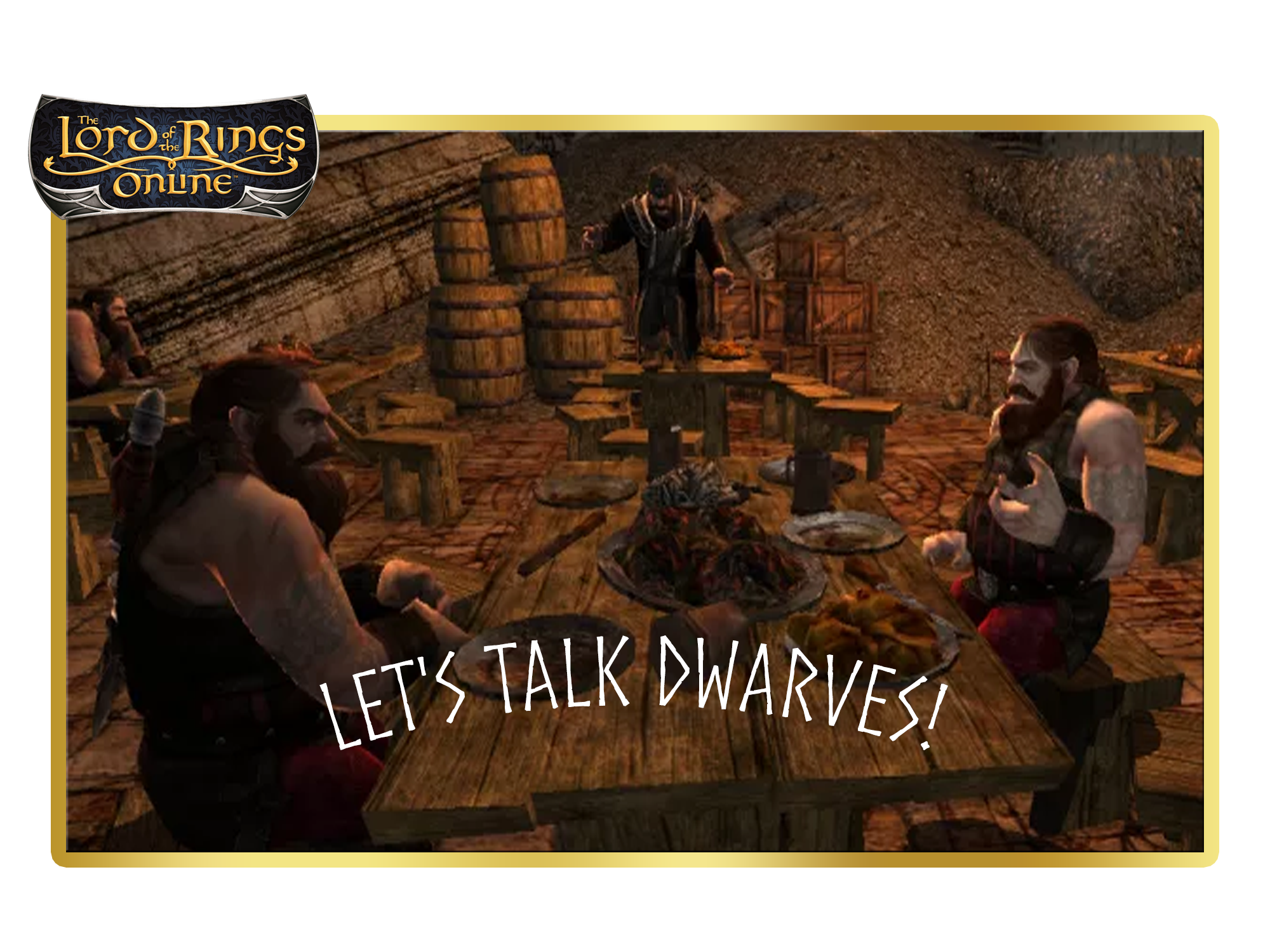
SSG, let’s talk Dwarves!

Last week I had the distinct pleasure to talk with Standing Stone Games’ Jerry Snook (LoTRO Community Manager) and Chris Pierson (LoTRO Lead World Builder) to muse about dwarves in LOTRO (being The Dwarrow Scholar… what else, right?).

After last week’s announcements made at GenCon we had no choice but to pin a date and talk dwarves. So, let’s just dive into a deliciously frothy interview full of Stout-Axes, LOTRO-lore, dwarf ladies, steeds, housing… sadly no ale though… so you better bring one (or two) along, while listening to this one.letstalkdwarves

Note: some background noises have already been filtered out, but some minor ones will still be present, apologies for that. 

Audio (recorded August 7th)


Full Transcript below…

Continue reading

Posted in LoTRO | Leave a comment

Honouring those that fell

As a few of you may know, when I’m not working on the dwarvish dictionary, replying to some of your wonderful Tumblr questions, or posting other material available through www.dwarrowscholar.com, I greatly enjoy roaming LOTRO, Middle Earth as created by Standing Stone Games.

So, naturally, when I heard an Erebor region was to be added in the next update (Update 22: “Legacy of the Necromancer”), I could hardly wait. In fact, it turned out I could not wait at all, as I ended up heading to the test server, known as Bullroarer.

Erebor in Lord of the Rings Online

To say I’m of a fan of this game is a slight understatement really. Not only has it been a staple for me these past years (apart from the much-needed family outings and sampling my whisky collection, likely my go to “unwinder”), but it has even given inspiration to quite a few of the words you’ll find in the Neo-Khuzdul dictionary.

Great and pleasant was my surprise when, roaming the lush fields at the foot of Erebor, I stumbled upon a grand memorial for Thorin and his nephews Fili and Kili (in addition to the statue of Dáin Ironfoot in Dale). Well, to be clear, the surprise wasn’t the memorial, but the fact that the plaques on the memorial seemed to make use of the words seen in the Dwarvish Dictionary.

Dáin Ironfoot Statue in LOTRO’s Dale

When I had a closer look, I could clearly identify and read the words written here. Some of these were general Neo-Khuzdul, others specific to the version I had made. At the same time, I noticed a few minor mistakes in the runes used (specific runes and types of runes) and in the words themselves.  So, I sent the good people of Standing Stone Games an email with some suggestions to improve and correct these plaques.

Memorial for Thorin, Fíli and Kíli in LOTRO


I thought nothing more of it after that, to be honest, and went back to my dwarvish business. A few days later though, I got a nice reply in which my suggestions seemed to be greatly appreciated. Before long I was having an enjoyable email exchange on the topic with Chris Pierson, LOTRO’s World Designer & Loremaster.

Long story short, the plaques were updated and in the process of doing so, LOTRO artist Mark Lizotte achieved a new level of Nerd-dom. My congratulations Mark. 🙂

For those interested in what the plaques actually say, here’s a screenshot with translations below.

Dwarvish plaques in LOTRO (click to enlarge)

Now, all we need to do as die-hard dwarf-aficionados is hope for a few more of those dwarf -themed regions in LOTRO in the years to come.

Posted in Language, LoTRO, Writings | Tagged , , | 12 Comments

“TDS Dwarvish” a free new font to make writing in dwarvish runes easier.

Writing in Khuzdul, while not transcribing it in Latin characters but using the proper runes can be a big challenge, especially given the fact that most runic fonts seem to have the character mappings wrong.  Meaning that if you type “a” you do not get the rune that should match with “a”.

The challenges don’t stop there sadly, seeing there are not one but several forms of dwarvish runes.

In addition one rune could be two letters in Latin script, so that if one were to make a font that allows you to type in dwarvish, it would need to make a distinction between a rune that combines two latin characters and a rune that is only one latin character (for instance, “sh”, “s”, and “h” are three different runes).

So, with all of the above in mind, I set to work on a new font and created one myself, so that you (and others like you with the same need) can write Dwarvish with greater ease.  

Note: To use this font with Android or iOS on your phone or tablet you may need third party software that will allow the usage of non-standard fonts (there are several available that will allow that, some good ones for only a few dollars). To be clear, I am currently NOT developing an app for Android or iOS, as such this font was made with Windows and MacOS in mind.

Firstly, this font is for Angerthas Moria (though an Angerthas Erebor version is planned to be created in future).

Seeing that all forms of (neo-)Khuzdul runic script do not have capital letters these were used for specific runic characters.

Active Capital letters:  

  • A, E, I, O and U are used to write the long Dwarvish vowels, being: “â”, “ê”, “î”, “ô” and “û”.
  • G, K, S and T are used to write the Dwarvish “gh”, “kh”, “sh” and “th”.
  • N is used to write the Dwarvish geminated n, being “nn”.
  • D and J are used to write the Dwarvish “nd” and “nj”  (Note: for “nj” also “ñ” or “Ñ” can be used)
  • C and P are in fact place holders for the Angerthas Erebor character set “ts” and “ps” – in this font they are written out in their Angerthas Moria counterparts.

meaning that the phrase “Baruk Khazâd.” should be typed as:

To end up correctly as…


Non-Active Capital letters:

  • The following capital letters are NOT used in this font. Hence, when you would type: B, F, H, L, M, Q, R, V, W, X, Y or Z (in capitals) you will not get a rune but the Latin character (and the font should revert to a Latin character font).

Active lower letters:

  • a, e, i, o and u are used for the shortened vowel only (for long vowels use the Capital version).
  • p, v and x are also active, though not part of the (neo-)Khuzdul own alphabet they may be used for words derived from other languages or non-native names and represent “p”, “v” and “ks” respectively in this script.

Non-Active lower letters:

  • q is the only lower letter character that is NOT active in this font. Hence, when you type “q” you will not get a rune but the Latin character (and the font should revert to a Latin character font).
  •  Digits:  0 to 9 have been included (clearly marking them with a dot below the rune to indicate they are indeed numbers and not letters).
  • Reading signs:  The vast majority of reading signs have been activated (ampersand, apostrophe, question mark, exclamation mark, left and right parenthesis, etc…. Most of these runes are inventions, yet some (like ampersand, space and period) are original runes.
  • $, € and £ symbols are used to indicate copper, silver and gold coins respectively. Here new runes were invented.
  • à, ò and ù are all characters (both in lower and Capital versions) that can be used to write the open-mid back unrounded vowel or caret – More information on the caret here
  • è (both in lower and Capital version) can be used to write the mid central vowel sound or schwa. Note: the schwa is usually omitted in writing – more information on this here.

Further notes on writing runes:

  • Don’t forget that (neo-)Khuzdul does not have capital letters, in fact the usage of capitals in this font has a different purpose (see above).
  • In order to write a proper line one must ensure you START each line with a period (.) This will give you the characteristic look familiar for dwarvish runes. You end each line with the reading sign required (period, question mark, exclamation mark, etc…)

Where to Download / Compatibility / How to Install:

  • You can download the font freely from the www.dwarrowscholar.com libary, HERE
  • The font is a “TrueType” font file, so any computer system that can read this type should be compatible.
  • This font was made with FontStruct and is packaged in .zip files together with a license document and a ‘read me’ document. The font file needs to be extracted from this .zip file so you can install it. You will find some excellent general information on installing fonts here – just note that all users, including users of OSX, will download their fonts in .zip format. Once installed you should find it listed among your fonts (restart may be required).

Ever at your service,

The Dwarrow Scholar

Posted in Language, Writings | Tagged , , | 1 Comment

Fancy LotRO RP in Neo-Khuzdul? Now you can!

Update: The plugin-in should actually work on a Mac.

Hail!

Remember I spoke about a tool for LotRO Dwarf RPers, allowing them to speak Dwarvish with the click of a button (or two)…. well, without further ado, I present to you:

The Neo-Khuzdul Tool LotRO plugin

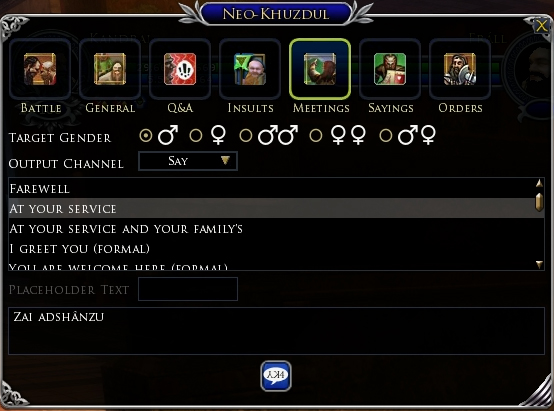
The Neo-Khuzdul Tool plugin is an vital tool for LotRO Dwarf RP-ers that wish to immerse themselves in the language of dwarves (without the need to plough through dictionaries or grammar documents).

Neo-Khuzdul Tool Plugin

Background

The Neo-Khuzdul Tool plugin was long a wish of mine, ever since I first started giving Neo-Khuzdul lessons in Lotro. As I felt there had to be an easier way for dwarf RPers to speak the language of their kind.

Back in February this year I got in touch with Simbo, the hobbit who created the fantastic Poetical tool I frequently used for my dwarf RP. I pitched this idea to him about a plugin for dwarf RPers, that would assist the RPer in speaking Neo-Khuzdul. To my astonishment he jumped on board and before I knew a first version was ready to be tested.

Without the hard work of Simbo, there simply would not be such a plugin… and it would likely still have been an unfulfilled wish of mine. So there you go, proof again that Dwarves need Hobbits when it matters!

A tremendous thank you to Simbo from myself and (I’m sure) the Dwarf RP-community of Lotro.

About the translations.

The latest updated material and dictionaries have been used to form the content of this tool.

Khuzdul is the language of the Dwarves in J.R.R. Tolkien’s legendarium set in Middle-earth. For this Neo-khuzdul Tool plugin both the original Tolkien material, David Salo’s Neo-Khuzdul and Khuzdul used in Turbine’s LoTRO have been used. This is my personal interpretation of Tolkien’s dwarven language, I do not claim this content to be canon.   This document is an interpretation of Tolkien’s work and any Khuzdul related material, all rights are reserved for their proper owners. Any reference to The Lord of the Rings Online or any other brand name is not meant to claim ownership of material.

In most cases I have opted for informal language, though in many translations found in this tool you will find both formal and informal versions.

How to install?

Drop the “Simbo” folder in your Lord of the Rings Online “plugins” folder. In case you already have a plugin by Simbo (which you really should have to be honest), you’ll have to drop the contents of it into the already existing Simbo folder.

How to use?

Simbo has really done his best to make the tool as user friendly as possible and I think he has done a brilliant job at that.

When you get started there are a few things to keep in mind.

  • Always think WHO you are speaking to, and ensure you select the proper “target audience” In English the pronoun “you” can be used for males, females, individuals or groups, not so in Khuzdul, where you have several forms. Hence it is important you always select the proper target audience in the tool before you press the “speak” button, otherwise your given translation may be incorrect.
  • Some lines mention (m) or (f), this indicates the line is speaking about a male or female (or intended for a male or female)
  • Some lines contain a field “___” to enter a name, feel free to type what you wish to say in the designated box.
  • Ensure you have the right channel selected “say, kinship, fellowship or raid”.

This tool is meant for mature RPers that have an affinity with lore, as such please take into account that Khuzdul was spoken among Dwarves ONLY (with the exception of place names and battle cries). It goes without saying that this is not to be used for spamming your fellow RPers.

Future?

Let’s see how this works out for everyone first…

Though I can already tell you that the Neo-Khuzdul Tool might in the months to come get an Elvish sister (oooh, exciting stuff but -hush- don’t tell anyone yet!)

Also, some of the saying might not be very clear at first glance, hence in a future version of the plugin you will be getting a little “extra information” box (that you’ll be able to show or hide) with some extra need-to-know info about these lines.

The files

UPDATE: Version 1.3 (3/3/2016)

Download UPDATED LotRO Plugin HERE

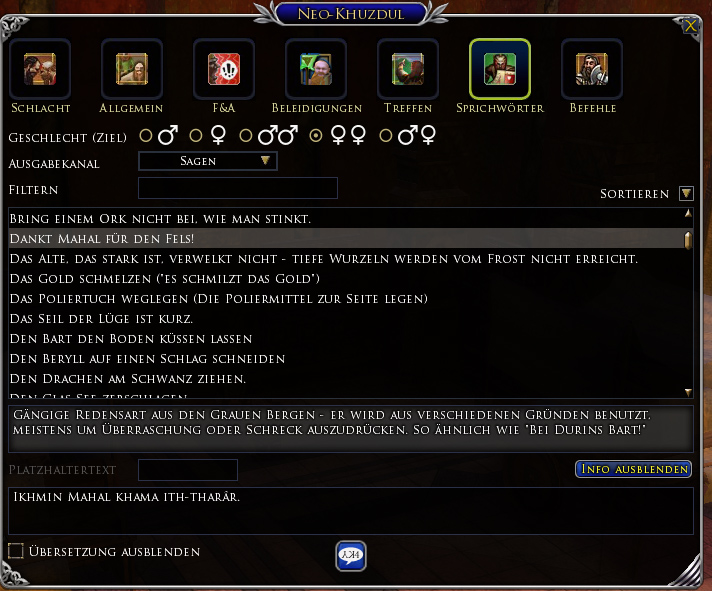
  • Adds German Translation (Translations by Grunior)
  • Adds “sort” button, to alphabetically sort all phrases in a section.
  • Adds “hide translation” button
  • Plugin will now remember it’s last position (open/closed)
  • Additional translations added.

NKpluginGerman

IMPORTANT NOTE: It is recommended to remove the previous plugin version before updating to this version.

A tremendous thank you again to Grunior for his enormous efforts in translating the existing plugin phrases to German and for spending much of his time on testing the new update.


UPDATE: Version 1.2 (17/09/2015)

  • Adds “filter” search box (As requested by many users. We hope this will benefit the user when looking for lines in categories with lots of phrases in it. Merely type in the box and only phrases containing the filter text will be listed)
  • Fixed issue with “hide” and “toggle”
  • Added French and German commands for “/say”, “/f” and “/k” (note: translation are still in English, not in French or German, this however allows usage on French or German clients)*
  • “Show Info” button has been moved below the phrases, this to ensure there would be no confusion with the new “filter” search box.
  • Translations added and placed in more accurate groups.


UPDATE: Version 1.1

  • Adds “extra information” button
  • Translations added and placed in more accurate groups.

Short video of the updated plugin:

Disclaimers

Some things to note:

  • The plugin has not been tested with the German and French client of LotRO. At present it is only available in English, yet other versions can be made (those interested in translating the English text to German or French, don’t hesitate to let us know).
  • The plugin-in should actually work on a Mac.
  • The plugin has however only been tested in Windows 7 and 8. If you run into problems with other operating systems, please let us know.

Let us know what you think!

How does the tool work for you? Does it work in your RP sessions? Are there bugs, are there suggestions for improvements? Please let us know! Just add your reply to this post and we’ll be sure to follow it up.

Posted in Language, LoTRO | 12 Comments

Updates to come

As some of you may have noticed, David Salo (the linguist responsible for the Neo-Khuzdul in the Hobbit movies) has recently released (and continues to do so) much of his notes related to these films on his wonderful site midgardsmal.

Though the vast majority of these notes is in line with the structures and patterns used in the version of Neo-Khuzdul I have worked on, I believe some adaptations need to be made.

Hence, I wanted to let you all know that in the weeks to come, an updated version of the dictionaries and support documents will be released (update is already in full swing).

Seeing that I wish to focus my available time on this in the weeks to come some translations requests have been put on hold. I do hope all will appreciate that requests and questions will be answered at the earliest convenience once the updated material has been released.

At the same time an excel tool will be made available (frequently requested) that should facilitate the searching of words in the dictionaries.

And lastly, a very talented hobbit friend of mine is currently developing a LUA plugin for LoTRO, aimed at dwarf-RPers, that will enable these players to speak Neo-Khuzdul in game, with just a few clicks of their mouse button. We are in the testing phase now and are updating and adding the various translations.

More news on this to follow.

Posted in Language, LoTRO | 6 Comments

Spreading the News among the Dwarrow…

Hello friends,

After months of preparation and work, I’m very pleased to announce the Dwarven community of LoTRO now has his own newspaper: “The Tablets of Khazadgund”.

Tablets of Khazadgund
The Tablets of Khazadgund will provide you with dwarven related news, trade info, notices, tasty recipes, fabulous art, entombment info and an events calendar. Everything you would expect from a dwarf newspaper basically.

You will find a direct a link to The Tablets of Khazadgund HERE

A tremendous thank you to our writers: Hilfar, Augir, Fryjpora and Midarin!
And a super thank you to our hobbit friend Speckles Tookburrow for creating this website for our community.

Are you a dwarf RPer or dwarven storywriter on LoTRO and you wish to join us as writer, or have some good ideas for articles or new pieces all are welcomed to send them to kstrongbeard[at]aol.com

Posted in LoTRO | Tagged , , , , , , , , | 1 Comment

Translations, Tattoos and Prayers

Hello my friends,

It has been quite some time since the last post here. Though it must be said the reason for that is nothing but good news (in my view). As I have been spending this time mainly on Neo-Khuzdul, both new documentation, video lessons, as well as some applications. So you can expect quite a bit of new info heading your way in the weeks and months to come.

This morning in fact I published the second installment of the Neo-Khuzdul video lessons, which you can watch HERE

I wanted to use this post also as an opportunity to talk about translation requests. Every now and then, either on this very blog or via email I get translation requests.  I have always said that my goal concerning this blog is to ensure people get all the information they could ever need concerning J.R.R. Tolkien’s dwarves, whether concerns their culture, language or history, so obviously my mailbox is always open for such requests.

At times though I do get requests from (mainly) writers of fan-fiction to translate words or sentences into Neo-Khuzdul.  I’m always grateful to get these and happy to work on the translation if time permits. Some of those requests are brilliant phrases that would be a great addition for the document on sayings, or words that previously  I had not added to the dictionaries.   At other times people ask me to translate poems or longer pieces of literature. I remember I once got a request to translate “The Hobbit” into Neo-Khuzdul. Though perhaps one day (when I’m retired) I might find the time, spirit and energy to start on such a massive job, at present that time isn’t here yet. So do take that into account when sending translation requests.   Any reasonable request will of course be translated, as always free of any charge, just send them to kstrongbeard[at]aol.com where, with a bit of patience, you’ll get your request translated.

When it comes to translations for tattoos (and I do get a few of those), I do want to stress that you must always take into account of course that Neo-Khuzdul, is not original Tolkien Khuzdul. It obviously uses all that Tolkien published on the language, yet much of it are inventions of myself based on my understanding of Tolkien’s work and Semitic Languages.

It’s important that all understand that before they would have anything inked permanently on their skin that they might regret later. In addition, I generally do not respond to request on tattoos on this blog, as I think the matter is a private one, hence anyone that has such requests should think of sending these to the email address listed above.

In closing, I wanted to share with you all a heartrending request I got recently from a reader in Brazil.  This reader had told me that his brother was in hospital going through a terrible ordeal. And as his brother and him were such great fans of Dwarves and Neo-Khuzdul in particular he had kindly asked me to translate “The Lord’s Prayer” into Neo-Khuzdul, so he could pray for his brother’s speedy recovery in very personal way.   I obviously could not refuse such a touching request and send him the text below, along with the best wishes of myself and my family.


Uzbadul Agrâf (The Lord’s Prayer)
‘Adadmâ ni khulthu, (Our Father in heaven,)
mailgin akhrâmzu. (hallowed be your name.)
Zibdînzu nekha, (Your kingdom come,)
amnâdzu muhula, (your will be done,)
ai-kâmin, azafr ni khulthu, (on earth, as it is in heaven.)
Ikhjim mâ ‘ala nurt hamdmâ nurtul (Give us this day our daily bread,)
ra latunsu mâ shakâdmâ, (and forgive us our debts,)
azafr ya lutunmâ ushkâdmâ. (as we also have forgiven our debtors.)
Ra ma sazbadi mâ ni ansâkh, (And lead us not into temptation,)
ini mahsansisi mâ udu ‘azn. (but deliver us from evil.)


Posted in General Updates, Language | Tagged , , | 9 Comments

TBOTFA SPOILER – Love is all you need

Updated 30/12/2014

SPOILER ALERT

Before you read on, if you haven’t seen The Hobbit: The Battle of The Five Armies and don’t want to spoil it for yourself, come back when you’ve seen it.

If you have seen the film, or feel confident you can handle a bit of a spoiler, read on.

Literally the day after I saw the film I got this question via email from Emily: Early in the movie we see our favorite hottie dwarf Kili say something in Khuzdul (or is it Elvish?) to Tauriel.  I think I’ve got a good idea what he is saying to her, but want to be sure. Can you tell me what he says to her?

Images from The Hobbit: The Battle of the Five Armies main trailer -  all rights reserved

Images from The Hobbit: The Battle of the Five Armies main trailer – all rights reserved

Emily wasn’t the only one sending me this question, as I got many similar ones in the hours that followed.

So, without further ado, this is my view on that line.

Kíli says to Tauriel “amrâlimê”, which I’m pretty sure is David Salo’s Neo-Khuzdul. Tauriel says she doesn’t understand it, so it’s very clear it isn’t Sindarin.

I believe the word consists of three parts “amrâl”, “im” and “ê”

amrâlimê

“amrâl”  – means “love”. It used the abstract construction aCCâC as seen in the Tolkien original khuzdul words such as “aglâb”.  The radicals in amrâl, MRL are faintly reminiscent of the Quenya “melmë” (love) and “mírima” (very lovely), and of the Sindarin “meleth” (love), while also hinting at the latin “amorem” (love).

“im” – Updated:  based on a screenshot from the video Appendices for DoS, provided by one of the readers of this blog (thank you Maite), it seems clear this is a genitive marker, indicating “of”. So, likely not a female indicator as previously assumed.

“ê” – is the first person possessive pronoun “my”, also use for “me”.

Putting all of this together we get “love-of-me”

Images from The Hobbit: The Battle of the Five Armies main trailer -  all rights reserved

Images from The Hobbit: The Battle of the Five Armies main trailer – all rights reserved

So, as a result we get: “My Love”

Again, this is my assumption based on Salo’s earlier writings, provided screenshots from the video Appendices for DoS (with thanks to Maite) and my study of neo-khuzdul.

I hope we’ll get it confirmed in the days and weeks to come.

I hope that answers your question Emily.

Posted in Language | Tagged , , , , , , , , , , | 51 Comments