With Durin’s day recently, I had the idea to make an article on astronomy from a dwarven viewpoint, hence this post… .
It turned out to take quite a bit longer to research that I had though initially, which is always good news I find as it proves some or most of my ideas on the matter were in need of some finetuning.
Firstly, what did I set out to do ? To gather all mentions of constellations, stars, planets related to the dwarves and provide a happy-meal-sized post for all to (hopefully) easily digest.
So, what do we know about dwarven astronomy ?
We know that Durin’s Day, like the rest of the dwarven calendar was based on the moon cycle. More can be found on that in previous articles on the matter on this blog.
Now, as for stars, there is “Durin’s Crown” , the constellation Durin saw when he was first at Kheled-zâram (Mirrormere). As written in “Song of Durin”: “He stooped and looked in Mirrormere, and saw a crown of stars appear”. It also formed the symbol of Durin, as seen on the doors of Khazad-dûm. Many believe that the seven stars that make up the Big Dipper (Sickle of the Valar) are those stars.
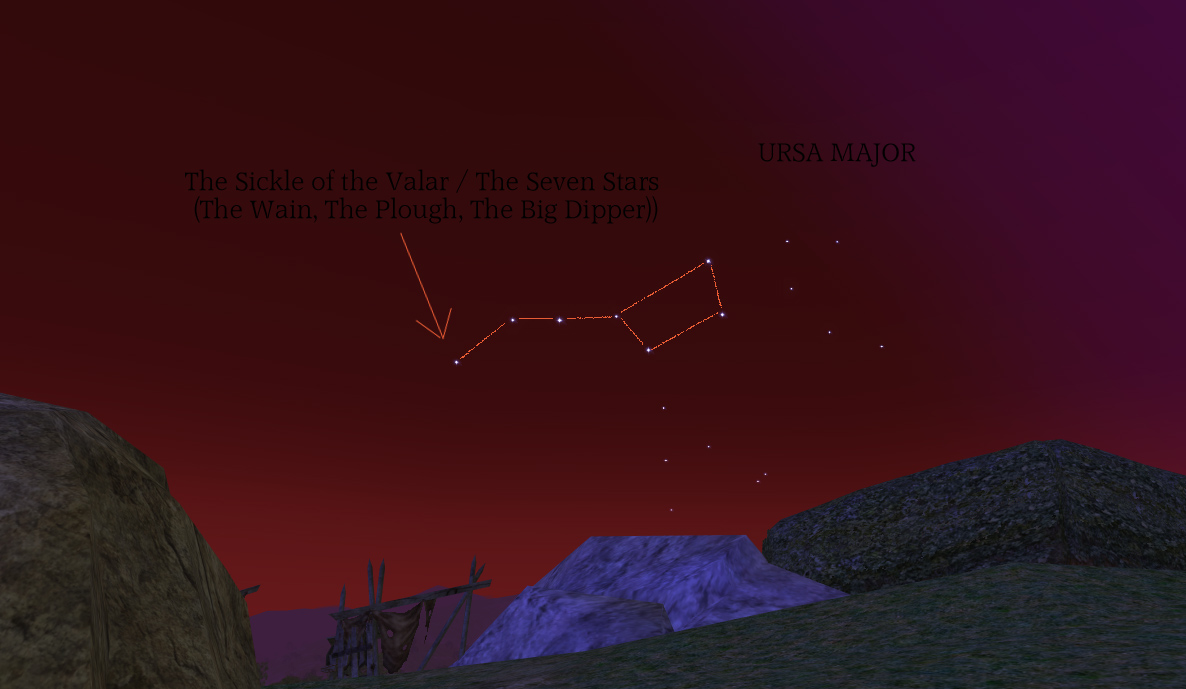
The Sickle of the Valar in LotRO
So did I at first… but I believe I’ll have to disagree on that now. First reason for that is that if we look at the 7 stars on the symbol of Durin’s crown, they are arragened in a specific order, 1 high in the middle, 3 on each side slightly lower.
Some believe “Durin’s Crown” is what is known as “The Netted Stars” in middle earth. A tiny group of seven stars, that in our modern age are known as Pleiades, which in fact is a part of Taurus.

I can’t agree with that myself, merely because these would have been too tiny to make up any crown, in addition to the fact that they do no look like a crown.
After looking at all the constellations and star groupings I could only find one constellation that comes close to a crown… which is the Northern Crown.
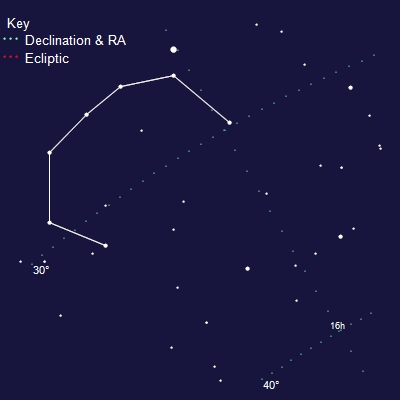
Northern Crown (Corona Borealis)
Not only does it look like a crown, the name itself says it, which Tolkien would have known without a doubt. If you look at the symbol on the doors of Moria, you can see a closer resemblance than the Big Dipper, which in my view is no crown at all.
In the Northern hemisphere, the Northern Crown can only be seen in summer time, which makes sense if you listen the “Song of Durin” where it says: “he drank from yet untasted wells”, which perhaps might prove difficult in winter time when wells can freeze over.
This is also the reason that we won’t find the Northern Crown in LotRO, as the stars in LotRO resemble those of the fall/winter skies, when Sam and Frodo departed on their quest.
Normally, the Northern Crown would appear upside down in the summer sky, however as a reflection in the water, it would “fit like a crown”. Hence my vote goes to the Northern Crown.
Apart from Durin’s Crown and the Moon phases (calendar) no other stars or bodies are mentioned in direct relation to the dwarves. Likely related to the fact that few of them saw many stars in the mines of the deep. Though obviously dwarven scholars must have used lunar tablets to calculate the passing of the months and years. Unlike with the elves or men it is likely that few other stars were of great importance to the dwarves however. The morning and evening star (Venus- Star of Eärendil) for instance, important to many middle earth cultures, has little meaning to the Dwarves.

 The Dwarrow Scholar
Nice post!
LikeLike
Fascinating bit of Dwarrow Astro-archaeology! I’ll be keeping my eyes turned upward!
LikeLike
What of Cassiopeia? It has always struck me as crownish. Of course, it doesn’t fit the group of stars described either…
LikeLike
Cheers 🙂 Aye, I thought of Cassiopeia as well, though it only has 5 main stars, which is a problem when comparing it too the 7 stars of Durin’s crown. The form of Cassiopeia is more of a “W” shape, so I guess it could pass as a crown, though the crown of stars in the Durin’s Crown symbol shows one in the middle and 3 on either side, hence my thought of the Northern Crown.
LikeLike
Nice article. My first thought was Cassiopeia as well but like theviking said, it doesn’t fit the description of the star group. I agree with you about the Northern Crown, not that I know all that much about astronomy.
LikeLike
Awesome post! Very interesting. Thanks!
LikeLike
Pingback: Dwarven Do’s and Don’t’s: Guide to Astronomy